Recognize unresolved opening conditions that exceed an apprentice's assigned scope and prepare a useful request for review. Learn to distinguish product advice, design decisions and authority approval.
An opening is an assembly with several jobs. It may control entry, permit exit, resist fire or smoke, and provide an accessible route. Making a reader work addresses only one part of that assembly. Before changing hardware or programming a new operating sequence, compare the actual opening with the approved documents and your assigned work.
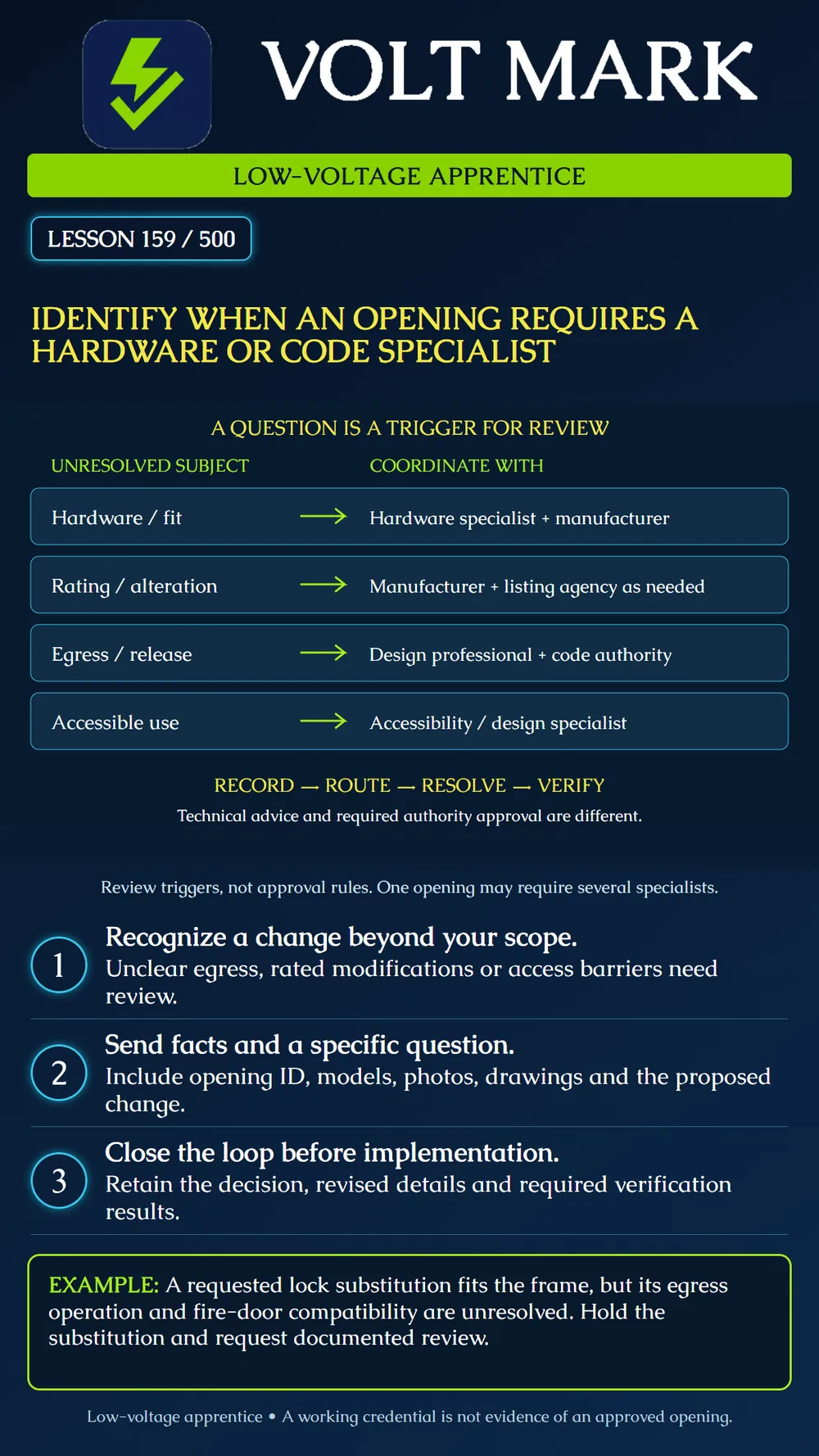
Ask for a hardware specialist when the proposed product's fit, handing, latch engagement, power transfer or compatibility is uncertain. Record the exact models and document revisions. "It fits the hole" does not establish that its function, certification or intended application matches the design. Obtain the relevant manufacturer's instructions rather than extrapolating from another door.
A rated opening adds questions about the door, frame and compatible hardware. An undocumented preparation or changed component can require manufacturer and listing-agency involvement. UL describes field evaluation as a way to examine particular modified or unlabeled assemblies against certification requirements. That is different from a routine inspection. Do not assume every minor change requires a field evaluation, or that a local technician can authorize any change. Route the actual proposal to determine the required process. [1]
Egress questions need the appropriate design and code review. Examples include an exit delay, a change to release behavior, stair reentry, or a proposed electromagnetic lock. Allegion's manufacturer guidance distinguishes ordinary access control with independent mechanical egress from arrangements that affect egress. Applicable model-code provisions and adopted amendments differ. An apprentice should describe how the opening is intended to work, not select a code pathway based solely on the presence of a reader. [2]
Accessibility review can be needed when a new pedestal affects the approach, a control cannot be reached, hardware is difficult to operate, or an automatic operator changes the opening arrangement. The Access Board's guidance treats maneuvering space, controls, clear opening and door operation as related requirements. A correct mounting height alone does not settle all of them. Ask the responsible accessibility or design specialist to evaluate the full route and opening. [3]
The diagram lists coordination roles, not a universal chain of legal authority. A product representative can explain a listed application but cannot replace the code authority's required decision. A code official's acceptance does not replace missing manufacturer installation details. The responsible designer coordinates the design, while contractors execute their authorized scope. Confirm who is assigned each role for the actual project.
Opening D159 serves a campus corridor. The crew receives an email requesting a different electrified lock. The replacement appears to fit, but the schedule does not identify it. No one has documented its effect on exit operation or its suitability for the marked door assembly. Record the existing opening ID, schedule revision, existing and proposed model numbers, photographs of relevant markings, and a plain-language description of the requested change. Ask: "Is this substitution compatible with this assembly and the required egress function? Please provide the approved revised hardware and operation details." Hold that proposed substitution while the question is resolved. Do not perform an improvised modification or leave the opening in an unsafe condition. If an immediate hazard is present, notify the supervisor and follow the site's protective procedure.
Use a fictional drawing package and four change requests: an undocumented frame preparation, a reader relocation into an approach area, an exit delay, and a product substitution with a different handing option. For each request, name the unresolved fact, list the supporting information and identify the first project contact. Multiple reviewers may be needed. Draft one short request that contains a single clear decision question. Compare it with a vague message such as "Please approve the door." Explain why the specific request is easier to resolve and less likely to conceal missing information.
Keep the opening identifier; document revision; observed condition; requested change; relevant product data; person responsible for resolving it; dated response; required revised drawings; and acceptance or test evidence. If a response is conditional, retain the conditions. A phone conversation without a traceable decision should not silently become an approved design revision. Record any continued uncertainty rather than marking the issue complete.
Answer: No; entry authorization does not establish the other opening functions.
Answer: No; hardware, certification, accessibility and code issues can overlap.
Answer: Advice explains a technical matter; required approval belongs to the responsible authority or assigned approval role.
Answer: The opening ID, actual condition, relevant documents, proposed change and a specific unresolved question.
Answer: When required decisions are documented, conditions are incorporated, and required verification is complete.
[1] UL Solutions, UL Fire Door Inspection and Field Evaluation Programs: What Are the Differences? https://www.ul.com/resources/ul-fire-door-inspection-and-field-evaluation-programs-what-are-differences [2] Allegion / iDigHardware, Electrified Hardware and Special Locking Arrangements. https://idighardware.com/sla/ [3] U.S. Access Board, Chapter 4: Entrances, Doors, and Gates. https://www.access-board.gov/ada/guides/chapter-4-entrances-doors-and-gates/
Free study material for low-voltage apprentices. This is a national foundation course: requirements differ by state and by local jurisdiction, and a practice that is common in one place is not a rule everywhere. Nothing here is a licence, a certification, or authority to work unsupervised, and completing it does not count as apprenticeship hours or continuing-education credit. Check the codes adopted where you are working, the licensing authority for that work, and your employer's safety programme. VoltMark is not affiliated with, endorsed by, or sponsored by NFPA, OSHA, NICET, BICSI, FOA, or any state or local licensing authority.

Electrician licensing exam prep: practice questions, timed exam simulations, and step-by-step help finding every answer in the NEC.