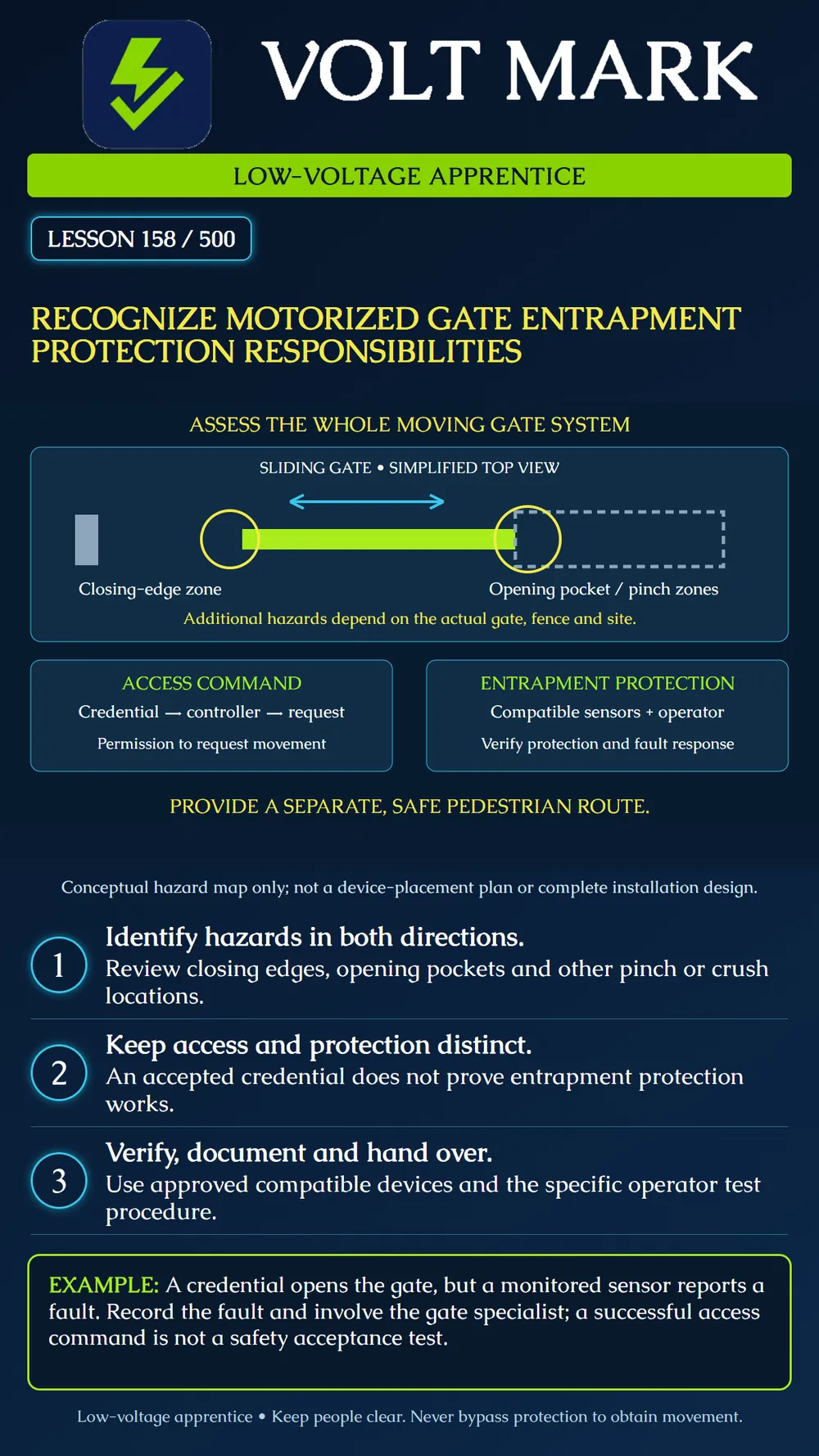
Recognize the difference between an access command and entrapment protection, identify matters requiring a gate specialist, and assemble an honest commissioning record. This awareness lesson does not qualify an apprentice to design, modify or certify a motorized gate.
A credential can be valid while a gate system has an unresolved safety problem. When an access controller sends an opening request, it has made an authorization decision. That event alone says nothing about the completeness of the gate's protective equipment or its response to a fault.
Look at the complete moving system, not just the reader pedestal. A sliding gate can create a closing-edge hazard and hazards where the moving panel travels beside fencing or into its opening pocket. A swing gate creates different geometry. Survey both directions with the responsible specialist. The diagram is a simplified hazard-identification example, not a complete hazard inventory or a sensor location drawing. Its circles do not define a prescribed protection distance.
UL 325 addresses operators and associated safety systems. ASTM F2200 addresses automated vehicular gate construction. Identify the applicable editions, product instructions and requirements for the project instead of assuming a national training poster establishes a locally approved design. Arrange a separate pedestrian route clear of the vehicular gate's operating area. These subjects require coordinated site review, not simply adding a reader to an existing gate. [1,2]
External entrapment protection can include monitored photoelectric sensors and sensing edges. Selection, compatibility, coverage and fault behavior must be established for the specific operator and installation. Do not substitute an ordinary access input, a vehicle-presence detector or an unrelated sensor merely because it produces a contact closure. Follow the manufacturer's documented system requirements. The lesson intentionally gives no universal sensor count, placement dimension or wiring arrangement. [3]
Responsibility is shared but must not be vague. The project designer and responsible gate specialist resolve the gate arrangement and protection plan. The access installer documents the interface and avoids changes that defeat the operator's protective functions. The commissioning team records the required checks and unresolved conditions. The owner receives operating, maintenance and service information. Contract assignments and licensing obligations still need project-specific confirmation; this paragraph is a coordination model, not a legal allocation of liability.
A campus vehicle gate opens when a staff credential is presented. The access log records a grant. A separate operator diagnostic reports a monitored sensor fault. A coworker says the gate works because it opened yesterday. The correct record separates those facts: access grant observed; protection fault present; safety acceptance unresolved. Keep people away from the moving area and notify the responsible supervisor and gate specialist. Apply the site's procedure for taking unsafe equipment out of service. Do not bridge, disable or reposition protective equipment to obtain an apparently successful demonstration.
Use drawings and photographs of a safely secured training installation; do not stand in a moving gate's path. Mark the moving panel, fixed objects, opening direction, closing direction and pedestrian route. Use a question mark wherever the drawing does not establish a clearance or protection measure. Have the supervisor compare your annotations with the approved site assessment. Next, use a mock controller record and a mock operator record. Highlight which evidence establishes authorization and which evidence concerns protection. Write an unresolved-item entry rather than guessing what an unobserved test would show. Any physical operational tests require the authorized specialist's procedure, controlled access to the area and manufacturer-specified test methods. Never use a person as an obstruction test object.
Record site and gate ID; operator model and applicable manual revision; protection-device identities; approved interface references; protection plan; test procedure and actual results; fault-response observations; unresolved items and responsible party; and owner instruction and maintenance records. A blank result is not a pass. A repeated access test cannot replace a missing protection test. Maintain the distinction between installer observations and formal acceptance.
Answer: No. Authorization and protection require separate evidence.
Answer: No. They highlight example hazards for discussion.
Answer: No. Escalate and resolve the fault through the responsible specialist and site procedure.
Answer: It provides fundamentals; project-specific documents and applicable requirements still control.
Answer: The responsible gate specialist using manufacturer documentation and required project review.
[1] UL Solutions, Door, Gate and Window Access Systems. https://www.ul.com/services/door-gate-and-window-access-systems [2] AutoGate (gate manufacturer), UL 325 Gate Safety Standards; introductory discussion of complete systems, site hazards, pedestrian separation and ASTM F2200. Historical tables on this page are not used as current universal requirements. https://www.autogate.com/ul-325-f2200-information/ [3] LiftMaster, Protecting People And Property. https://www.liftmaster.com/architect-resource-center/protecting-people-and-property
Free study material for low-voltage apprentices. This is a national foundation course: requirements differ by state and by local jurisdiction, and a practice that is common in one place is not a rule everywhere. Nothing here is a licence, a certification, or authority to work unsupervised, and completing it does not count as apprenticeship hours or continuing-education credit. Check the codes adopted where you are working, the licensing authority for that work, and your employer's safety programme. VoltMark is not affiliated with, endorsed by, or sponsored by NFPA, OSHA, NICET, BICSI, FOA, or any state or local licensing authority.

Electrician licensing exam prep: practice questions, timed exam simulations, and step-by-step help finding every answer in the NEC.