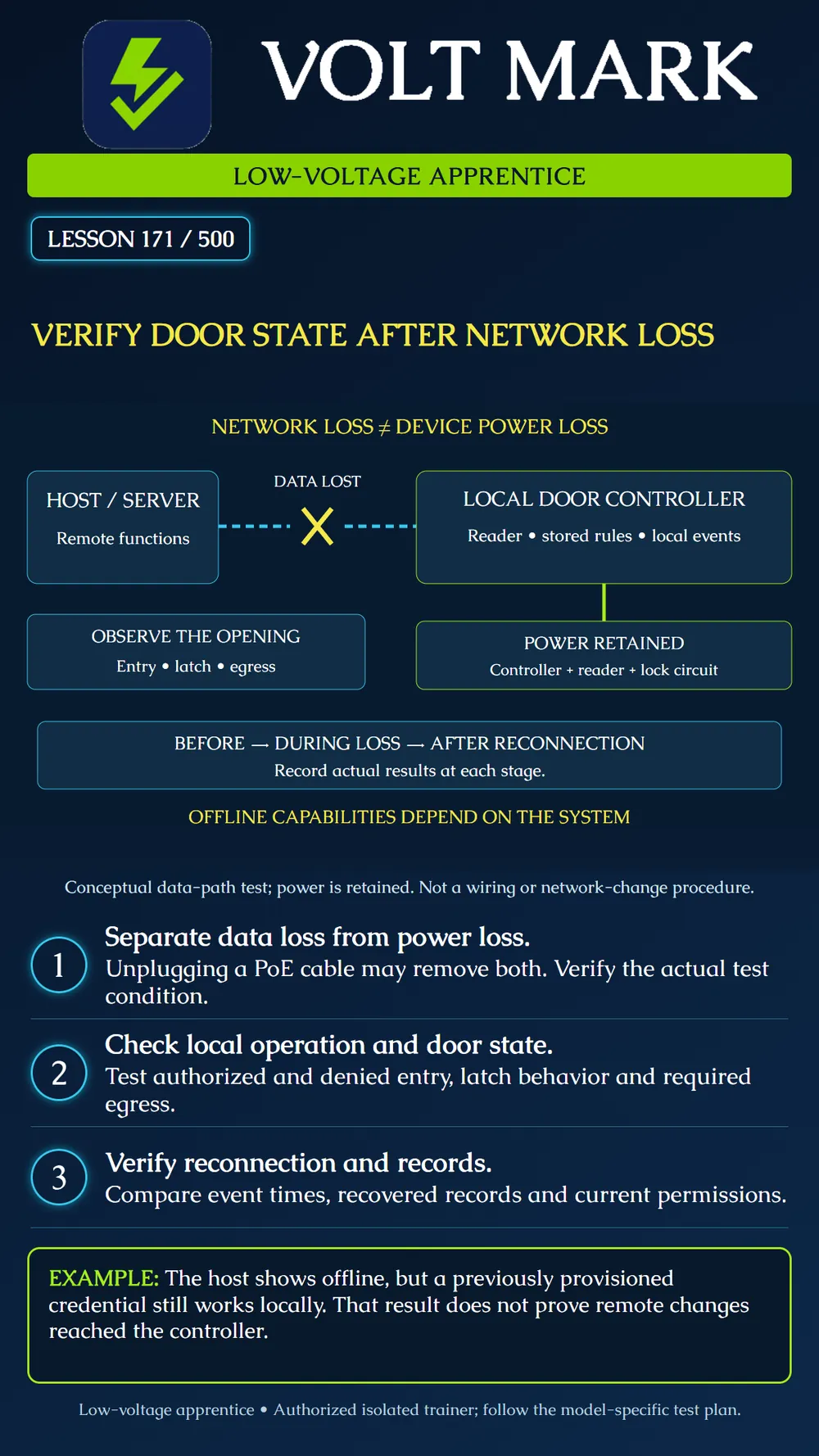
Distinguish an interrupted host connection from loss of device power, compare expected offline behavior with an isolated trainer's actual door functions, and document recovery. This lesson is a learning exercise, not an authorization to interrupt an occupied building's access system.
An offline indication describes a communication condition. It does not, by itself, tell you whether the reader has power, whether a lock is energized, whether a door is latched, or whether required egress operates. Start by naming the path being interrupted: controller-to-host, controller-to-peer, reader-to-controller, or wireless lock-to-hub. These are different tests. This exercise concerns the host data path while local device power remains present.
Axis describes the A12 series as supporting local door-access operation during a network outage and local storage of credentials and event logs. That is a product-family capability, not evidence that every server-dependent feature or every other manufacturer's controller works identically. Consult the actual controller, firmware and software documentation before selecting expected results. Source: https://www.axis.com/products/axis-a12-series
Feature dependencies matter. The AXIS Camera Station Pro Secure Entry manual states that offline anti-passback can continue when the zone's doors belong to the same controller; it describes a limitation when the zone spans different offline controllers. This demonstrates why a successful local credential test does not establish correct operation of a distributed feature. Do not confuse that controller-to-host condition with the separate wireless-lock offline condition described elsewhere in the manual. Source: https://help.axis.com/en-us/axis-camera-station-secure-entry
Use a dedicated, supervised trainer and fictitious credentials. Identify the controller, reader, lock simulator or trainer hardware, firmware, software, relevant configuration revision and expected sequence. Record which functions are local and which require communication. Obtain the instructor's approved method for interrupting only the intended data path while retaining the existing power arrangement.
Do not casually unplug a PoE connection: it may carry the controller's power as well as data. Likewise, disabling a switch port may affect PoE depending on its configuration. Have the instructor establish a suitable isolated test method. This lesson does not instruct you to alter a production firewall, disable shared switches or add an alternate power supply.
Create a baseline with one authorized test credential and one deliberately unentitled test credential. Record the reason for each expected outcome. Keep schedules, time, input conditions and the test opening consistent. Confirm that the instructor can stop and restore the exercise.
Trainer T171 has locally provisioned fictional credential A and an unentitled credential B. Its approved exercise predicts that A can obtain entry and B cannot during a host disconnection. That prediction belongs to this fictional configuration, not every controller.
Before disconnection, observe the entry-side response, opening and closing, latch condition and instructor-approved egress check. Record the corresponding host events. During the controlled interruption, confirm that power remains present, note the host's communication indication and repeat the same test cases. A green reader indication alone is not a complete result: record the access decision and actual lock or simulator response separately.
If an instructor stages a permission change on the isolated host, record it as pending until delivery and enforcement are demonstrated. A successful save in a management application is not proof that an unreachable controller received a revocation. Do not use real credentials or create a security exposure to demonstrate this point.
After communication returns, verify the connection state and repeat the access tests. Compare observations with event records using event occurrence times as well as receipt times where the system exposes them. Verify any expected buffered event transfer; do not assume unlimited storage, guaranteed backfill or a particular duplicate-handling method. Record missing evidence as unresolved. Verify that intended permission changes reached the target and that the trainer returned to its documented normal configuration.
Record the opening/trainer ID; system versions; data path interrupted; power-retention evidence; preloaded configuration reference; interruption and restoration times; each credential's expected and observed outcome; physical entry, latch and egress observations; local and host event references; pending updates; post-reconnection results; anomalies; restoration confirmation; and instructor sign-off. Keep secrets and personal credential identifiers out of teaching examples.
Answer: No. Observe and record the specific device and opening functions.
Answer: It can remove power as well as communication, combining two failure conditions.
Answer: No. Validate the configured functions and their dependencies separately.
Answer: Delivery to the target controller and enforcement after synchronization, according to the actual system.
Answer: No. Verify behavior, records, pending changes and restoration.
Free study material for low-voltage apprentices. This is a national foundation course: requirements differ by state and by local jurisdiction, and a practice that is common in one place is not a rule everywhere. Nothing here is a licence, a certification, or authority to work unsupervised, and completing it does not count as apprenticeship hours or continuing-education credit. Check the codes adopted where you are working, the licensing authority for that work, and your employer's safety programme. VoltMark is not affiliated with, endorsed by, or sponsored by NFPA, OSHA, NICET, BICSI, FOA, or any state or local licensing authority.

Electrician licensing exam prep: practice questions, timed exam simulations, and step-by-step help finding every answer in the NEC.