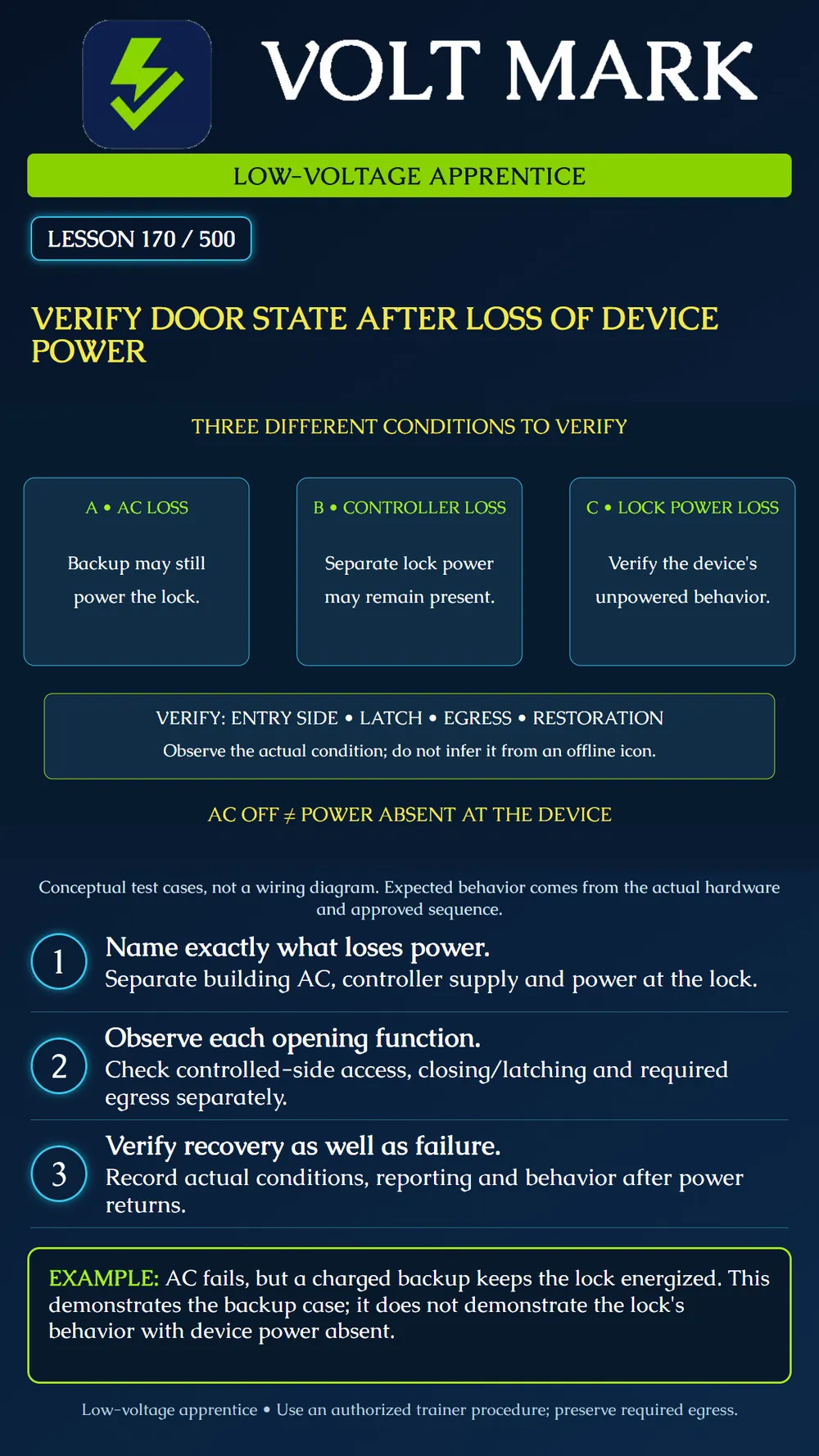
Distinguish separate power-loss conditions and verify the actual opening behavior against its documented requirements. Treat controlled-side access, mechanical latching and egress as separate observations.
Use an instructor-approved access trainer with a safely supported hardware mockup where mechanical observations are required. No occupied building door or production fire-alarm interface is part of this exercise. The instructor establishes the isolation, test controls and permitted measurements. This lesson is not a procedure for opening mains-powered enclosures or disconnecting live battery conductors.
The phrase "power failed" is incomplete. Name the affected source and device. Building AC can fail while a battery-backed supply continues to feed the lock. A controller can lose its own power while a separate lock supply remains energized. The lock can lose power while the controller remains online. Those are different tests with potentially different outcomes.
Altronix's AL400UL3X product information gives a concrete example of an access-control supply that switches to standby battery operation when AC fails. That feature illustrates why loss of AC is not equivalent to absence of DC at a lock. Actual continued operation depends on the installed backup, its condition, load and the complete distribution arrangement. No backup duration is promised by this lesson. [1]
Manufacturer terminology describes fail-safe hardware as unlocking when its electrical power is removed and fail-secure hardware as remaining locked on the controlled side without that power. Identify the exact product and selected function rather than relying on a generic sticker or software name. These terms do not mean that the leaf necessarily swings open, that a latch has retracted, or that every form of exit depends on electricity. [2]
The complete egress arrangement needs its own review. Many controlled-entry openings provide independent mechanical egress; other electrical locking arrangements have specific release requirements. Allegion's guidance distinguishes ordinary access control from arrangements affecting egress. Do not infer that all fail-secure hardware traps occupants, or that all fail-safe installations satisfy every opening requirement. [3]
Record opening/trainer ID, hardware models and selected functions, power sources, backup arrangements, relay configuration and the approved sequence. State the expected behavior for each test condition. Identify which observations can be made on the trainer and which remain outside its capability. If only an indicator lamp represents a lock, it can show an output state but cannot prove physical latch or egress operation.
Case A: the instructor simulates loss of the normal supply input using the trainer's designed test control while its documented backup remains available. Observe whether the intended devices remain powered and whether the corresponding condition is reported. Case B: the instructor simulates loss of controller power with the lock supply arrangement documented. Observe the resulting control output and hardware behavior. A separate supply alone does not guarantee the lock stays energized because relay state and circuit design also matter. Case C: the authorized procedure establishes absence of operating power at the lock itself. Compare the actual controlled-side behavior with the documented hardware function. Do not substitute an offline controller icon for verification at the affected device.
With the safely supported trainer in the specified initial condition, separately record whether controlled-side operation permits entry, whether the leaf closes and latches as designed, and how the egress hardware operates. Use the assigned functional checks; do not force components. Door-position feedback does not itself prove latch engagement. A device-power result is not a full acceptance test of a rated assembly or life-safety interface.
The AC-loss condition is simulated. The lock continues operating because the backup is supplying it. A learner writes "fail-secure power-loss behavior passed." Correct the record: backup-supported operation was observed; the lock's unpowered behavior has not yet been tested. Proceed only with the separately authorized trainer case. Do not defeat the backup on a live opening to turn the first result into the second.
Restore each test condition according to the instructor's procedure before moving to the next case. Check the expected output state, hardware operation, controller reconnection, status restoration and any required acknowledgement. A power LED returning does not prove all functions recovered. Record unexpected movement, persistent faults or an incorrect access state and stop further testing until the responsible instructor resolves it.
Prepare a results sheet with the exact source removed, sources still available, expected behavior, actual electrical evidence, entry-side result, closing/latching result, egress result, reporting and restoration. Use "not tested" where the trainer cannot demonstrate a function. Compare each case with the approved sequence rather than with a blanket rule about what every door should do.
Answer: No; backup may still supply it.
Answer: No.
Answer: No; it describes the relevant locking function without power.
Answer: No.
Answer: The system must return to the intended operating state, not merely show power present.
[1] Altronix, AL400UL3X product specifications. https://www.altronix.com/products/AL400UL3X [2] Allegion Knowledge Center, What is the difference fail safe and fail secure? https://kc.allegion.com/kb/article/what-is-the-difference-fail-safe-and-fail-secure/ [3] Allegion / iDigHardware, Electrified Hardware and Special Locking Arrangements. https://idighardware.com/sla/
Free study material for low-voltage apprentices. This is a national foundation course: requirements differ by state and by local jurisdiction, and a practice that is common in one place is not a rule everywhere. Nothing here is a licence, a certification, or authority to work unsupervised, and completing it does not count as apprenticeship hours or continuing-education credit. Check the codes adopted where you are working, the licensing authority for that work, and your employer's safety programme. VoltMark is not affiliated with, endorsed by, or sponsored by NFPA, OSHA, NICET, BICSI, FOA, or any state or local licensing authority.

Electrician licensing exam prep: practice questions, timed exam simulations, and step-by-step help finding every answer in the NEC.