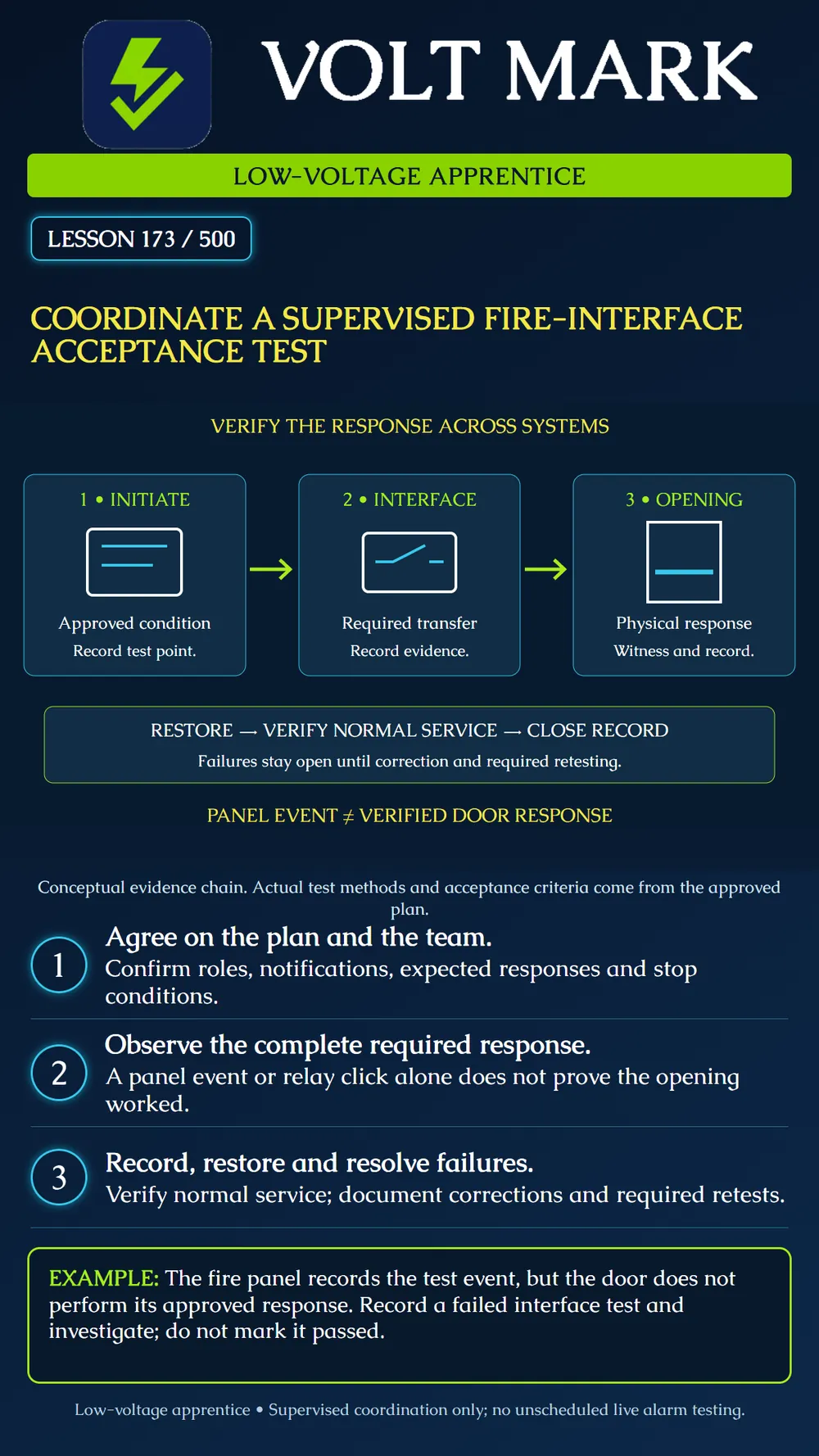
Explain how an apprentice supports a supervised, opening-specific fire-interface test: prepare the evidence, understand assigned responsibilities, observe the intended physical response and record restoration. This lesson does not authorize live alarm activation, impairment, bypassing or changes to an occupied facility.
Lesson 172 established that each opening needs an approved sequence. This lesson asks how a responsible team demonstrates that sequence. A diagram may correctly identify an interface, yet a field connection, configuration or hardware problem can prevent the intended result. Separate a system's own functional test from evidence that connected systems act together.
UCSF's January 2026 fire-prevention bulletin describes integrated testing as verification of systems working together, rather than reliance on separate system tests. Its plan and reporting discussion includes participants, expected input/output relationships, observations, discrepancies and resolutions. It is a UCSF/California implementation example referencing NFPA 4, not a statement that every U.S. access-control project has identical requirements. Determine the project's actual adopted requirements and responsible authority before selecting acceptance scope. Source: https://ehs.ucsf.edu/fire-prevention-design-bulletin-0003-integrated-fire-protection-and-life-safety-system-testing
Honeywell's Fire-Lite AD365A detector instructions illustrate manufacturer expectations for notifying proper authorities before testing and restoring normal operation with notification afterward. Those particular instructions address a Canadian-listed detector and its maintenance testing. They are not a U.S. door-interface acceptance procedure, and their device test methods or disabling instructions must not be transplanted into an integrated test. Use the installed equipment's applicable documentation and approved project plan. Source: https://buildings.honeywell.com/content/dam/hbtbt/en/documents/document-lists/firelie/manuals/I56-9140.pdf
Before the exercise, ask the supervising test leader which approved plan and revision apply, which opening and devices are included, which initiating condition will be used, and what constitutes success. Identify the responsible fire-alarm specialist, access-control technician, hardware representative, owner/facility contact and any required witness or authority. The apprentice does not assume the authority of those roles.
Confirm who handles monitoring-station coordination, building notifications, any authorized impairment arrangements and the response to an actual emergency. Record acknowledgments as the plan requires. Having a system on a monitoring test window does not by itself prove that local outputs are safe to operate or that the intended interface remains active. Conversely, a local panel test mode may not exercise the required output. The responsible specialist must confirm the chosen method covers the intended sequence.
Use the approved plan to define the communication method between observers and the stop instruction. Resolve missing people, unclear criteria or conflicting document revisions before proceeding. Do not improvise by bridging contacts or defeating a release device.
In a fictional training packet, opening D173 has an approved alarm-release response documented in matrix row F-07. The instructor assigns a fire-panel observer, an interface observer and an opening observer. The packet defines the simulated initiating condition and the expected response; this lesson supplies no live alarm activation steps.
Case A: the panel observer sees the expected event, but the opening observer reports that the required release did not occur. Record the input evidence and the failed response together. Do not turn the overall result into a pass because one checkpoint succeeded. The test leader stops dependent testing and assigns investigation.
Case B: a trainer's local release input is exercised directly and the door simulator responds. That may demonstrate a downstream portion of the chain, but it does not establish that the upstream fire-system path works. Describe exactly what was simulated and what was not tested. An approved plan may allow particular simulations; the report must preserve their limits.
Case C: the required response occurs, but a temporary test setting remains active afterward. The observed response can be recorded while restoration remains incomplete. The team must resolve the remaining condition before claiming normal service has been restored.
Compare what happened with the approved response rather than substituting a generic 'unlocked' checkbox. Depending on the opening, observations may concern release, available egress, maintained state, closing/latching and reset behavior. Record any required timing using the plan's acceptance criteria; do not invent a universal number.
After testing, the responsible team follows the approved restoration sequence. Confirm the affected systems and opening are back in their intended normal condition, temporary test arrangements are removed, required monitoring is restored and required parties receive completion information. A normal screen alone cannot account for every physical or configuration change.
Use a separate row for each test: test ID; opening; approved reference/revision; participants; initial state; actual initiating point or simulation boundary; expected response; observed panel/interface/opening results; times if required; pass/fail/unverified status; discrepancy reference; corrective action and retest reference; restoration evidence; and responsible signatures. Do not sign as the accepting authority unless that is genuinely your authorized role. Keep failed attempts with later successful retests.
Free study material for low-voltage apprentices. This is a national foundation course: requirements differ by state and by local jurisdiction, and a practice that is common in one place is not a rule everywhere. Nothing here is a licence, a certification, or authority to work unsupervised, and completing it does not count as apprenticeship hours or continuing-education credit. Check the codes adopted where you are working, the licensing authority for that work, and your employer's safety programme. VoltMark is not affiliated with, endorsed by, or sponsored by NFPA, OSHA, NICET, BICSI, FOA, or any state or local licensing authority.

Electrician licensing exam prep: practice questions, timed exam simulations, and step-by-step help finding every answer in the NEC.