Recognize the different normal-operation concepts behind delayed egress and controlled egress, then identify the documents and qualified reviewers needed to classify a real opening. Do not select, reprogram or approve an egress locking arrangement from this lesson.
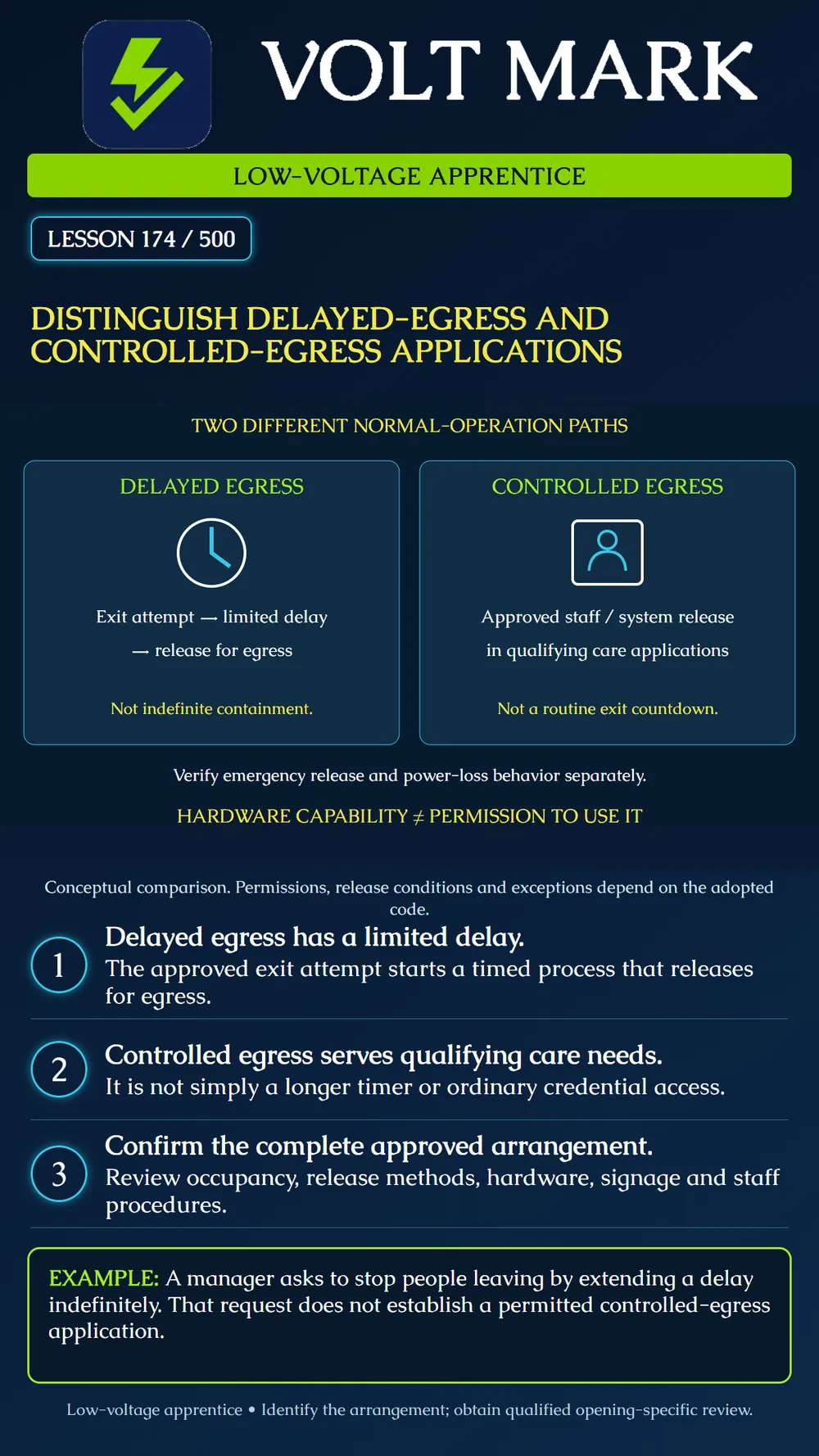
Delayed egress uses a bounded delay following the specified exit attempt before allowing egress. Controlled egress in qualifying care applications is not an ordinary exit-attempt countdown; release depends on the approved staff and system provisions. Ordinary credential-controlled entry with free mechanical egress is a different concept from either of these special arrangements.
Allegion's 2022 health-care FAQ describes delayed-egress release at 15 seconds, or 30 seconds with AHJ approval, and distinguishes controlled-egress release through staff or fire-protection functions. These are model-code examples, not permission to choose either duration everywhere. The FAQ links controlled-egress eligibility to patients' containment needs and explains that certain specialized areas have exceptions to automatic release provisions. Therefore, verify the applicable adopted requirements and approved sequence rather than assuming one universal alarm or power-loss response. Source: https://idighardware.com/2022/03/faqs-about-controlled-egress-locks-in-health-care-facilities/
The left clock illustrates a limited normal-operation delay. It intentionally does not provide a field-adjustment value. The right badge represents authorized staff participation, not a mandatory product or a substitute for required system release. The comparison does not show the complete emergency sequence. The bottom instruction calls for a separate review of those conditions.
A component can support multiple modes while a particular building is permitted to use only one specified arrangement. A selectable software option, a matching product name or an owner's preference does not establish compliance.
Prepare three fictional opening records. Do not energize hardware or confine anyone.
Opening A: an instructor-approved training narrative describes an exit attempt that starts a finite, irreversible release sequence. Classify the narrative as delayed egress, subject to confirming the actual code basis and all required conditions. The trainee should not infer permission from the word 'warehouse' or 'school' alone.
Opening B: a fictional care-unit narrative describes staff-controlled release for documented clinical containment needs and an approved emergency sequence. Classify the narrative as a controlled-egress candidate. Leave final permission unresolved until the occupancy, clinical justification, code basis and approved design are confirmed. Calling a room 'memory care' is not a complete approval record.
Opening C: a reader grants entry from a corridor while a lever mechanically permits immediate exit. Classify this narrative as ordinary ingress control with mechanical egress, rather than controlled egress merely because an access-control system is present.
For each record, list what the occupant does, what the hardware does next, whether a normal exit attempt begins a countdown, who can release the opening and which approved document establishes emergency behavior. If two documents disagree, preserve the conflict instead of choosing the description that seems most convenient.
Imagine a manager requesting that a delayed-egress door stop releasing because people still leave after its delay. That request changes the intended function. It is not a routine adjustment for an apprentice. Refer the request to the responsible designer, hardware specialist and authority through the project's process. Likewise, do not change a controlled-egress opening into a timed-release arrangement simply because that mode exists in a device menu.
In another fictional case, an equipment label says 'delayed egress' but the approved schedule describes a different special application. Record the model, options, configuration reference and schedule revision. Ask the responsible team to reconcile the discrepancy; do not conclude that the label alone proves either correct operation or permission.
Record:
These are questions for review, not a claim that every item has the same requirement in both arrangements. Exceptions and edition differences must remain attached to their specific context.
Use the fictional records to explain the difference aloud without using a product brand. Then compare the approved plan with a mock configuration printout. Highlight any setting for which the printout has no corresponding design authority. Do not change it. Present the issue as an evidence-based question: 'The schedule specifies X; the configuration shows Y. Which approved revision governs this opening?'
Answer: No; it is a distinct special application with separate qualifying conditions.
Answer: No.
Answer: No; the applicable permission and approved design must support the setting.
Answer: No.
Answer: No; use the complete approved opening-specific sequence.
Primary manufacturer guidance accessed October 1, 2026 UTC. An attempt to open the 2024 IBC Chapter 10 page returned HTTP 403; its full text was not reviewed and no exact current section is asserted here. This lesson is conceptual training with original scenarios, not a jurisdictional determination, installation instruction or actual door test. Qualified technical, fire/life-safety, jurisdictional and publication review remain pending.
Free study material for low-voltage apprentices. This is a national foundation course: requirements differ by state and by local jurisdiction, and a practice that is common in one place is not a rule everywhere. Nothing here is a licence, a certification, or authority to work unsupervised, and completing it does not count as apprenticeship hours or continuing-education credit. Check the codes adopted where you are working, the licensing authority for that work, and your employer's safety programme. VoltMark is not affiliated with, endorsed by, or sponsored by NFPA, OSHA, NICET, BICSI, FOA, or any state or local licensing authority.

Electrician licensing exam prep: practice questions, timed exam simulations, and step-by-step help finding every answer in the NEC.