Interpret exposure duration, calculate simple image travel during exposure and explain why motion detail, lighting and frame rate must be assessed separately.
Exposure duration is the interval during which the sensor collects light for an exposure. Camera menus may call it shutter speed even when timing is electronic. In fractional notation, 1/250 second is a shorter duration than 1/50 second. Frame rate describes the frequency of images, not the exposure duration inside each image period. At uniform 30 fps, frame starts are about 33.3 ms apart. An exposure can be shorter than that interval; actual choices depend on the camera and mode.
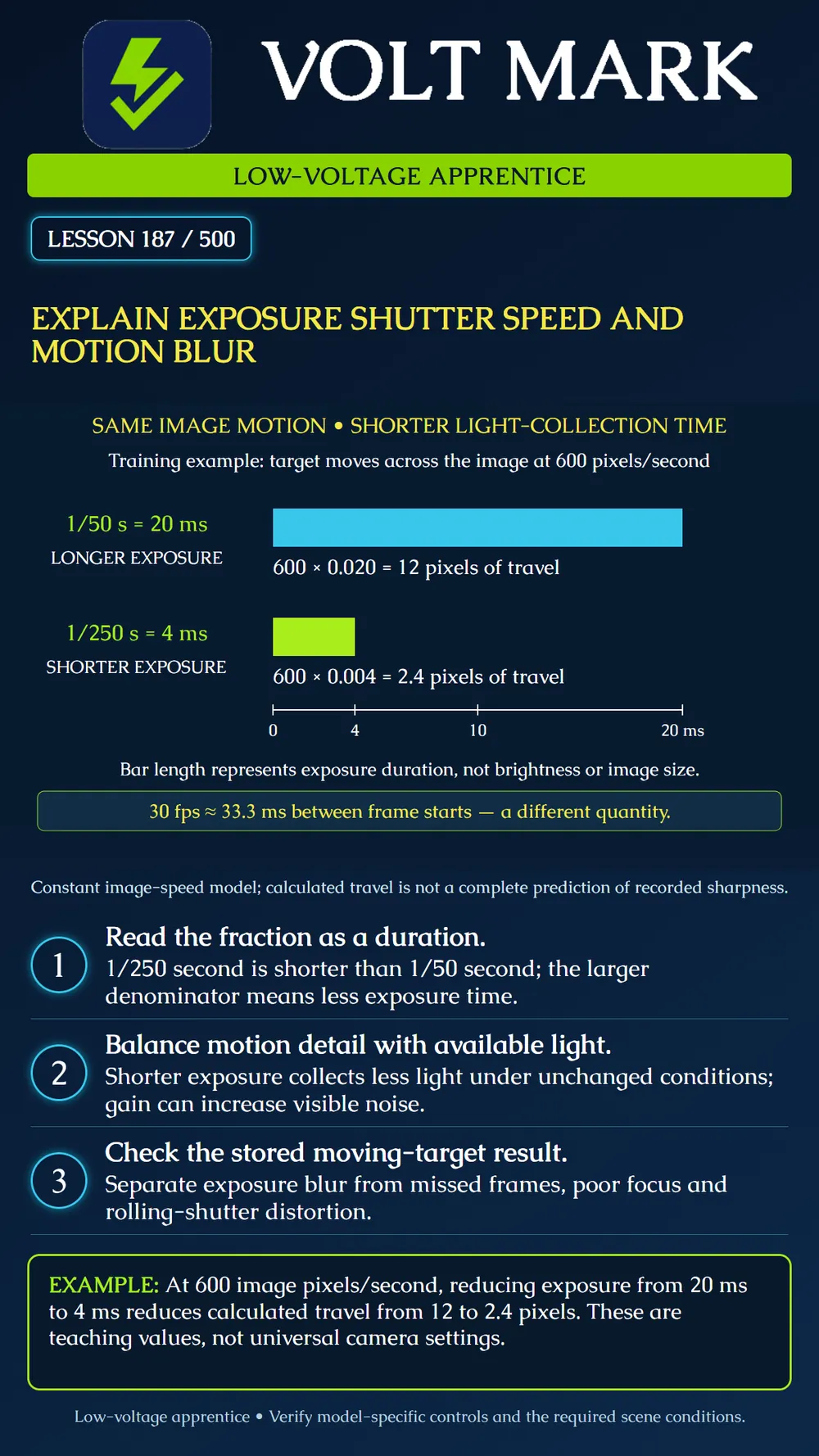
Assume a target moves laterally through the image at a constant 600 pixels per second. Assume continuous illumination and consider only that motion during one exposure. Image travel = image speed × exposure duration. At 1/50 s: t = 0.020 s = 20 ms. Travel = 600 px/s × 0.020 s = 12 pixels. At 1/250 s: t = 0.004 s = 4 ms. Travel = 600 px/s × 0.004 s = 2.4 pixels. The exposure duration and computed travel both decrease by a factor of five. This is a geometric motion estimate, not a promise of an exact visible blur width. Optical blur, pixel sampling and processing still affect the final recording.
The two bars begin at the same origin. Their lengths represent 20 ms and 4 ms on a common scale. The larger bar does not represent a brighter display or a larger target. The image speed is given directly in pixels/second; it is not a person's walking speed in metres/second. To convert a physical speed into image speed, the relevant projection and local image scale must be known. Do not substitute a road speed directly into the pixel formula.
For unchanged scene illumination and aperture, shorter exposure collects less light. The Q1647 manual discusses the relationship among exposure time, motion blur, light and gain. Increasing gain may make noise more visible. A brighter-looking image therefore does not necessarily contain more usable moving-target detail. These are general teaching principles supported by a model-specific manual; no universal gain, shutter or minimum-light setting is prescribed.
Motion blur is associated with movement during an exposure. Rolling-shutter distortion results from different sensor rows being exposed at different times. A global shutter does not prevent blur from an exposure that is too long for the motion. The Axis sensor paper distinguishes these mechanisms. Poor focus, lens contamination, compression artifacts and missing temporal samples are other possibilities. Do not label every soft or distorted moving object "low fps."
A fictional camera watches an authorized moving test card. Its stationary card is readable, but its moving card is smeared. Record the actual camera mode and settings before drawing a conclusion. Compare the stored moving result with the stationary result. If an authorized shorter-exposure trial is conducted, preserve the before/after values and representative lighting conditions. Look for noise, dark detail loss or other tradeoffs as well as improvement in the moving card. If both stationary and moving cards remain soft, investigate more than exposure. If objects look tilted while individual edges stay relatively crisp, consider sensor timing and projection rather than assuming motion blur. No live camera is changed as part of this lesson.
At a stated image speed of 400 px/s and an exposure of 1/100 s, travel is 4 pixels. At 1/200 s, it is 2 pixels. A hypothetical design exercise permits no more than 3 pixels of geometric travel at 600 px/s. The arithmetic limit is t = 3/600 = 0.005 s, or 1/200 s. This invented limit is not an acceptance standard, required setting or guarantee of readability. Actual task evidence still matters.
Use fields for target, route, image speed assumption or measurement, camera mode, requested exposure limit, observed exposure if available, frame rate, illumination, gain, recording profile, clip reference and task result. Automatic exposure may choose a value within a configured range. A maximum-duration setting is not proof that every frame used that duration. Verify the specific manufacturer's menu definition, particularly ambiguous labels such as "max shutter." If lighting conditions cannot be reproduced, state the limitation. Do not call two recordings a controlled comparison when several unrecorded variables changed.
Axis Communications, Global shutter vs rolling shutter (August 2026): https://whitepapers.axis.com/en-us/global-shutter-vs-rolling-shutter Basis: exposure duration versus row-timing distortion and shorter-exposure light tradeoff. Worked numbers here are original. Axis Q1647 Network Camera manual: https://help.axis.com/en-us/axis-q1647 Basis: exposure, gain and motion-blur controls. Product-specific examples do not create a universal settings procedure.
Free study material for low-voltage apprentices. This is a national foundation course: requirements differ by state and by local jurisdiction, and a practice that is common in one place is not a rule everywhere. Nothing here is a licence, a certification, or authority to work unsupervised, and completing it does not count as apprenticeship hours or continuing-education credit. Check the codes adopted where you are working, the licensing authority for that work, and your employer's safety programme. VoltMark is not affiliated with, endorsed by, or sponsored by NFPA, OSHA, NICET, BICSI, FOA, or any state or local licensing authority.

Electrician licensing exam prep: practice questions, timed exam simulations, and step-by-step help finding every answer in the NEC.