Explain how near-infrared illumination supports a compatible camera, recognize possible reflection paths and prepare an evidence-based nighttime recording check.
A compatible day/night camera can use reflected near-infrared light in night mode. This is different from thermal imaging of emitted heat radiation. Confirm the exact camera response, filter mode and illuminator wavelength; an IR label alone does not establish compatibility. Typical IR-assisted night images are grayscale. Material reflectance in near-IR can differ from visible-light appearance, so a bright garment in that image does not establish its visible color. Illumination distance and useful task distance are also different claims. Verify coverage and recorded target detail at the required locations.
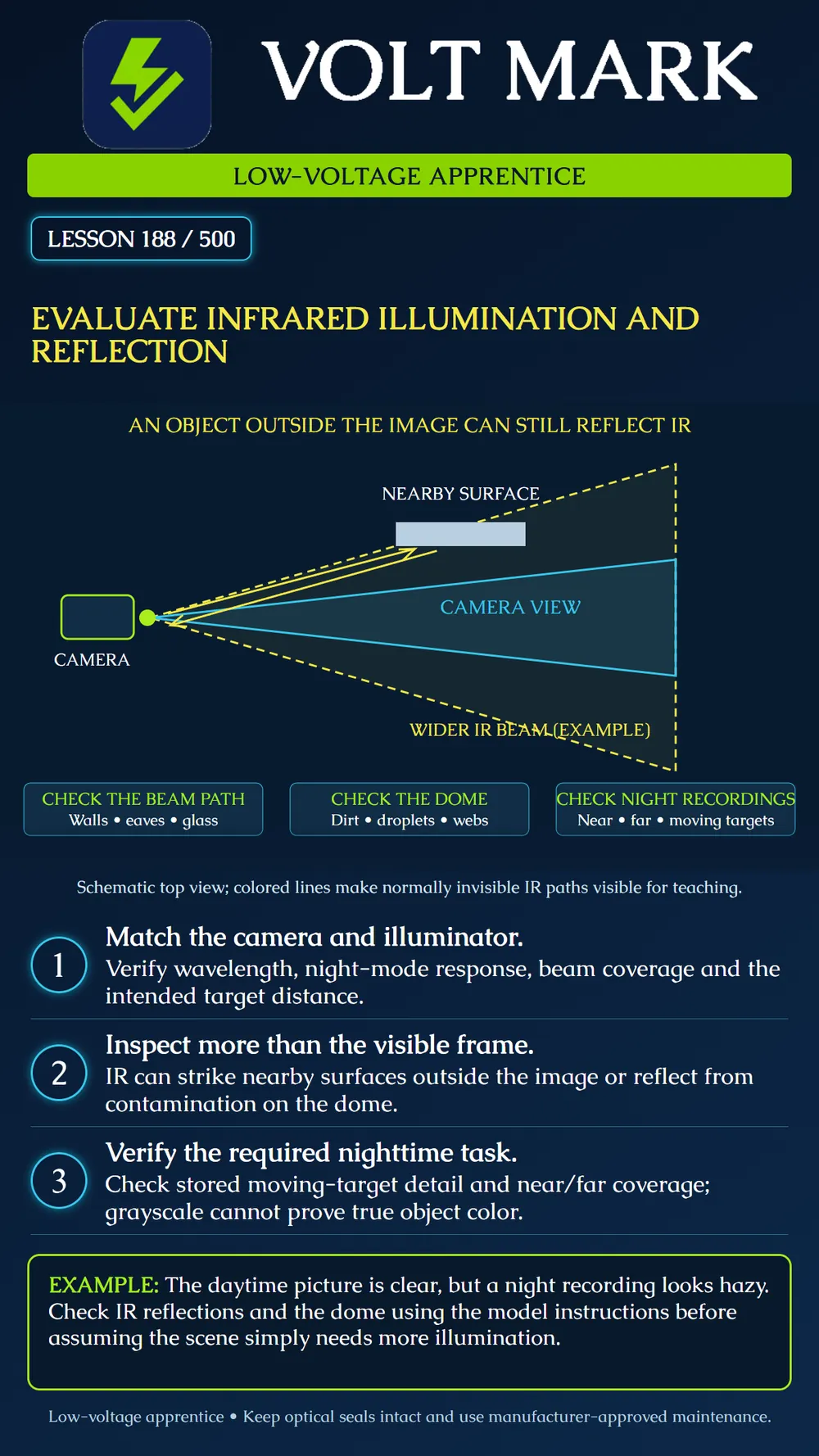
The Axis dome-reflection guidance identifies nearby structures, contamination on the dome, external light sources and optical-seal problems as possible contributors. An illumination beam may extend beyond the camera view, so an object absent from the image can still intercept IR. Dirt, droplets and webs can return light toward the lens and degrade the picture. Preserve the lens isolation seal and follow the exact model's installation and maintenance instructions. These are possible causes, not a remote diagnosis of every hazy image.
The cyan triangle represents the camera field of view. The dashed yellow boundary represents a wider illuminator beam in this example. A nearby surface sits outside the cyan view but inside the yellow beam. Yellow arrows illustrate an outgoing path and some reflected light returning toward the camera. The drawing is not an optical simulation. It does not assign reflection intensity, a coverage distance or a required beam angle. Colored lines are used only to teach otherwise invisible near-IR paths.
A fictional exterior camera records clearly in daylight. Its night recording develops a pale haze. The support note says "increase IR power." Do not accept that conclusion without evidence. Preserve the day and night examples. Record the camera model, night mode, illuminator settings, scene condition and when the symptom starts. Check accessible surroundings for a close soffit, wall edge, pane of glass or other surface intersecting the illumination path. The edge does not have to appear in the stored image to matter. Inspect the dome using approved access and maintenance methods. Record contamination or damage. Do not prescribe an unapproved coating, solvent or improvised optical-seal modification. If an authorized model-specific adjustment or cleaning is performed, compare recordings under representative conditions. Record what changed; a symptom disappearing after several simultaneous changes does not identify which one caused it.
A bright near target and a dark far target require separate observations. A single centrally placed target does not establish illumination at every edge. Make a route or position list that includes the intended near, far and peripheral task locations. A product's stated IR reach is not automatically a guaranteed identification range. Use the project's actual task, camera view, recording profile and conditions. Avoid inventing one range value that applies to every surface or night.
A loading area needs a marked training parcel to be distinguishable while carried along a specified route. List three test positions and include representative movement. For each, record whether the required mark is distinguishable, not just whether a person-shaped object appears. Repeat any relevant near-to-far movement and the day/night transition. Note glare, haze, lost detail and focus changes. If rain or another required condition is not available, state it as untested. If the task also requires true parcel color, explicitly identify that requirement. A successful grayscale view cannot demonstrate it. Refer the lighting/camera design decision for resolution rather than silently changing the task.
Record observed facts: "haze starts when integrated IR activates" is more precise than "the camera is broken." That timing is a clue, not proof of a particular reflection source. Record approved actions separately from observations. Keep the original settings and baseline clip reference. Do not leave illumination disabled and call the problem solved if nighttime coverage is thereby lost. A second camera or illuminator may affect the scene; include relevant nearby sources in the record rather than considering the camera in isolation.
Camera and illuminator model; wavelength and mode; lens/view setting; required locations and task; nearby structures; dome condition; optical-seal condition if inspection is authorized; representative weather; before/after settings; clip references; observed result; unresolved conditions; reviewer. Use the manufacturer's illuminator safety and service instructions. Do not judge an invisible emitter safe by its lack of visible glow.
Axis Communications, IR in surveillance (July 2026): https://whitepapers.axis.com/en-us/ir-in-surveillance Basis: day/night near-IR operation, material appearance, illumination and task considerations. Axis Communications, IR reflections in dome cameras: https://whitepapers.axis.com/en-us/ir-reflections-in-dome-cameras Basis: reflection paths, dome contamination and optical isolation. Specific cleaning products or surface treatments are not generalized here. Diagrams, scenarios and worksheets are original teaching material.
Free study material for low-voltage apprentices. This is a national foundation course: requirements differ by state and by local jurisdiction, and a practice that is common in one place is not a rule everywhere. Nothing here is a licence, a certification, or authority to work unsupervised, and completing it does not count as apprenticeship hours or continuing-education credit. Check the codes adopted where you are working, the licensing authority for that work, and your employer's safety programme. VoltMark is not affiliated with, endorsed by, or sponsored by NFPA, OSHA, NICET, BICSI, FOA, or any state or local licensing authority.

Electrician licensing exam prep: practice questions, timed exam simulations, and step-by-step help finding every answer in the NEC.