Prepare and document a repeatable camera acceptance review under representative daylight and nighttime conditions. Judge the recorded result against the approved task, not merely whether the picture looks bright or attractive. This lesson provides a fictional exercise; it does not certify an actual camera installation.
Obtain the approved camera purpose and acceptance criteria. State what the reviewer must be able to determine, at which location and distance, while the target is stationary or moving. Identify the required illumination conditions, recording profile and viewing method. Do not turn a general overview camera into a promised face-identification or license-plate system without an approved design.
A numerical pixel-density criterion, if specified, is one input to the test. It does not alone prove usable recorded detail under motion, difficult lighting or compression. Do not substitute a different standard edition or a familiar target number for the project's stated requirement.
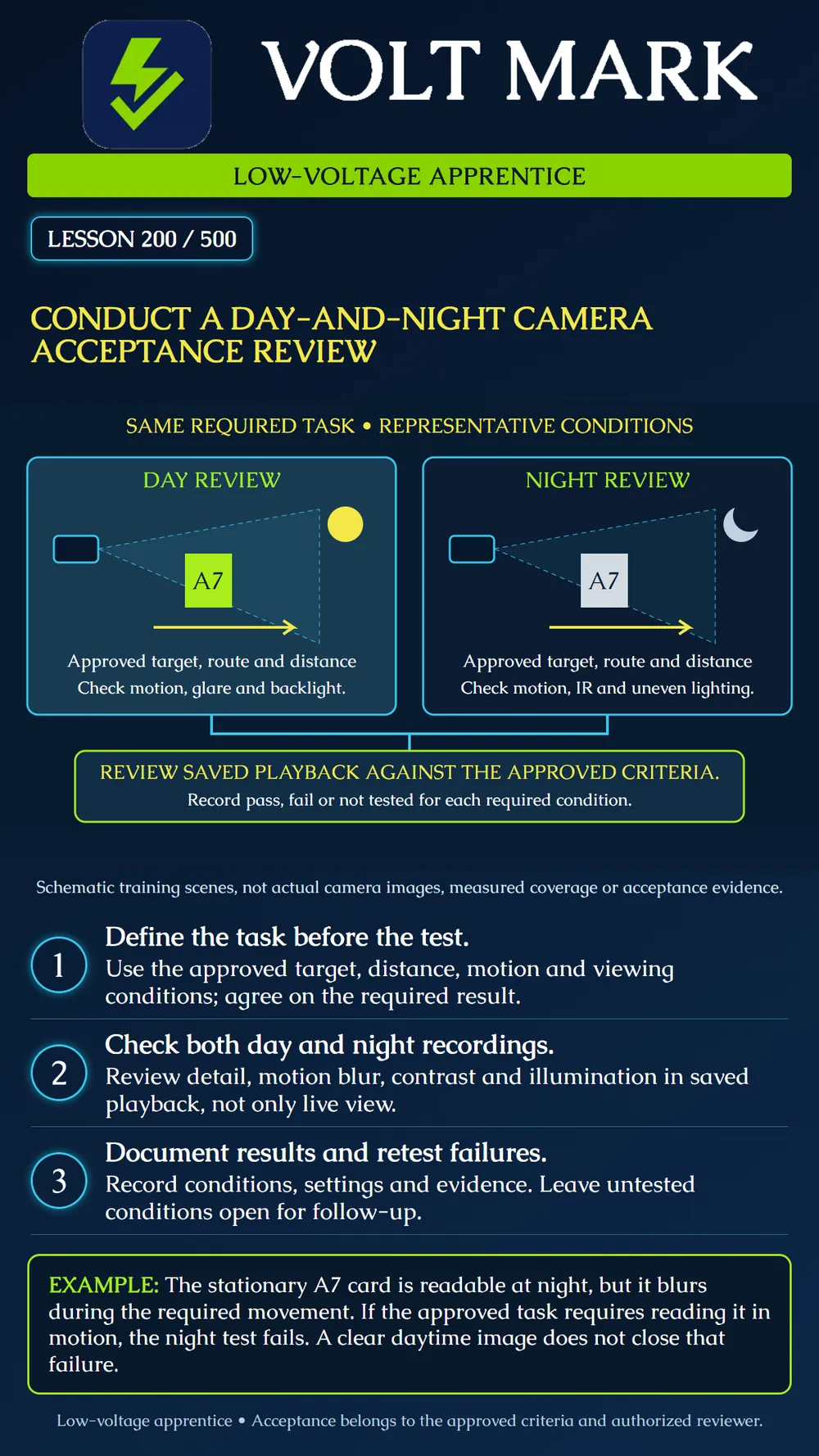
The two panels use a fictional A7 training target on the same route and at the same intended test position. One panel represents day and the other night. The target drawing stays sharp so the diagram identifies the test setup; it is not a simulation of actual camera performance. Both panels lead to review of saved footage, with each required condition recorded as pass, fail or not tested.
The A7 card is not a standardized face or plate test target. In this exercise it represents an agreed simple reading task. A real application needs a target and test method appropriate to its actual purpose.
Axis lighting guidance explains that light quantity, distribution and reflected light influence camera performance. Glare and uneven illumination can affect usable detail. Near-infrared imaging does not provide the same color information as appropriately illuminated visible-light imaging. Source: https://whitepapers.axis.com/en-us/lighting-for-network-video
Axis guidance on dome-camera IR reflections discusses reflections from nearby objects and contamination or other issues around the dome. This supports inspecting the installed night scene rather than assuming the illuminator's advertised range establishes performance. Source: https://whitepapers.axis.com/en-us/ir-reflections-in-dome-cameras
Axis's explanation of pixel density under IEC62676-4:2025 treats it as a planning factor alongside other image-quality influences. The manufacturer's explanation is not the full standard and does not establish this site's acceptance contract. Source: https://whitepapers.axis.com/en-us/pixel-density-based-on-iec-62676-4-2025 Sources accessed2026-09-30.
Use an authorized, harmless training target and a safe route. Record camera ID, mounting/view direction, test position, target distance, movement direction and speed or repeatable movement method. Record date/time and time basis, weather or relevant scene conditions, lighting state and camera/recorder profiles. Note exposure settings or automatic limits when available and relevant.
Use the approved configuration rather than temporarily improving the scene with a work light that will not remain in service. If temporary light is part of a diagnostic comparison, label that test separately. Do not claim it represents the installed operating condition.
Test the required near and far locations. Include the approved movement rather than only a stationary pose. Inspect the relevant target detail, clipped highlights, deep shadows and backlit conditions. Where sun direction changes the scene, record the actual condition tested and schedule any required missing condition. One midday test cannot establish every morning or evening glare condition.
Compare recorded playback with the approved criteria at the agreed viewing scale. Digital enlargement cannot reconstruct missing recorded detail. Record the actual stream/profile tested so a lower-quality recording is not confused with a higher-quality live stream.
Repeat the agreed task with the site's representative night illumination. Confirm that the intended day/night mode and lighting state are active. Check moving targets for blur or loss of detail, near targets for excessive brightness and distant targets for insufficient illumination. Inspect uneven lighting and reflections that obscure the required scene.
If infrared is used, do not infer an object's true visible color from its grayscale brightness. If the task requires color, the approved design and test must support that requirement. Check the effects of nearby surfaces or dome contamination through authorized inspection; follow the product's maintenance instructions rather than applying improvised cleaners or coatings.
Include headlights, switching lights or mode transitions only where they are required and can be tested safely. A dry, calm-night test does not establish performance in rain or other conditions that were not observed. Label those conditions not tested and assign follow-up if the acceptance plan requires them.
Suppose the approved fictional task is to read the A7 card while it moves across a marked route at the agreed speed. Daytime playback shows both characters. Nighttime playback shows both when the card stops, but the moving card becomes unreadable.
Day result: pass for the tested condition. Night stationary observation: informative, but it is not the required moving-task result. Night moving result: fail. The correct next step is an authorized investigation and correction followed by the same night movement test. Do not mark the whole camera accepted because one frame at a standstill was clear. Do not change the task after seeing the result just to create a pass.
Verify that the required test event is actually recorded and retrievable with correct camera identity and understood timestamps. Check relevant approved privacy masks and user access during the workflow. Confirm exported evidence only where export is authorized, using the controlled destination and handling process. An image-quality pass is not a substitute for retention, privacy or recording-system checks.
Camera ID and approved task: Criterion source and authorized reviewer: Target, position, distance and movement: Date/time, lighting and environmental conditions: Relevant camera and recording configuration: Clip reference and permitted storage location: Observed result and pass/fail/not-tested status: Limitation or failure: Authorized correction and repeat-test result: Open condition, owner and follow-up:
Keep the comparison evidence and settings record with the approved handover material. Distinguish an apprentice's observations from the authorized reviewer's acceptance decision. If required conditions remain untested, keep them visible. A signature field left blank is not approval.
Free study material for low-voltage apprentices. This is a national foundation course: requirements differ by state and by local jurisdiction, and a practice that is common in one place is not a rule everywhere. Nothing here is a licence, a certification, or authority to work unsupervised, and completing it does not count as apprenticeship hours or continuing-education credit. Check the codes adopted where you are working, the licensing authority for that work, and your employer's safety programme. VoltMark is not affiliated with, endorsed by, or sponsored by NFPA, OSHA, NICET, BICSI, FOA, or any state or local licensing authority.
Electrician licensing exam prep: practice questions, timed exam simulations, and step-by-step help finding every answer in the NEC.