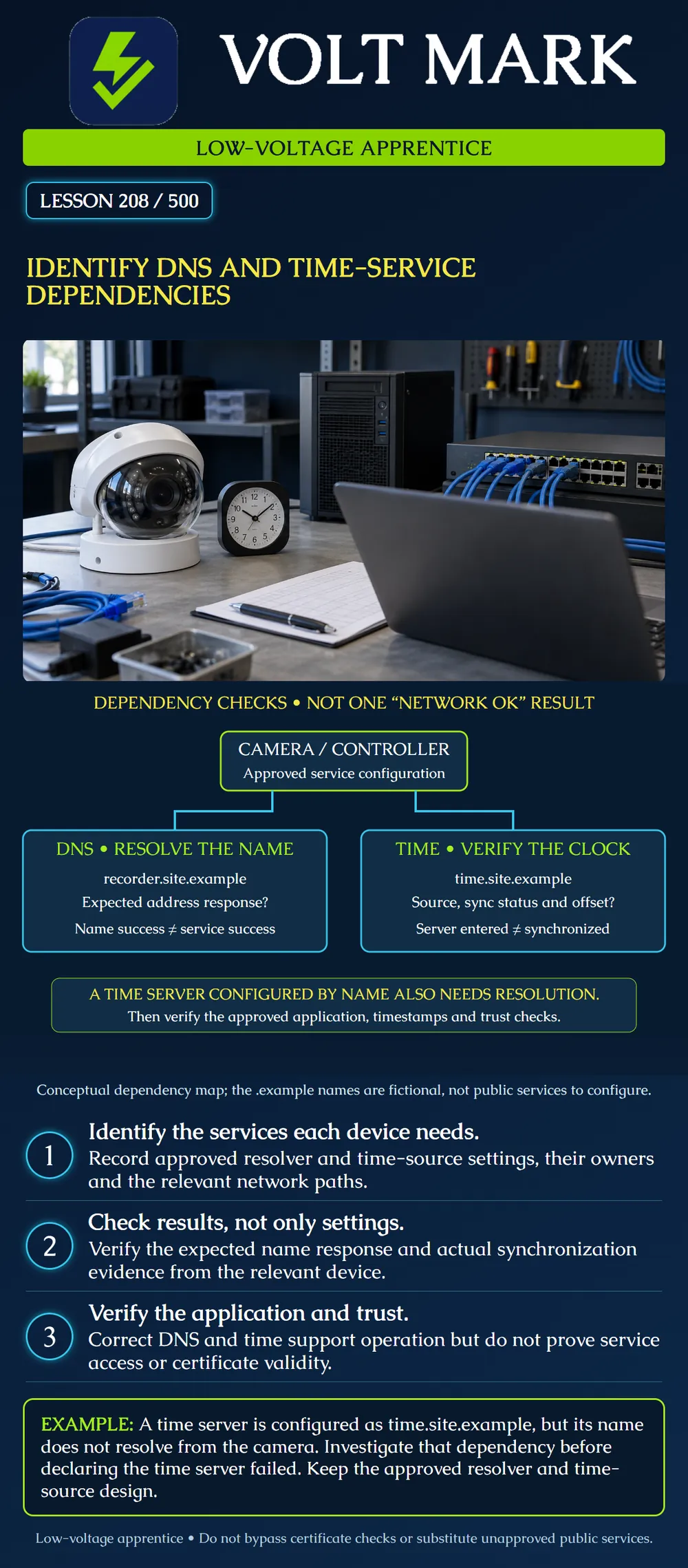
Map the name-resolution and time-synchronization dependencies of a low-voltage endpoint and distinguish configured intent from observed success. This is a fictional exercise. No DNS query, time-service test or equipment change is performed here.
The camera or controller depends on services required by its approved configuration. The left branch asks whether a required name resolves as expected. The right branch asks whether the device clock is actually synchronized with the approved time source.
The branches are not completely independent: a time source configured by hostname may require successful name resolution before the device can contact it. Other systems may use an approved numeric time-server address or a different supported mechanism. Record the actual design rather than assuming the same dependency on every device.
The names recorder.site.example and time.site.example are fictional teaching names. They are not operational public services and should not be entered into a production device.
A fictional camera lists time.site.example as its time source and reports no successful synchronization. A maintenance laptop resolves that name; the camera's approved diagnostic record reports a name-lookup timeout. Write the unresolved dependency, the next owner-assisted check and two separate results required to close the issue. Use supplied records only.
Answer: Name resolution from the camera's context is unresolved; laptop success does not settle it. Compare the exact name, approved resolver and permitted lookup path with the network owner. After an authorized correction, record the camera-context lookup result and the device's actual time-synchronization evidence separately. Then verify the dependent function under the original test scope. Do not invent a working NTP result from the repaired lookup.
Mistake: Marking time synchronized because the NTP server field is populated. Correction: Read the device's synchronization result and freshness evidence using its documented field meanings.
Mistake: Using a successful laptop lookup as proof that the camera resolves its named time server. Correction: Record the camera's configured resolver and relevant source network, then obtain an authorized lookup result in that context.
Mistake: Replacing a service hostname with its numeric address to dismiss a certificate warning. Correction: Preserve the warning and have the owner verify intended identity, time and trust configuration; a numeric substitution is not a general trust repair.
Microsoft explains that a DNS query includes a name and requested record type. Responses can come from cached information or DNS servers. An address response provides name-resolution information; it is not a test of the destination application's operation. Source: https://learn.microsoft.com/en-us/windows-server/networking/dns/queries-lookups
Axis's NTP API describes configuration and synchronization information, including server selection, synchronization state, offset and timing information. A server entry and a synchronization result are different evidence. Source: https://developer.axis.com/vapix/network-video/ntp-api/
Axis device guidance identifies correct time as relevant to certificate-based authentication. This is one product example, not a diagnosis of every certificate error. Source: https://help.axis.com/en-us/axis-d3110-connectivity-hub Sources consulted2026-09-30. The map, worksheet and cases below are original exercises.
Record the exact configured hostname rather than a remembered abbreviation. Identify the approved resolver settings, the requesting device and its network location. If relevant, record the query type and returned IPv4 or IPv6 addresses.
A successful result on a technician's laptop does not necessarily demonstrate the camera's resolver configuration or permitted network path. A cached response can also allow one device to keep resolving a name while another cannot. Record the actual observation and its time.
Check that the returned result matches the approved service design. Multiple legitimate addresses can exist for one service, so do not assume any second address is a fault. If the answer differs from the documented expectation, preserve the result and have the responsible owner investigate.
Distinguish a response saying the requested name or record is absent from a query timeout. Both may prevent an application from reaching its named service, but they are different observations. Do not label every failure "internet down"; internal name services can operate without public internet access.
Identify the intended time source and whether it is configured by name, numeric address or a supported automatic configuration method. Record the actual device's synchronization state, source information, offset and freshness evidence where available. Interpret each status field using that product's documentation.
A clock that looks approximately correct is not proof of ongoing synchronization. Similarly, a configured NTP server address is not proof of a successful exchange. Check the approved path and the time client's own result, not only whether a server responds to an unrelated ping.
Record UTC or an explicit offset with observations. A display-zone difference is not the same as a clock error; Lesson197 covers timestamp comparisons. Do not alter the zone to conceal a clock discrepancy. Do not set clocks to arbitrary dates to make a security warning disappear.
The fictional camera is configured to use time.site.example. Its status shows no successful synchronization. The relevant name lookup fails from the camera's approved network.
The evidence identifies an unresolved prerequisite. It does not prove that the actual time server is stopped. Verify the exact name, approved resolver and permitted lookup path with the responsible owner. After an authorized correction, verify both resolution and actual synchronization. A repaired lookup alone does not close the time-service issue.
The endpoint resolves recorder.site.example to the expected address, but the required application connection fails. The successful lookup narrows the investigation; it does not prove routing, access policy, credentials or service health. Keep the DNS result and the application error as separate entries.
Changing the resolver to an arbitrary public service may break private-name resolution or violate the site's design. Use the approved service owner and change process instead of substituting familiar internet addresses.
An authorized client reports a certificate warning while connecting to the expected service. Record the exact warning and relevant device/client times. Review time correctness, intended hostname and the approved trust configuration as distinct possibilities.
A corrected clock does not by itself establish that a certificate is otherwise valid or trusted. A valid DNS response also does not authenticate the service. Do not disable certificate validation, accept an unknown identity without verification or replace an intended hostname with a numeric address as a blanket workaround. Follow the documented trust and identity process.
Endpoint ID and interface: Required application/service: Configured hostname or address: Approved resolver and owner: Relevant source network: Expected and observed resolution result: Approved time source and owner: Synchronization state, offset and observation time: Application/trust result: Unresolved prerequisite and responsible owner:
Test only through the authorized procedure, using the device or equivalent approved source context. Preserve the original failure evidence. After a correction, repeat the failed dependency check and then the application task it supports.
Record limitations explicitly. A settings screenshot establishes values visible at that moment. It does not prove long-term availability, synchronized capture, accurate historical recordings or successful future certificate renewals. Handover should show what was configured, what was observed and what remains open.
Texas journeyman, 15 questions, scored by topic against the 70% mark. No card, and no account needed to start.
Free study material for low-voltage apprentices. This is a national foundation course: requirements differ by state and by local jurisdiction, and a practice that is common in one place is not a rule everywhere. Nothing here is a licence, a certification, or authority to work unsupervised, and completing it does not count as apprenticeship hours or continuing-education credit. Check the codes adopted where you are working, the licensing authority for that work, and your employer's safety programme. VoltMark is not affiliated with, endorsed by, or sponsored by NFPA, OSHA, NICET, BICSI, FOA, or any state or local licensing authority.

Electrician licensing exam prep: practice questions, timed exam simulations, and step-by-step help finding every answer in the NEC.