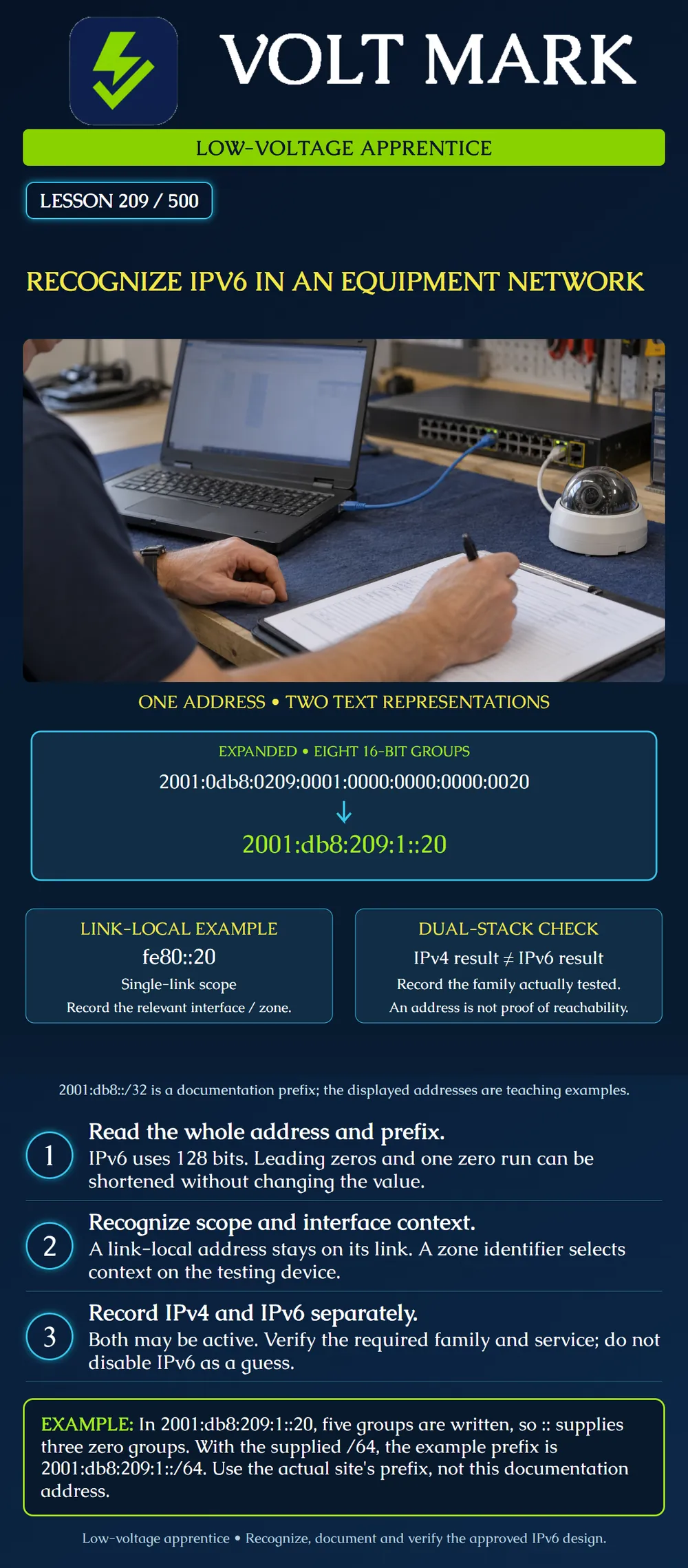
Recognize IPv6 notation in a camera, controller or workstation record; expand a compressed address; and distinguish link-local scope from an assumed routed path. This is an observation and interpretation exercise, not a deployment instruction.
Expanded address: 2001:0db8:0209:0001:0000:0000:0000:0020 Compressed address: 2001:db8:209:1::20
Both represent the same128-bit value. The expanded form has eight groups of sixteen bits. Each group can contain up to four hexadecimal digits. Eight times sixteen equals128.
Remove leading zeros within each group:0db8 becomes db8,0209 becomes209,0001 becomes1 and0020 becomes20. Do not remove zeros from the end of a nonzero group;20 and2 are different hexadecimal values.
The three consecutive all-zero groups are represented by::. Five groups remain written explicitly:2001,db8,209,1 and20. Eight minus five gives three omitted zero groups. Compression shortens text, not the underlying address.
Mistake: Shortening the last group 0020 to 2 while normalizing the example. Correction: Remove leading zeros only: 0020 becomes 20; keep its hexadecimal value unchanged.
Mistake: Sending a campus-wide test toward fe80::20 because it looks like an ordinary destination. Correction: Identify its link-local scope and the intended local interface; use an owner-supplied routable destination for a routed test.
Mistake: Copying %12 from one laptop as though it were VLAN12 on every workstation. Correction: Resolve the zone identifier against the issuing system's interface inventory; it is local context, not a portable VLAN assignment.
RFC5952 specifies canonical text representation: omit leading zeros, use lowercase letters and compress the longest suitable zero run, using the first run when equal longest runs tie. Its canonical form does not use::to replace only one zero group. Different valid textual forms can still identify the same address. Source: https://www.rfc-editor.org/rfc/rfc5952.html
RFC4291 describes128-bit IPv6 addressing, multiple addresses per interface and link-local scope. Routers do not forward link-local source or destination traffic to another link. Source: https://www.rfc-editor.org/rfc/rfc4291.html
RFC3849 reserves2001:db8::/32 for documentation. The example is not a production address allocation. Source: https://www.rfc-editor.org/rfc/rfc3849.html
RFC4007 explains scoped-address zone identifiers. Their interpretation is local to the system using them. Source: https://www.rfc-editor.org/rfc/rfc4007.html Sources accessed2026-09-30.
For this fictional example, the supplied prefix length is/64. The first four16-bit groups make the64-bit prefix: 2001:db8:209:1::/64.
The slash number is a count of prefix bits, not a decimal IPv4 subnet mask and not a port number. Use the prefix supplied by the actual network design. This lesson does not claim that every IPv6 address or route must use/64.
An IPv6 address without its relevant prefix, scope and interface information may be insufficient for a useful installation record. Copy the supported device display carefully and distinguish the address from any lifetime or status fields next to it.
The example fe80::20 is link-local. It is useful only within the relevant link scope; it is not a remote-campus destination merely because the same characters can be typed elsewhere.
A test tool may represent an interface context with a suffix such as fe80::20%12. In that illustrative syntax,12 identifies a zone/interface context on the machine issuing the test. It is not part of the128-bit address and is not a switch VLAN number. Another machine can use a different local identifier for the corresponding link. Follow the actual tool's syntax and interface inventory.
Do not remove a required scope identifier just to make two copied strings look alike. Conversely, do not paste one laptop's interface number into every other device's configuration and assume it has the same meaning.
An interface may show a link-local address and other IPv6 addresses. It may also have IPv4 configured. Seeing several address entries is not by itself proof of a duplicate-address fault. Record their roles and state instead of deleting unfamiliar entries.
The presence of an address does not establish that the destination is reachable, the address is ready for use or the required service accepts connections. Retain the status shown by the product and use the approved verification method. Do not infer physical identity from a partial address suffix.
A fictional recorder has both IPv4 and IPv6 enabled. A technician records one successful connection without noting the address family. Another technician reports an IPv6 failure. These results are not necessarily contradictory: the successful connection may have used IPv4.
Record the actual source and destination addresses, address family, name-resolution result if used, and application tested. If a name resolves to more than one family, a client may choose a path that differs from the one you intended to check. Do not label all networking healthy from one unqualified success.
A firewall or service configuration that works for IPv4 does not automatically establish the corresponding IPv6 behavior. Refer the approved policy and device capabilities to the network owner. Do not disable IPv6, bypass a security control or invent routes as an exploratory fix.
Answer: 2001:0db8:0209:0001:0000:0000:0000:0020.
Answer: No. Its final value is hexadecimal2 rather than hexadecimal20.
Answer: No. Two::sequences do not specify how many missing zero groups belong in each place.
Answer: No. Link-local scope does not cross that boundary.
Answer: No. It identifies the number of prefix bits in this address notation.
Device and interface: Exact observed IPv6 address: Normalized representation if needed: Prefix length: Address scope and observed state: Local zone/interface context used for testing: IPv4 also present: Approved destination and application: Actual family tested and result: Unresolved issue and network owner:
Keep addresses in a consistent readable format while preserving their exact values and context. Identify documentation examples so no one mistakes them for allocated production settings. Record what was observed and tested, including limitations. The goal is to recognize IPv6 evidence accurately before more advanced configuration or troubleshooting.
Texas journeyman, 15 questions, scored by topic against the 70% mark. No card, and no account needed to start.
Free study material for low-voltage apprentices. This is a national foundation course: requirements differ by state and by local jurisdiction, and a practice that is common in one place is not a rule everywhere. Nothing here is a licence, a certification, or authority to work unsupervised, and completing it does not count as apprenticeship hours or continuing-education credit. Check the codes adopted where you are working, the licensing authority for that work, and your employer's safety programme. VoltMark is not affiliated with, endorsed by, or sponsored by NFPA, OSHA, NICET, BICSI, FOA, or any state or local licensing authority.
Electrician licensing exam prep: practice questions, timed exam simulations, and step-by-step help finding every answer in the NEC.