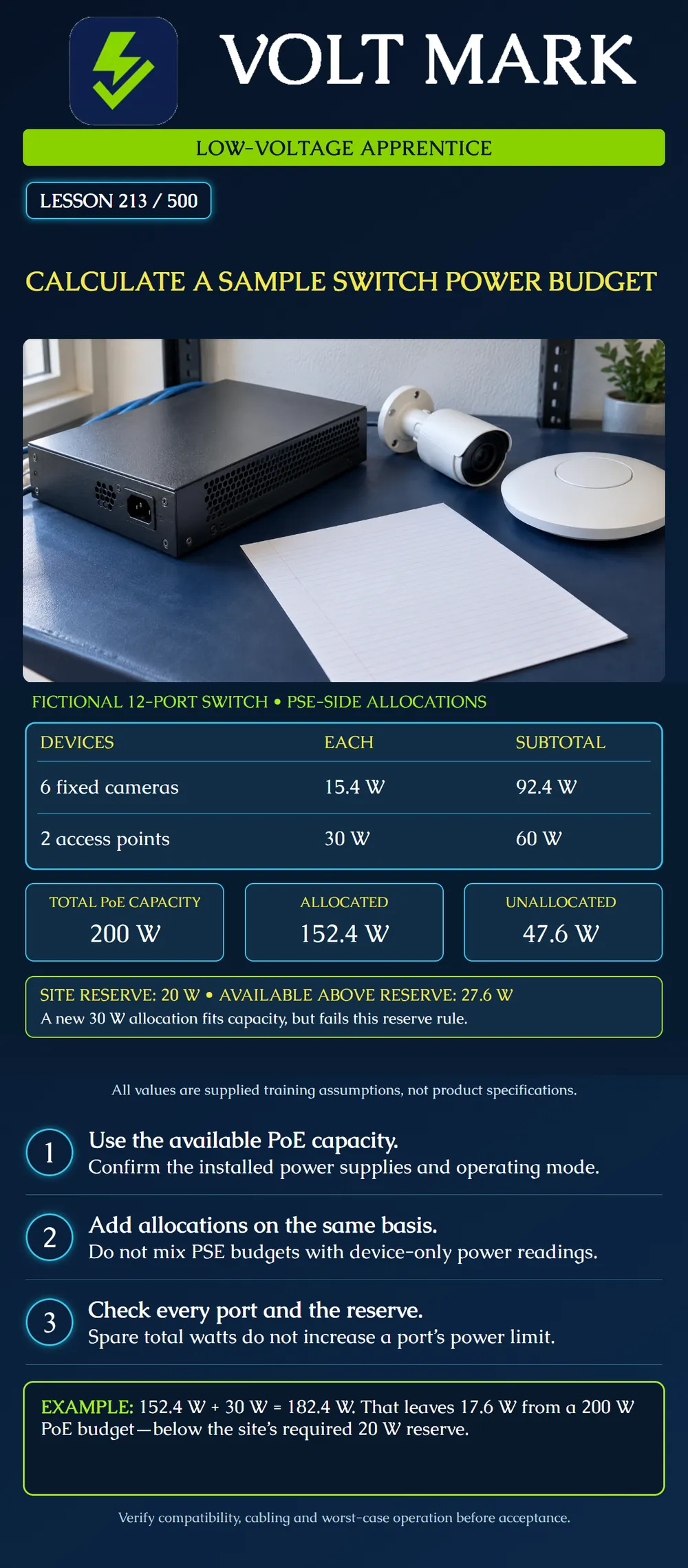
Calculate a fictional PoE switch's allocation total, remaining capacity and compliance with a supplied reserve rule. Check the total separately from each port's capability.
PSE means power sourcing equipment, such as the PoE switch. PD means powered device, such as a camera. A switch's total PoE capacity is not necessarily its power-supply nameplate rating or its AC wall-input consumption. Installed power supplies and operating configuration affect usable PoE capacity. Power allocated or reserved to ports can differ from momentary measured consumption. Use the actual platform's budgeting method.
Camera typical and maximum power values describe different operating conditions. Infrared illumination, heaters, accessories and other enabled functions can change demand. A device-side figure also differs from source-side requirements because the cable dissipates power. Establish a consistent calculation basis rather than adding unlike readings.
Assume a fictional 12-port switch has:
These allocations are supplied exercise inputs, not measured consumption or claims about a particular camera or access point. The exercise assumes the relevant source-side allowance is already included. Do not add a second arbitrary cable-loss percentage to these supplied allocations.
First calculate each group: 6 x 15.4 W = 92.4 W. 2 x 30 W = 60 W.
Add the allocations: 92.4 W + 60 W = 152.4 W.
Subtract from available capacity:
Apply the site reserve:
Eight of the twelve PoE ports are occupied in this example. Four empty ports do not prove sufficient power for four additional devices.
A proposed ninth device requires a 30 W source-side allocation on a compatible unused port.
New allocated total: 152.4 W + 30 W = 182.4 W.
New unallocated capacity:
The total is below 200 W, so it passes that arithmetic capacity comparison. It fails the supplied 20 W reserve requirement by 2.4 W. Do not describe this as a physical overload, and do not call it fully approved. The administrator or designer must resolve the planning shortfall using an approved design change.
For comparison, a new device with a supplied 15.4 W allocation would bring the total to 167.8 W and leave 32.2 W. It passes both arithmetic comparisons, assuming the stated per-port and compatibility conditions still hold. Arithmetic alone does not complete acceptance.
The exercise's 20 W reserve is a fictional owner requirement. It equals 10 percent of this 200 W budget, but neither 20 W nor 10 percent is asserted as a universal code requirement. Record the actual project's reserve, redundancy and future-growth requirements. Do not silently substitute a rule of thumb.
Suppose a different proposed device requires a 45 W PSE-side allocation, but the selected port supports only 30 W under the installed configuration. The present 47.6 W aggregate headroom does not make that port capable of supplying 45 W. Do not combine spare wattage from other ports or force an unsupported power mode. Obtain a compatible, approved powering arrangement.
Likewise, matching an RJ45 connector does not prove matching power type, negotiation, voltage or wiring. Lesson 214 addresses negotiated PoE versus passive injection in more detail.
Suppose the designer provides a second operating case with only 150 W PoE capacity after a supply failure. The original 152.4 W allocation exceeds that supplied degraded-mode budget by 2.4 W. A system that fits in normal mode therefore does not necessarily meet its required failure-mode behavior.
This is a hypothetical arithmetic case, not a prediction of which real port shuts down. Actual priority and power-shedding behavior come from the switch configuration and documentation. Record critical-device requirements and the approved recovery plan.
Use one row per endpoint, with: Asset and port; required operating functions; PD documentation reference; PoE type/class or negotiated allocation; PSE-side planning value; per-port capability; startup or environmental assumptions; verification evidence.
At the bottom, record the actual total PoE capacity for the installed supply/input mode, summed allocations, reserve requirement and remaining headroom. Keep watts beside every value. If documentation gives only PD consumption, have the designer establish the corresponding PSE allowance and compatible PoE class or negotiation method.
Verify operation under the required conditions within the approved test plan. A daytime reading with heaters and IR off is not evidence that the budget covers every required camera mode. Do not change production power priorities or disconnect devices merely to demonstrate the arithmetic.
Mistake: Calling the 30 W addition approved because 182.4 W is below 200 W. Correction: Also apply the supplied reserve: 17.6 W remains, which misses the 20 W requirement by 2.4 W.
Mistake: Using the switch's 47.6 W spare total to approve a 45 W device on a 30 W port. Correction: Check the selected port independently and obtain an approved compatible powering arrangement.
Mistake: Replacing planning allocations with a daytime consumption snapshot to fit more cameras. Correction: Keep a consistent PSE-side basis that covers required operating modes and the installed power-supply configuration.
Cisco, PoE, powered device, and switch: https://www.cisco.com/c/en/us/td/docs/switches/lan/c9000/infra/poe/poe-configuration-guide/g-poe/c-poe-and-switch.html Read for allocation-based budgeting and dependence on installed power supply configuration. Platform-specific priority and negotiation details are not universalized.
Axis, Typical and maximum power consumption in Axis cameras: https://whitepapers.axis.com/en-us/typical-and-maximum-power-consumption-in-axis-cameras Read for operating-condition differences and cable loss in source-side estimates. No example product power values were imported into the fictional calculation.
Texas journeyman, 15 questions, scored by topic against the 70% mark. No card, and no account needed to start.
Free study material for low-voltage apprentices. This is a national foundation course: requirements differ by state and by local jurisdiction, and a practice that is common in one place is not a rule everywhere. Nothing here is a licence, a certification, or authority to work unsupervised, and completing it does not count as apprenticeship hours or continuing-education credit. Check the codes adopted where you are working, the licensing authority for that work, and your employer's safety programme. VoltMark is not affiliated with, endorsed by, or sponsored by NFPA, OSHA, NICET, BICSI, FOA, or any state or local licensing authority.

Electrician licensing exam prep: practice questions, timed exam simulations, and step-by-step help finding every answer in the NEC.