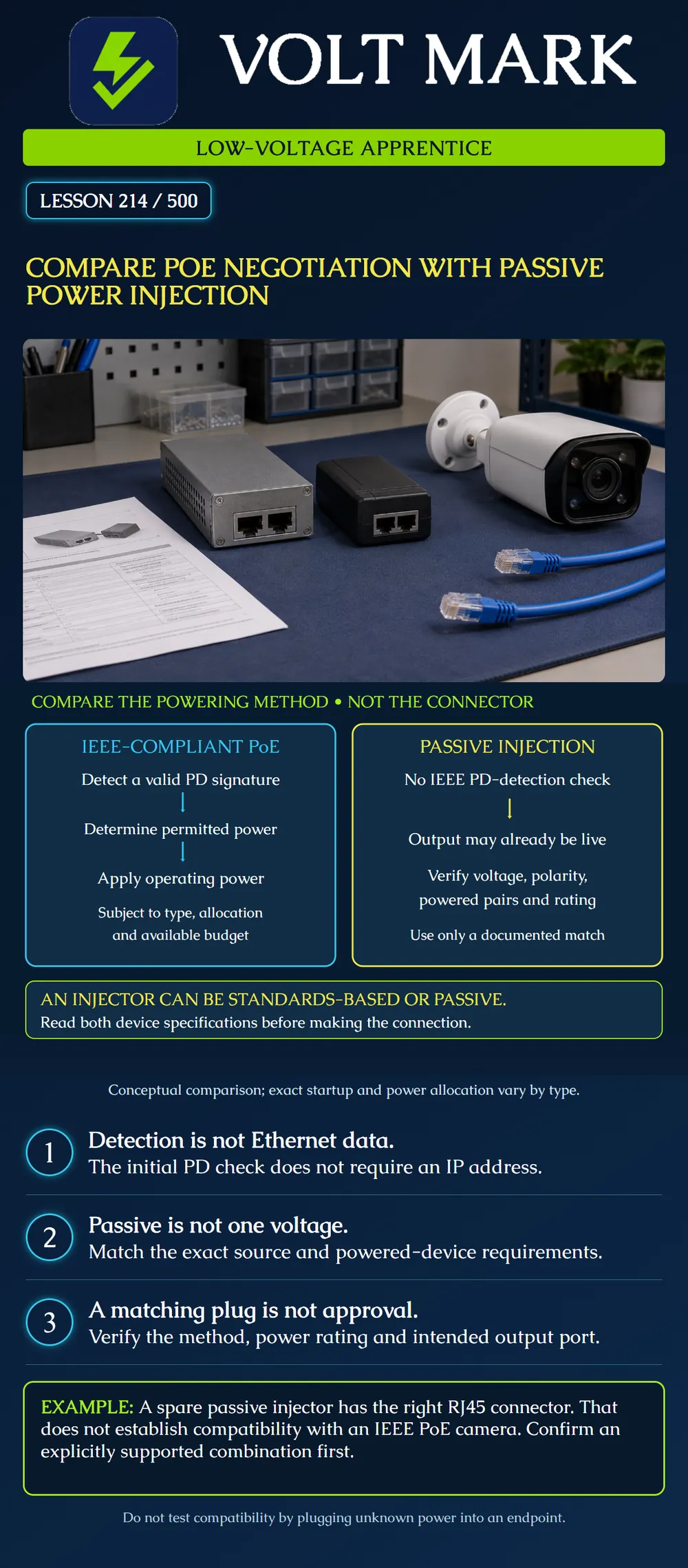
Distinguish standards-based PoE startup from passive injection and assemble a compatibility record before connecting a low-voltage endpoint.
A power sourcing device, or PSE, supplies power; a powered device, or PD, receives it. In normal IEEE-compliant PoE operation, the PSE checks for a valid PD detection signature before applying operating power. Detection uses electrical probing rather than an IP exchange. No DHCP lease is required for that initial check.
Power classification and allocation identify the permitted power level. Their details depend on the PoE type and supported mechanisms; some systems also use LLDP after startup. Do not assume every device performs the same packet handshake or that detection alone guarantees its highest-power mode. The supplied power budget and endpoint requirements must also fit.
Passive injection does not provide the IEEE PD-detection process. Its powered output may be energized without first recognizing a compatible endpoint. Passive does not identify a universal voltage, polarity, pair assignment or capacity. Use the specific source and endpoint documentation.
The left path is conceptual: detect a valid PD, determine permitted power, then apply operating power. It is not a complete timing diagram for every IEEE PoE type. The right path emphasizes the missing IEEE detection check and the need for a documented electrical match.
Neither column depicts a wiring pinout. Do not infer which conductor carries power from the placement of a line or arrow. The word injector describes a device that adds power to a data link; it does not establish whether that injector is passive or standards-based.
Three fictional inventory cards are on a workbench:
Card A: Camera C1. Its documentation states support for IEEE 802.3at Type 2 input. No passive input support is listed on the supplied card. Card B: Injector I1. Its documentation states IEEE 802.3at support, with adequate PSE-side allocation for C1 in the required operating mode. Card C: Injector I2. Its card states fixed 24 V passive output. There is no manufacturer compatibility statement for C1.
The justified candidate is I1, subject to the complete model/version, cabling, environment and installation checks. I2 is not established as compatible. Do not connect I2 merely to see whether C1 starts. The exercise does not claim all Type 2 devices reject every passive supply; it says this evidence does not authorize that pairing.
Now add Card D: Radio R1, with a manufacturer instruction naming a particular passive adapter and specifying its output requirements. A passive arrangement can be intentional when the manufacturer documents it. That does not make a visually similar adapter an acceptable replacement. Identify the exact approved adapter or an explicitly supported equivalent.
Create a compatibility worksheet with: Endpoint model and hardware revision; source model and output port; powering method; supported PoE type/class or required passive electrical parameters; maximum required operating mode; power capacity; data-rate support; cable requirements; manufacturer reference; reviewer; result.
For C1 plus I2, mark the combination unverified, with the missing evidence stated. Do not write failed unless a justified test or specification comparison actually establishes failure. An incomplete worksheet is a reason to obtain information, not a reason to improvise a powered trial.
An injector can have separate data-input and powered-output connections. Identify them from that unit's markings and instructions. Do not direct a passive powered output toward an ordinary data port or unverified test instrument. Label installed passive feeds clearly so a later technician does not mistake them for ordinary data-only connections.
A product's voltage label alone does not establish its complete powering behavior. Likewise, a PoE marketing label does not prove the needed type or class. Read the specifications for the actual hardware revision and operating mode. A device that powers up in a reduced mode may still fail the required heater, radio or other functional requirements.
If an approved IEEE pairing does not power up, preserve the model numbers, port identity, relevant status and configuration evidence. The responsible technician can compare detection, allocation, cable condition and budget information using approved tools and procedures. Do not treat an absent power indication as permission to force passive power.
When an adapter or endpoint supports more than one powering method, record which method the design uses. Do not change modes to conceal a mismatch. A passive splitter cable is not automatically an IEEE PD interface; an appropriate active conversion device must explicitly support both its source input and endpoint output requirements.
Answer: The source/endpoint powering-method and electrical compatibility evidence, plus required power and installation checks.
Answer: The initial signature check is electrical; it does not depend on DHCP.
Answer: Follow that documented pairing. Do not generalize its voltage or pinout to other devices.
Answer: Being an injector does not make it passive. Verify its stated standard and capacity.
Answer: Startup is not full functional acceptance. Review permitted allocation, compatibility and the required operating mode with the responsible technician.
Answer: Identify and document the source before connecting an endpoint or test instrument; do not use the endpoint as a detector.
Complete two compatibility rows from the supplied inventory cards without energizing equipment. For C1 with I1, record IEEE 802.3at Type 2 support at the camera, the source's stated 802.3at support and the supplied adequate allocation. Mark it candidate pending the remaining model, cabling and installation checks, because matching the supplied power information is not complete acceptance.
For C1 with I2, record fixed 24 V passive output and no supplied C1 passive compatibility statement. Mark compatibility unverified and request the manufacturer's exact source/endpoint evidence. Do not mark electrically failed, since no justified comparison or test has established failure, and do not connect it to discover the answer. A shared connector does not resolve the missing evidence.
Mistake: Trying the 24 V passive injector on C1 because both connectors are RJ45. Correction: Keep the pairing unverified until the specific electrical and manufacturer compatibility requirements are established; do not use a powered trial to identify them.
Mistake: Waiting for a DHCP lease before checking IEEE PoE detection. Correction: Separate electrical PD detection from later data networking; review the approved PSE/PD evidence without treating DHCP as its prerequisite.
Mistake: Recording every device called injector as passive. Correction: Read the exact source model's documented powering method; I1 is a standards-based injector in this exercise.
Microchip, How Power over Ethernet (PoE) Detection Works: https://developerhelp.microchip.com/xwiki/bin/view/applications/ethernet/poe/detection/ Basis for electrical signature detection before operating power. Detailed electrical tolerances are outside this apprentice comparison.
Microchip, Learn Power over Ethernet (PoE) Single-Signature Classifications: https://developerhelp.microchip.com/xwiki/bin/view/applications/ethernet/poe/sspd-classification/ Basis for distinguishing classification from detection and for type-dependent power allocation.
TP-Link France, PoE actif vs PoE passif: https://www.tp-link.com/fr/support/faq/2521/ Used narrowly for the absence of negotiation in passive injection and non-universal passive voltage. Its historical power table and broad connection claims are not used as a compatibility guarantee.
No universal passive pinout or power table is provided. This is national technical instruction, not a product approval or permission for live testing. The TP-Link reference is used only for the limited points stated above, not its historical power table or broad connection claims.
Texas journeyman, 15 questions, scored by topic against the 70% mark. No card, and no account needed to start.
Free study material for low-voltage apprentices. This is a national foundation course: requirements differ by state and by local jurisdiction, and a practice that is common in one place is not a rule everywhere. Nothing here is a licence, a certification, or authority to work unsupervised, and completing it does not count as apprenticeship hours or continuing-education credit. Check the codes adopted where you are working, the licensing authority for that work, and your employer's safety programme. VoltMark is not affiliated with, endorsed by, or sponsored by NFPA, OSHA, NICET, BICSI, FOA, or any state or local licensing authority.

Electrician licensing exam prep: practice questions, timed exam simulations, and step-by-step help finding every answer in the NEC.