Compare candidate fiber routes using documented constraints rather than choosing by apparent length alone. Identify the evidence needed before a candidate can become an approved construction route.
Underground describes placement below the surface. It can involve cable in duct or cable designed for direct burial. Aerial describes supported placement above ground. Existing-pathway reuse describes using infrastructure already present; that infrastructure might itself be underground or aerial. A single campus route can combine these conditions.
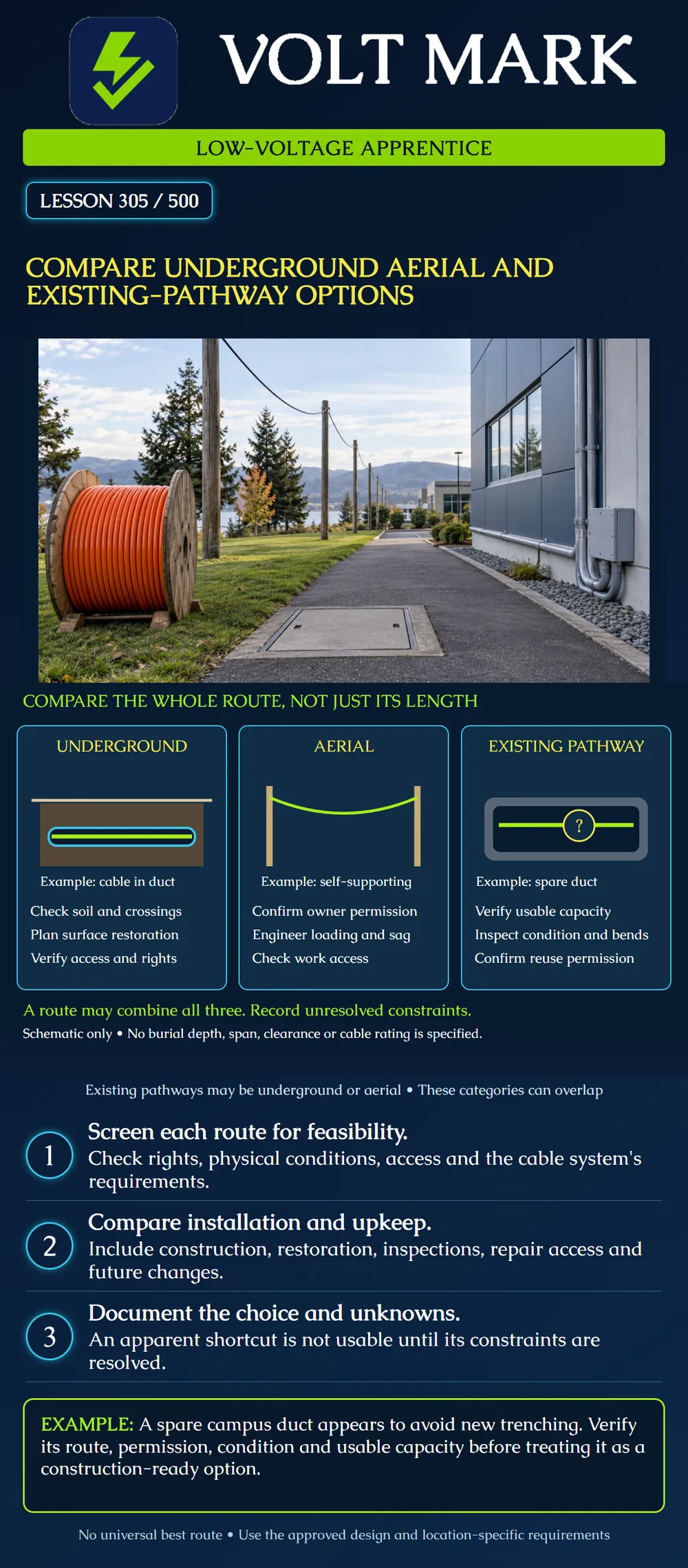
The first panel shows a cable inside buried duct. It does not depict direct burial, trench dimensions or an approved depth. The second shows a simplified self-supporting cable span, not messenger-and-lash hardware. Pole geometry and sag are illustrative, not engineered values. The third shows an existing duct whose condition remains uncertain. The question mark is an investigation item, not a measured obstruction. All three drawings are original schematics.
What rights and route approvals are needed? What crossings and surface restoration must be included? Which underground facilities are present, including private campus lines? How will installation and later repair reach the route? Collect these questions for the designer and construction team rather than assigning a generic burial depth.
Cable in duct and direct-buried cable are different systems. Reuse of a buried duct still requires verification of its route and condition. A line on a map is not proof of an open, available pathway.
Who controls the poles and attachments? What engineering and preparation are required before another cable can be supported? What access will installation and restoration need?
All-dielectric self-supporting cable supports its own designed span; a lashed system uses supporting messenger infrastructure. Those choices require suitable cable and hardware. The word fiber does not make nearby electrical facilities safe, and this lesson does not authorize apprentices to climb poles or work near supply conductors. Refer pole loading, sag, clearance and attachment questions to the responsible qualified team. Do not borrow a span limit from a different cable product.
Confirm which duct actually connects the intended endpoints and whether the owner permits its use. Obtain documented condition and capacity information. Existing services may occupy the pathway even when a drawing calls it spare.
A route survey and duct assessment can reveal installation constraints, including bends and offsets. Follow the project-specific inspection and pull-planning process; this lesson is not a rodding or confined-space procedure. Cable bend and pulling limits come from the actual cable specifications. An available opening at each end does not establish suitability throughout the route.
The owner asks for a link between a workshop and a records building. The team has three candidate routes:
Start an evidence sheet, not a winner ranking. For A, list the crossing, locating, restoration and access questions. For B, list owner permission, engineering and attachment preparation. For C, list route continuity, present occupancy, condition and permission.
The old drawing identifies C as spare, but no inspection record exists. Its status is unverified. That does not prove C is unusable, nor does it justify scheduling a cable pull. Record who will resolve the gap and what evidence will be accepted. If C proves suitable, update the comparison with its verified facts. If it does not, retain that result rather than quietly assuming another duct is equivalent.
For each candidate record: endpoints and route map; owner and approval status; existing facilities; cable/pathway compatibility; construction activities; service disruption; maintenance access; future capacity; evidence source/date; open questions and responsible party.
Compare routes using the same scope. A price that excludes restoration cannot be compared fairly with one that includes it. A short route with unresolved access should remain conditional. Avoid invented universal cost-per-foot figures, schedule guarantees or claims that underground always wins.
FOA, Outside Plant Fiber Optic Network Design: https://www.thefoa.org/tech/ref/OSP/design.html Used for placement options, site-dependent routing and ownership/site investigation. Historical cost, conduit size, fiber-type recommendations and microtrench dimensions are not adopted.
Corning, Duct Installation of Fiber Optic Cable, SRP 005-011, Issue 17, June 2019, sections 1 and 2: https://www.corning.com/content/dam/corning/catalog/coc/documents/standard-recommended-procedures/005-011.pdf Used for route/duct assessment, pull planning and product-specific handling limits. No generic force, bend radius or duct-fill value is taught.
Corning, Which Aerial Cable is Right for You?: https://www.corning.com/fiber-to-the-premise/cala/en/home/applications/community-broadband/which-aerial-cable-is-right-for-you.html Used only to distinguish self-supporting and strand-and-lash systems. Marketing span figures and broad worker-certification statements are not treated as nationwide requirements.
Texas journeyman, 15 questions, scored by topic against the 70% mark. No card, and no account needed to start.
Free study material for low-voltage apprentices. This is a national foundation course: requirements differ by state and by local jurisdiction, and a practice that is common in one place is not a rule everywhere. Nothing here is a licence, a certification, or authority to work unsupervised, and completing it does not count as apprenticeship hours or continuing-education credit. Check the codes adopted where you are working, the licensing authority for that work, and your employer's safety programme. VoltMark is not affiliated with, endorsed by, or sponsored by NFPA, OSHA, NICET, BICSI, FOA, or any state or local licensing authority.
Electrician licensing exam prep: practice questions, timed exam simulations, and step-by-step help finding every answer in the NEC.