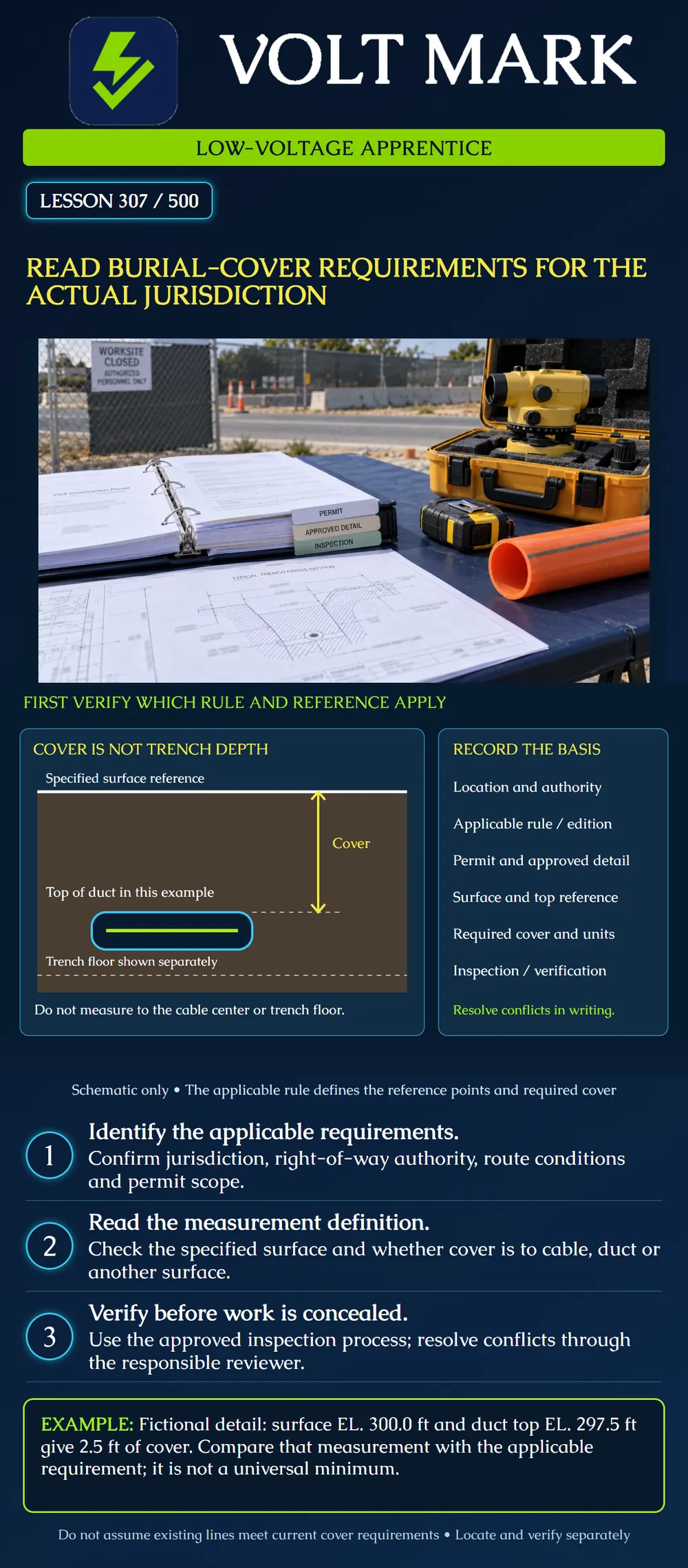
Find the applicable burial-cover requirement for a fiber route, identify its measurement references and document the basis for verification. This lesson provides a reading method for use nationwide, not a nationwide burial-depth table.
A requirement is useful only when its scope matches the work. Identify the property, route segment, right-of-way authority, installation type and approved permit or plan. A rule for a state highway crossing cannot automatically be assigned to a private campus lawn. Crossing a roadway and running parallel to it may have different conditions.
Record the governing source, edition or revision, relevant section or detail, and who has confirmed applicability. Check the applicable adopted requirements, local amendments, permit conditions and project specifications with the responsible designer or authority. Do not assume the newest published model code is the locally adopted edition.
The illustrated duct contains a fiber cable. The yellow arrow runs vertically from the stated surface reference to the duct top. The trench floor is lower and has a separate dashed line. The cable center is inside the duct and is not the endpoint of this example's cover measurement.
This drawing intentionally has no required depth. Its geometry teaches reference points, not an installation detail. Depending on the actual rule and construction system, the relevant top surface may be the direct-buried cable, conduit, casing or another explicitly defined element. Read the definition rather than guessing.
For a roadway or ditch, confirm which grade or surface the rule uses. Also confirm whether the design references existing or finished conditions. A grade change can change cover even if the buried duct does not move. Where encasement or protective construction is specified, obtain the exact detail and measurement definition.
Suppose an invented approved training detail defines cover from finished surface to duct top. At the same location and datum, surface elevation is 300.0 feet and duct top elevation is 297.5 feet: 300.0 − 297.5 = 2.5 feet, or 30 inches.
This calculates illustrated cover only. It does not establish whether the design meets any real jurisdiction's requirement. To decide that, the exercise would also need a verified applicable requirement and all relevant installation conditions. The trench depth cannot be derived from these two values because duct dimensions and bedding are not specified.
In a second fictional exercise, the finished surface is lowered by 0.5 foot while the duct top remains unchanged. Cover becomes 299.5 − 297.5 = 2.0 feet, or 24 inches. A prior measurement from the old surface does not prove the revised condition is acceptable.
Imagine a plan note refers to one detail, the permit refers to another and the crew has an older print. Do not resolve this by using the shallower number, copying a neighboring project or independently deciding that deeper is always acceptable. A depth change can affect other crossings and the approved route. Identify the disagreement, hold the affected work and obtain the responsible reviewer's documented resolution.
An exception must follow the actual authority's process. Field convenience is not evidence that an exception has been granted. Preserve approved changes with the construction record.
Use a training worksheet with: route segment/station; jurisdiction and owner; rule and edition; permit/detail reference; surface reference; top-of-installation reference; required cover; measured or documented cover; units and method; inspection status; discrepancy and disposition.
Arrange verification through the project's approved process before concealment. Work only within your training and the crew's safety controls. Never enter an excavation merely to obtain a measurement. Trench safety is addressed in the next lesson.
Do not use a required installation depth to predict where an existing utility is today. Existing records, grade changes, undocumented work and other uncertainties require separate locating and verification. A compliant design does not prove the location of every buried facility.
An invented approved training detail defines cover from finished surface to duct top. The surface is EL. 410.0 feet and duct top is EL. 407.0 feet at the same point and datum. A revision lowers the surface to EL. 409.5 feet. Calculate both covers and identify what is still needed for a compliance decision. No required minimum is supplied. Expected reasoning: original cover is 410.0 - 407.0 = 3.0 feet, or 36 inches. Revised cover is 409.5 - 407.0 = 2.5 feet, or 30 inches. The change reduces cover by 6 inches. Neither value establishes compliance without the verified applicable requirement and installation conditions. Record the revision and obtain the responsible review; do not infer a trench depth or an exception from these elevations.
Washington, WAC 468-34-110(32), Definition of terms: https://app.leg.wa.gov/wac/default.aspx?cite=468-34-110 The highway-utility definition ties cover to the top of pipe relative to roadway or ditch grade. Used as a specific example of why the definition matters, not as a national fiber rule.
TxDOT, ROW Utilities Manual, Utility Accommodation Rules: https://www.txdot.gov/manuals/row/utl/chapter-5--utility-considerations-during-highway-d/section-6--compliance-with-the-rules-and-policies/utility-accommodation-rules--uar-.html Used for the scope of TxDOT right-of-way requirements and its documented exception process. Texas numeric cover values are not reproduced or generalized.
Texas journeyman, 15 questions, scored by topic against the 70% mark. No card, and no account needed to start.
Free study material for low-voltage apprentices. This is a national foundation course: requirements differ by state and by local jurisdiction, and a practice that is common in one place is not a rule everywhere. Nothing here is a licence, a certification, or authority to work unsupervised, and completing it does not count as apprenticeship hours or continuing-education credit. Check the codes adopted where you are working, the licensing authority for that work, and your employer's safety programme. VoltMark is not affiliated with, endorsed by, or sponsored by NFPA, OSHA, NICET, BICSI, FOA, or any state or local licensing authority.

Electrician licensing exam prep: practice questions, timed exam simulations, and step-by-step help finding every answer in the NEC.