Explain the apprentice's coordination duties around a fiber-duct trench, identify the excavation competent person's role, and respond appropriately when conditions change. This lesson is an awareness overview, not excavation qualification or permission to enter. WHO DOES WHAT? Under OSHA's excavation definition, a competent person can identify existing and predictable hazards and is authorized to take prompt corrective action. The role involves both capability and authority. Being the most experienced fiber splicer or holding a general job title does not, by itself, establish that role. The employer remains responsible for safe work. The fiber crew must know who is responsible for excavation inspection and hazard correction, who directs the assigned task, and how to raise an immediate concern. An apprentice should not classify soil, redesign protection or override restrictions merely to keep cable work moving.
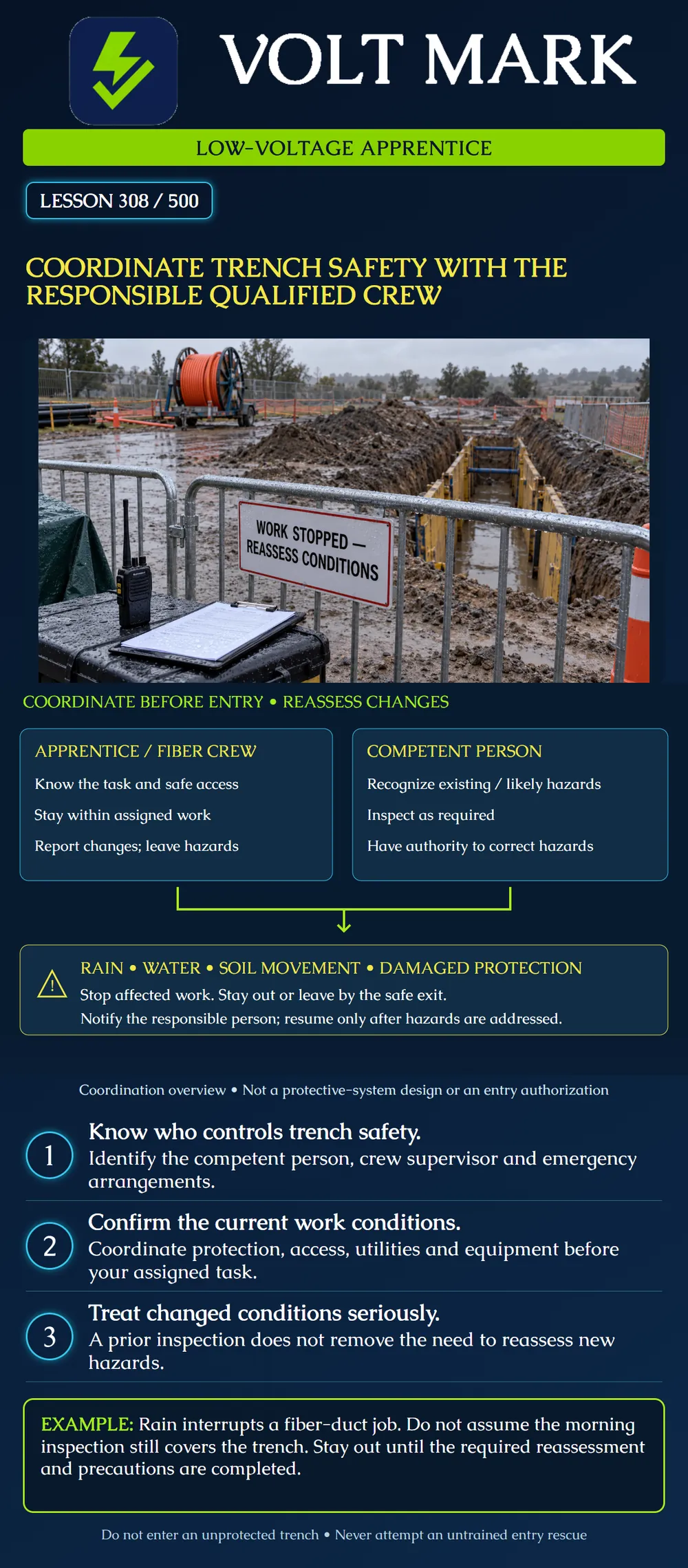
The two panels describe complementary roles, not a transfer of responsibility. Apprentices understand their assignment and access route, remain within the work plan and report changing conditions. The competent person evaluates hazards, performs required inspections and has corrective authority.
The lower panel is a change-response reminder. Rain, accumulating water, soil movement or damaged protection require attention. Stay out, or leave the hazardous area using the safe exit, and notify the responsible person. A poster cannot confirm that an excavation is currently safe.
OSHA requires competent-person inspections before work, as needed during the shift, and after rainstorms or other hazard-increasing occurrences when exposure is reasonably anticipated. When hazardous conditions are found, exposed workers must be removed until precautions ensure safety.
For trenches at least 4 feet deep, federal rules require safe egress with no more than 25 feet of lateral travel. That is a recognition point, not a reason to omit safe access in other circumstances. Utilities, falling loads, water and atmospheric hazards also require controls appropriate to the work. The employer must determine the applicable federal or state-plan requirements.
The federal cave-in rule requires an adequate protective system unless the excavation is entirely in stable rock, or it is less than 5 feet deep and a competent person's ground examination shows no potential cave-in. Therefore, “under five feet” alone is not a clearance to enter.
A trench shield and shoring are not the same thing. A shield is designed to protect people within it from cave-in forces; shoring supports the excavation sides. Neither is permission to ignore access, water, utilities or other hazards. Selection, placement, limitations and use must follow the applicable protective-system requirements. Apprentices must not remove braces or work outside the designated protected area to reach a cable.
You arrive to label a duct that will eventually carry campus fiber. The planned work is at the surface. Another worker asks you to step into the excavation for a photograph because “the inspector was here this morning.” During lunch, rain occurred and water is now visible.
A suitable response is: “Conditions have changed. I will stay out and contact the person responsible for excavation safety.” Report the exact location and what you observed without approaching an unstable edge. The responsible crew evaluates conditions and determines necessary controls before work resumes. Your camera task does not justify exposure.
For discussion, change the scenario: the access route is blocked by stored material, or a protective component appears damaged. Identify the affected task and notify the supervisor and competent person. Do not improvise access by climbing the trench wall or use equipment as an unauthorized lift.
On a training worksheet, record these questions and the actual responsible person's answer:
This worksheet is a communication exercise, not an entry permit or complete inspection checklist. Unknown answers should be resolved before the affected task proceeds.
If a collapse occurs, activate the site's emergency response and call emergency services. Do not enter an unstable excavation to attempt an untrained rescue. Keep others from entering and provide location and incident information from a safe position. Professional rescue resources and the site plan control the response.
OSHA 29 CFR 1926.650(b), excavation definitions: https://www.osha.gov/laws-regs/regulations/standardnumber/1926/1926.650 Used for competent person, shield and shoring distinctions.
OSHA 29 CFR 1926.651(c)(2), (k), and related hazard provisions: https://www.osha.gov/laws-regs/regulations/standardnumber/1926/1926.651 Used for egress, inspections and removal from hazardous areas. This lesson does not reproduce a complete excavation procedure.
OSHA 29 CFR 1926.652(a) and (c): https://www.osha.gov/laws-regs/regulations/standardnumber/1926/1926.652 Used for cave-in protection and the precise limited exceptions. No slope configuration or support design is supplied.
OSHA, Trenching and Excavation Safety fact sheet: https://www.osha.gov/sites/default/files/publications/TRENCH_EXCAVATION_FS.pdf Used for recognition of federal or comparable state-plan requirements.
Texas journeyman, 15 questions, scored by topic against the 70% mark. No card, and no account needed to start.
Free study material for low-voltage apprentices. This is a national foundation course: requirements differ by state and by local jurisdiction, and a practice that is common in one place is not a rule everywhere. Nothing here is a licence, a certification, or authority to work unsupervised, and completing it does not count as apprenticeship hours or continuing-education credit. Check the codes adopted where you are working, the licensing authority for that work, and your employer's safety programme. VoltMark is not affiliated with, endorsed by, or sponsored by NFPA, OSHA, NICET, BICSI, FOA, or any state or local licensing authority.

Electrician licensing exam prep: practice questions, timed exam simulations, and step-by-step help finding every answer in the NEC.