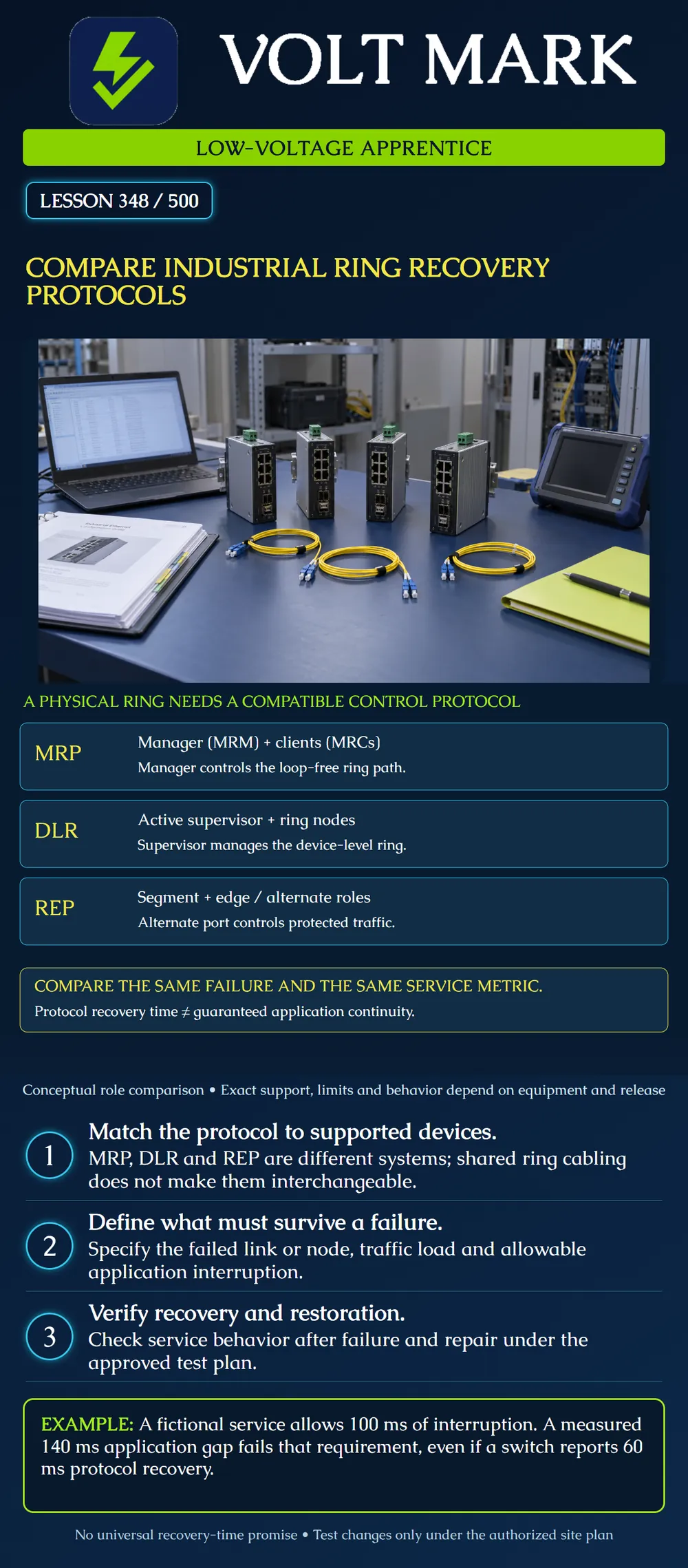
Compare the roles and evidence needed for MRP, DLR and REP, and distinguish network recovery measurements from the service interruption experienced by an application.
Connecting devices in a physical Ethernet ring does not by itself establish a safe, resilient forwarding topology. A compatible protocol and correct configuration must control loops and handle the intended failure cases. The glass links provide the physical paths; they do not select a recovery protocol.
MRP means Media Redundancy Protocol. The documented ring uses a Media Redundancy Manager and Media Redundancy Clients. In a healthy ring, the manager blocks a ring port for normal traffic to prevent a forwarding loop; behavior changes when the ring fails [1]. Manager capability and client capability are distinct support questions.
DLR means Device Level Ring. An active ring supervisor manages the ring and blocks ordinary traffic on one ring port in normal operation while protocol traffic performs its required functions [2]. Confirm which devices can supervise and which can participate as ring nodes. Do not assume that two Ethernet ports alone establish DLR capability.
REP means Resilient Ethernet Protocol. Cisco documents it as a proprietary protocol using segments, edge roles and an alternate port to control loops and respond to failures [3]. Traffic and VLAN arrangements affect the detailed configuration. It is not simply another name for MRP or DLR.
Imagine four nodes A, B, C and D connected around a ring: A–B–C–D–A. With a suitable configured protocol, a single failed B–C link leaves a physical path B–A–D–C. Whether the required service recovers within its limit still depends on the system. If A–B and C–D both fail, the remaining physical connections are A–D and B–C. The ring is split into two groups. A recovery protocol cannot create a missing physical path. If node B loses power, devices served only by B may remain unavailable even if communications among surviving ring nodes recover. Keep node survival separate from path recovery.
For every candidate, record the exact product identifiers, software releases, supported roles, topology restrictions, ring size, interface requirements and application needs. Then identify what a published recovery claim actually covers: failure type, detection method, node count, load and measurement endpoints. Do not treat a nominal protocol figure from one test as a guarantee for an unrelated plant application. Restoration after a repaired link may also affect forwarding and should be included in the approved verification plan.
The fictional application requirement allows no more than 100 ms of interruption for the defined single-link failure. One test record reports a 60 ms protocol recovery event, while the application monitor records a 140 ms gap. The application result exceeds the requirement by 140 − 100 = 40 ms. It fails the stated exercise criterion even though the protocol figure is shorter. A second fictional test records a 90 ms application gap. That is 10 ms below the limit in that particular test. It is favorable evidence for the stated conditions, not proof of all failure cases or zero packet loss. These numbers are original classroom inputs. They are not MRP, DLR or REP performance specifications.
A procurement sheet describes every candidate as “industrial Ethernet with two fiber ports.” One supports only a client role in the desired protocol; another supports the required management role; a third does not list that protocol for its supplied release. The optical ports do not resolve those differences. Mark the client-only unit as unable to fill the required management role based on the supplied packet. Record the unsupported or undocumented release as unresolved until exact support evidence is obtained. Do not mix protocols on the same ring ports by assumption.
Mistake: Comparing a 60 ms protocol event directly with the application interruption limit. Correction: Use the specified application observation: a 140 ms gap exceeds the fictional 100 ms limit by 40 ms.
Mistake: Assuming two fiber ports establish the manager or supervisor role required by the ring. Correction: Verify the exact protocol role, hardware and software support for each node before approving the topology.
Mistake: Treating successful single-link recovery as proof against two cuts or a failed endpoint. Correction: List the covered failure and surviving physical path; keep multi-failure and endpoint-loss cases separate.
[1] Cisco, Media Redundancy Protocol Configuration Guide for IE 2000, IE 4000, IE 4010 and IE 5000: https://www.cisco.com/c/en/us/td/docs/switches/connectedgrid/cg-switch-sw-master/software/configuration/guide/mrp/b_mrp_ie.html [2] Rockwell Automation, EtherNet/IP Device Level Ring Application Technique: https://literature.rockwellautomation.com/idc/groups/literature/documents/at/enet-at007_-en-p.pdf [3] Cisco, Configuring Resilient Ethernet Protocol, Catalyst 9500 IOS XE 26.x: https://www.cisco.com/c/en/us/td/docs/switches/lan/catalyst9500/software/release/26-x/configuration_guide/lyr2/b_26x_lyr2_9500_cg/configuring_resilient_ethernet_protocol.html Primary indexed excerpts inspected 2026-10-01 for role and loop-control concepts only. These platform-specific sources do not establish support on every industrial switch. No numerical recovery guarantee or configuration command is imported. Original scenarios and calculations are independent classroom exercises.
Texas journeyman, 15 questions, scored by topic against the 70% mark. No card, and no account needed to start.
Free study material for low-voltage apprentices. This is a national foundation course: requirements differ by state and by local jurisdiction, and a practice that is common in one place is not a rule everywhere. Nothing here is a licence, a certification, or authority to work unsupervised, and completing it does not count as apprenticeship hours or continuing-education credit. Check the codes adopted where you are working, the licensing authority for that work, and your employer's safety programme. VoltMark is not affiliated with, endorsed by, or sponsored by NFPA, OSHA, NICET, BICSI, FOA, or any state or local licensing authority.

Electrician licensing exam prep: practice questions, timed exam simulations, and step-by-step help finding every answer in the NEC.