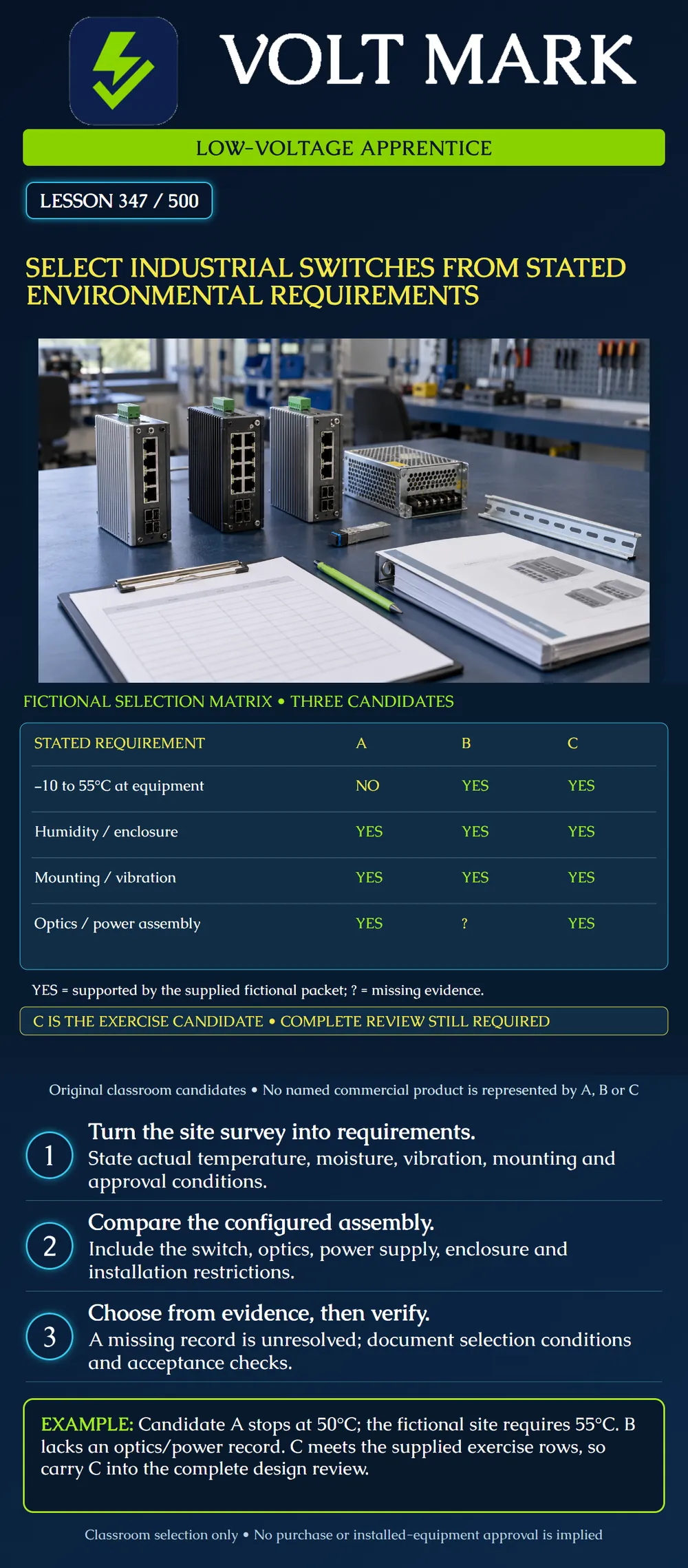
Use a requirement-by-requirement matrix to identify a supported switch candidate while distinguishing failed requirements, missing evidence and final installation approval.
The survey should become a written requirement set. Specify where each environmental condition applies: at the equipment, along the cable route, inside an enclosure or at exposed connectors. Include the operating states and uncertainties established by the survey. An attractive product description cannot fill missing site requirements.
Cisco’s IE3100 Rugged data sheet distinguishes operating-temperature ranges by cabinet arrangement and lists humidity, shock/vibration and approval information separately [1]. Its installation guide also addresses the environment around the unit, cabinet temperature, access and mounting [2]. These are examples of the documents to reconcile, not a claim that all industrial switches share the same limits. If documents appear inconsistent, resolve the issue with the responsible designer or manufacturer for the exact configuration. Do not choose the most generous isolated number.
Everything below describes fictional candidates, not Cisco products. The site requires operation from −10 to 55°C at the equipment in a defined sealed enclosure. Its documented humidity range is 20 to 85 percent RH, noncondensing. The packet includes an identified mounting drawing and a vibration profile named VP-1. Exact compatible optics and power supplies must be documented for the same conditions. For this exercise, the site’s classification review identifies the proposed position as unclassified. That supplied fact is not a classification made by the apprentice. The enclosure and material-compatibility requirements are already defined in the fictional project documents. Networking requirements include the specified optical interfaces, application functions and capacity. The poster abbreviates the packet into four rows; it is not an exhaustive procurement checklist.
Its fictional assembly evidence covers 0 to 50°C. The other displayed rows have supporting records. The required −10°C lower endpoint is 10°C below its lower limit. The required 55°C upper endpoint is 5°C above its upper limit. Mark the temperature row NO. Passing other rows cannot cancel this mismatch. Do not average scores or count the number of favorable rows to approve A.
The fictional host is documented for −20 to 60°C under the stated enclosure conditions. The humidity, mounting and vibration records match the supplied requirements. However, the exact optical module and power-supply configuration are not documented. Mark the optics/power row “?” rather than YES or an invented technical failure. B may become a viable candidate if suitable evidence is supplied, but the present packet is incomplete.
The fictional packet supports the complete proposed assembly from −20 to 60°C under the stated enclosure conditions. It documents the required humidity, enclosure, mounting and VP-1 compatibility, together with the specified optical module and power supply. C has supported answers for the displayed rows. Carry C forward as the exercise candidate for complete design review. The matrix does not prove installation quality, service performance or every requirement outside the abbreviated rows. At the upper endpoint, 60 − 55 = 5°C separates the supplied limit from the requirement. At the lower endpoint, −10 − (−20) = 10°C. Those arithmetic differences are not independently established design margins.
The site requirement is revised to include 65°C at the equipment. C’s fictional upper limit remains 60°C. The previous temperature YES no longer holds: 65 − 60 = 5°C above the supplied limit. Reopen the selection. Do not silently reuse the original result or assume a different cooling arrangement is authorized. Any proposed environmental mitigation needs its own design and evidence.
Confirm the exact switch, firmware or feature dependencies, optical interfaces, loss/reach design, power arrangement, enclosure, mounting, clearances, cable entries and applicable approvals. Record the document revision supporting each conclusion. Then define installation inspections and service tests appropriate to the intended system. A requirement matrix helps select a candidate; an acceptance record documents whether the installed system meets the agreed requirements. Keep those records distinct.
Mistake: Approving Candidate A by counting its favorable rows. Correction: Treat the temperature mismatch as unresolved design failure; other passing requirements do not compensate for it.
Mistake: Calling Candidate B incompatible when only its optics and supply evidence are absent. Correction: Mark those configuration requirements unknown and obtain the missing documents before deciding compatibility.
Mistake: Reusing Candidate C's favorable result after the required temperature becomes 65°C. Correction: Reopen the temperature comparison: the requirement is now 5°C above the supplied 60°C limit.
[1] Cisco Catalyst IE3100 Rugged Series Data Sheet, compliance and operating environment: https://www.cisco.com/c/en/us/products/collateral/networking/industrial-switches/catalyst-ie3100-rugged-series/catalyst-ie3100-rugged-series-ds.html [2] Cisco Catalyst IE3100 Rugged Series Switches Hardware Installation Guide, Switch Installation: https://www.cisco.com/c/en/us/td/docs/switches/lan/cisco_ie3100/installation/ie3100-hw-install-guide/m-ie3100-switch-installation.html Primary HTML inspected 2026-10-01. Sources support checking configuration-dependent ratings and installation instructions. All A/B/C ratings, site conditions and VP-1 references are original fictional exercise inputs; they are not manufacturer specifications.
Texas journeyman, 15 questions, scored by topic against the 70% mark. No card, and no account needed to start.
Free study material for low-voltage apprentices. This is a national foundation course: requirements differ by state and by local jurisdiction, and a practice that is common in one place is not a rule everywhere. Nothing here is a licence, a certification, or authority to work unsupervised, and completing it does not count as apprenticeship hours or continuing-education credit. Check the codes adopted where you are working, the licensing authority for that work, and your employer's safety programme. VoltMark is not affiliated with, endorsed by, or sponsored by NFPA, OSHA, NICET, BICSI, FOA, or any state or local licensing authority.

Electrician licensing exam prep: practice questions, timed exam simulations, and step-by-step help finding every answer in the NEC.