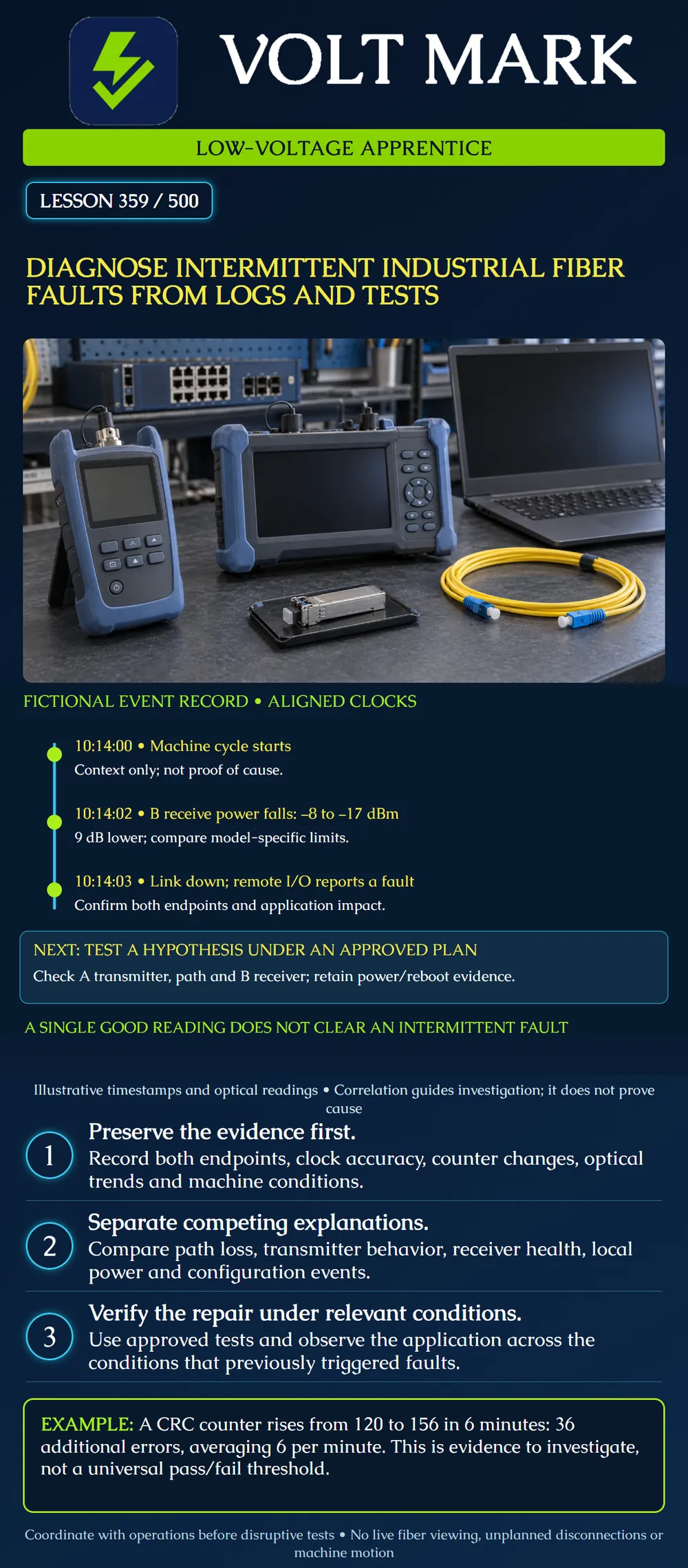
Build a defensible fault hypothesis from time-aligned evidence, choose an authorized test that distinguishes alternatives, and describe what would demonstrate recovery. This is a classroom exercise, not permission to interrupt an industrial process.
An operator says, “The fiber drops when the machine moves.” Record that statement as a report, then ask what actually stopped: physical link, a network service, or application updates? A link can remain up while an application faults. A down/up indication confirms a transition, but does not identify the defective component. Draw the affected path and identify both endpoint ports, transceiver models, intermediate connections and local power supplies.
Preserve the original logs and counter values before resets, swaps or reboots erase useful information. In an approved evidence worksheet, record device identity, time zone, synchronization status, event timestamp, collection time and sampling interval. A timestamp printed to milliseconds does not establish millisecond accuracy. If device clocks differ by several seconds, events close together cannot be confidently ordered without additional evidence. Obtain approved exports rather than experimenting with unfamiliar production commands.
Cisco's Catalyst 9000 troubleshooting guidance uses link-event logs, interface counters, supported optics and DOM readings to investigate flaps. DOM availability depends on the equipment. Its procedures and commands are product-specific. Do not transfer them automatically to an industrial switch of another family. Copper TDR is not a fiber test. Manufacturer optical limits apply to the identified module and operating conditions.
The poster assumes aligned clocks for a simplified example: 10:14:00 — a machine cycle begins. 10:14:02 — B's reported receive level changes from −8 dBm to −17 dBm. 10:14:03 — the link goes down and remote I/O reports a communication fault.
The receive reading is 9 dB lower: −17 − (−8) = −9 dB. A dBm reading is an absolute power level referenced to 1 mW; the difference is in dB. Do not call this “9 dBm of cable loss.” The observation alone cannot separate A's transmitter change, an optical-path change, or B's measurement/receiver problem. Sampling may also miss short events. No sensitivity or overload limits are supplied, so the worksheet cannot claim that either value passes a particular receiver specification.
H1: Motion affects an optical path. Seek a documented route/motion association and an approved inspection of strain, bends and the cable assembly's intended motion service. A repeated timing association strengthens a lead but remains insufficient to identify a damaged location. H2: A's transmitter or local supply changes. Compare available transmitter telemetry, voltage/power alarms and reboot history. A simultaneous reboot is evidence for a different branch of investigation. H3: B's receiver, optic or host has a fault. Compare supported diagnostics and an approved controlled substitution plan. Change one documented variable at a time when practical. H4: The application problem is independent of optical loss. Review the separate application and network records. A recovered physical link does not demonstrate restored control behavior.
FOA's network troubleshooting discussion shows that optical performance can involve issues beyond simple cable attenuation, including reflected light and receiver overload. Consequently, “more received power is always better” is not an acceptance rule.
State the question first. A correctly configured power measurement addresses optical level; a suitable insertion-loss test addresses the installed path; an appropriately configured OTDR can help locate optical events. They are not interchangeable conclusions. Instrument setup, wavelength, reference conditions, launch/receive arrangements and interpretation belong in the approved test method. Preserve baseline files and identify the tested strand and direction. Do not attach an instrument to an active industrial link merely to complete this exercise. Do not look into a fiber or connector; use an approved inspection method after following the site's optical safety process.
Assume no counter reset or rollover. A CRC count increases from 120 to 156 in six minutes. Increase = 156 − 120 = 36. Average = 36 / 6 = 6 errors per minute. This does not show that errors were evenly distributed. Without packet totals it is not a packet error percentage. If the counter restarted, the subtraction may be invalid. Acceptance must follow the actual service and equipment criteria.
A proposed repair needs a controlled work window, owner, rollback conditions and agreed observations. Document the changed item, part identity, port and configuration as applicable. Retain before/after records under comparable traffic and machine conditions. Observe application recovery as well as link status. A five-minute quiet period after a cold restart does not resolve a fault historically seen only after several hours of operation. Use a justified monitoring period approved by the responsible team; no universal duration is provided here.
Mistake: Reporting the change from -8 to -17 dBm as 9 dBm of cable loss. Correction: Record a 9 dB decrease in reported received power and investigate transmitter, path and receiver evidence separately.
Mistake: Resetting counters or swapping optics before retaining the intermittent event records. Correction: Preserve timestamps, counter state, device identity and optical readings before authorized changes.
Mistake: Closing a motion-related fault after a short stationary test. Correction: Compare before-and-after service behavior under approved representative machine conditions and the justified observation period.
Cisco, Troubleshoot Port Flaps on Catalyst 9000 Switches: https://www.cisco.com/c/en/us/support/docs/switches/catalyst-9500-series-switches/218397-troubleshoot-port-flaps-on-catalyst-9000.html Scope: opened primary article; logging, counters, supported optics, DOM and copper-only TDR distinctions. No universal industrial command recipe. The Fiber Optic Association, Network Troubleshooting: https://www.thefoa.org/tech/ref/testing/test/network-troubleshooting.html Scope: primary page and indexed content on optical performance, reflectance and overload; no universal loss or receiver thresholds derived. All event data, worksheet cases and arithmetic above are original fictional teaching examples.
Local requirements, site operating procedures and manufacturer instructions govern actual work.
Texas journeyman, 15 questions, scored by topic against the 70% mark. No card, and no account needed to start.
Free study material for low-voltage apprentices. This is a national foundation course: requirements differ by state and by local jurisdiction, and a practice that is common in one place is not a rule everywhere. Nothing here is a licence, a certification, or authority to work unsupervised, and completing it does not count as apprenticeship hours or continuing-education credit. Check the codes adopted where you are working, the licensing authority for that work, and your employer's safety programme. VoltMark is not affiliated with, endorsed by, or sponsored by NFPA, OSHA, NICET, BICSI, FOA, or any state or local licensing authority.

Electrician licensing exam prep: practice questions, timed exam simulations, and step-by-step help finding every answer in the NEC.