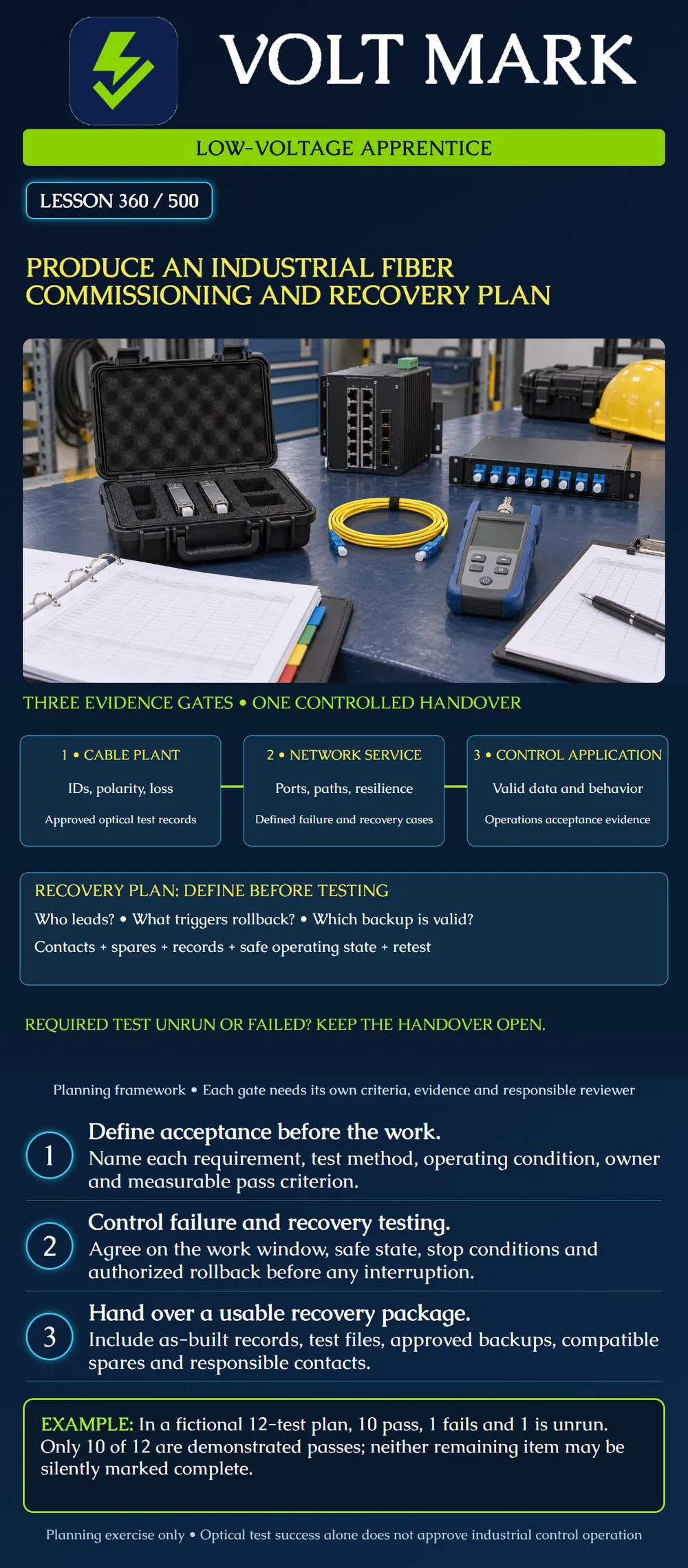
Produce a reviewable commissioning and recovery plan that connects every acceptance requirement to evidence and an accountable owner. This capstone closes the fiber section; it does not grant authority to operate a plant or approve a safety function.
A fictional plant connects PLC-1 and two remote-I/O cabinets through industrial Ethernet equipment. Its fiber routes and port assignments are already designed. You are preparing the plan, not redesigning the network. The plan must preserve the difference between successful optical installation, successful communications and acceptable process behavior.
Use a revision identifier such as PLAN-F1 rev A. List affected systems, drawings, link IDs, software/firmware versions, intended operating modes and exclusions. Name the operations lead, network lead, fiber-test lead and acceptance authority. These are roles to fill with actual authorized people before real work. An apprentice can assemble evidence without becoming the acceptance authority.
Create a row for every required optical test or inspection. Identify endpoints, fiber/strand, direction and wavelength where applicable; cite the approved project specification and test method. Attach instrument identity, relevant calibration status, setup/reference information and original result files. A filename without a reliable strand mapping is weak handover evidence. Compare against the stated design criteria rather than inventing a universal loss limit. Review workmanship and update the route, enclosure and termination records to match the actual installation.
Map the service to its actual ports and equipment. Confirm the approved configuration baseline and supported optics. Define traffic, clocking and redundancy requirements that apply to this design. A redundant drawing is not evidence that the installed system recovers correctly. Specify which single failures are in scope, which shared dependencies remain and what restoration behavior must be checked. Distinguish a switch protocol event from the application's interruption.
Cisco's CPwE physical-infrastructure guidance identifies application factors such as recovery performance, physical layout and latency/jitter tolerance when selecting resilience approaches. Its validated architectures are design references, not proof that this fictional installation passed a test.
The responsible controls/operations team defines valid-data behavior, fault annunciation, restart conditions and acceptable process response. A ping reply is not a completed remote-I/O test. A link-up indication does not establish correct output behavior. Safety-related functions require their own applicable engineering and validation process; this apprentice worksheet cannot certify them.
Requirement R-07: During an authorized simulation of one specified network-link failure, the fictional application must show no interval between successive valid received updates greater than 100 ms and must not restart. The interval is measured at the named application observation point using the approved method. This 100 ms limit is invented for the exercise, not a recommendation for industrial control.
Record: Requirement and revision: R-07, rev A. Test case: TC-07; exact failure and operating mode defined in the approved method. Prerequisites: owners present, approved window, safe operating state, backups checked. Evidence: measurement file, synchronized event records, observer notes. Observed maximum interval: 126 ms. Decision: fail; 26 ms beyond the fictional limit. Follow-up: assigned owner, investigation/change reference, retest required. A later result of 84 ms is 16 ms below the limit for that run. It does not retroactively validate different failure cases or missing evidence.
Before testing, name who may stop the test and who decides whether service can resume. Define conditions that trigger rollback, where the approved baseline and backups are stored, what restoration procedure applies, and how restored behavior is checked. A backup file should have a known device/version relationship and controlled access. A file that has never been assessed for recoverability is not a demonstrated recovery capability.
Prepare a contact roster, escalation path, compatible spare inventory and fiber repair resources appropriate to the site. Identify access arrangements, route/strand documentation, enclosure records and baseline test files. FOA's restoration guidance emphasizes retained component information, fiber identification, test records and responsibility for keeping documentation current. The plan must be tailored to the actual network.
Do not casually disconnect a live control link to “prove the ring.” A real test requires the operations-approved method, safe state and consequences assessment. Do not automatically restore old controller logic because a communications test failed. Configuration recovery has its own scope and authorization.
A fictional plan contains 12 required tests: 10 pass, 1 fails, 1 has not been run. Demonstrated pass fraction = 10/12 = 83.33 percent, rounded to two decimals. Executed tests = 11/12 = 91.67 percent. These percentages answer different questions and neither means acceptance. Do not hide the failed or unrun row by labeling the overall package “complete.” Document unresolved items and apply the agreed acceptance process. No waiver is assumed.
Provide a clear index to requirements, drawings, port/strand maps, test methods, original results, approved configurations, recovery procedures, inventory and responsible contacts. Include revision dates and an owner for updates. Record who received the package and who accepted which scope. Cable-plant acceptance and operational acceptance can have different responsible parties.
FOA's installation checklist places test-data review, communications-system testing, documentation updates and restoration planning in the project closeout process. Our three-gate worksheet is an original teaching structure for organizing that work; it is not presented as a mandated national form.
Mistake: Calling commissioning complete because cable-plant tests pass while TC-07 fails. Correction: Keep the three acceptance scopes separate and retain the 126 ms application's failure against its 100 ms criterion.
Mistake: Reporting 11 executed tests as 11 passes. Correction: Record 10 passed, one failed and one unrun; the execution fraction does not resolve either open requirement.
Mistake: Writing 'restore the backup' without identifying its scope or validation. Correction: Specify the approved baseline, responsible owner, restoration procedure and checks of restored application behavior.
FOA, Installation Checklist: https://www.thefoa.org/tech/ref/install/checklist.html FOA, Fiber Optic Restoration: https://www.thefoa.org/tech/ref/restoration/rest.html Cisco, Physical Infrastructure for Converged Plantwide Ethernet: https://www.cisco.com/c/en/us/td/docs/sanity/suman/CPwE-Physical-Infrastructure_Feb2023.html Scope: authoritative indexed excerpts used for closeout, restoration documentation and application-specific resilience considerations. No claim of reviewing a complete project standard or validating a production design. Cases, thresholds, arithmetic and worksheet structure are original classroom examples.
Applicable requirements and manufacturer instructions govern actual work.
Texas journeyman, 15 questions, scored by topic against the 70% mark. No card, and no account needed to start.
Free study material for low-voltage apprentices. This is a national foundation course: requirements differ by state and by local jurisdiction, and a practice that is common in one place is not a rule everywhere. Nothing here is a licence, a certification, or authority to work unsupervised, and completing it does not count as apprenticeship hours or continuing-education credit. Check the codes adopted where you are working, the licensing authority for that work, and your employer's safety programme. VoltMark is not affiliated with, endorsed by, or sponsored by NFPA, OSHA, NICET, BICSI, FOA, or any state or local licensing authority.

Electrician licensing exam prep: practice questions, timed exam simulations, and step-by-step help finding every answer in the NEC.