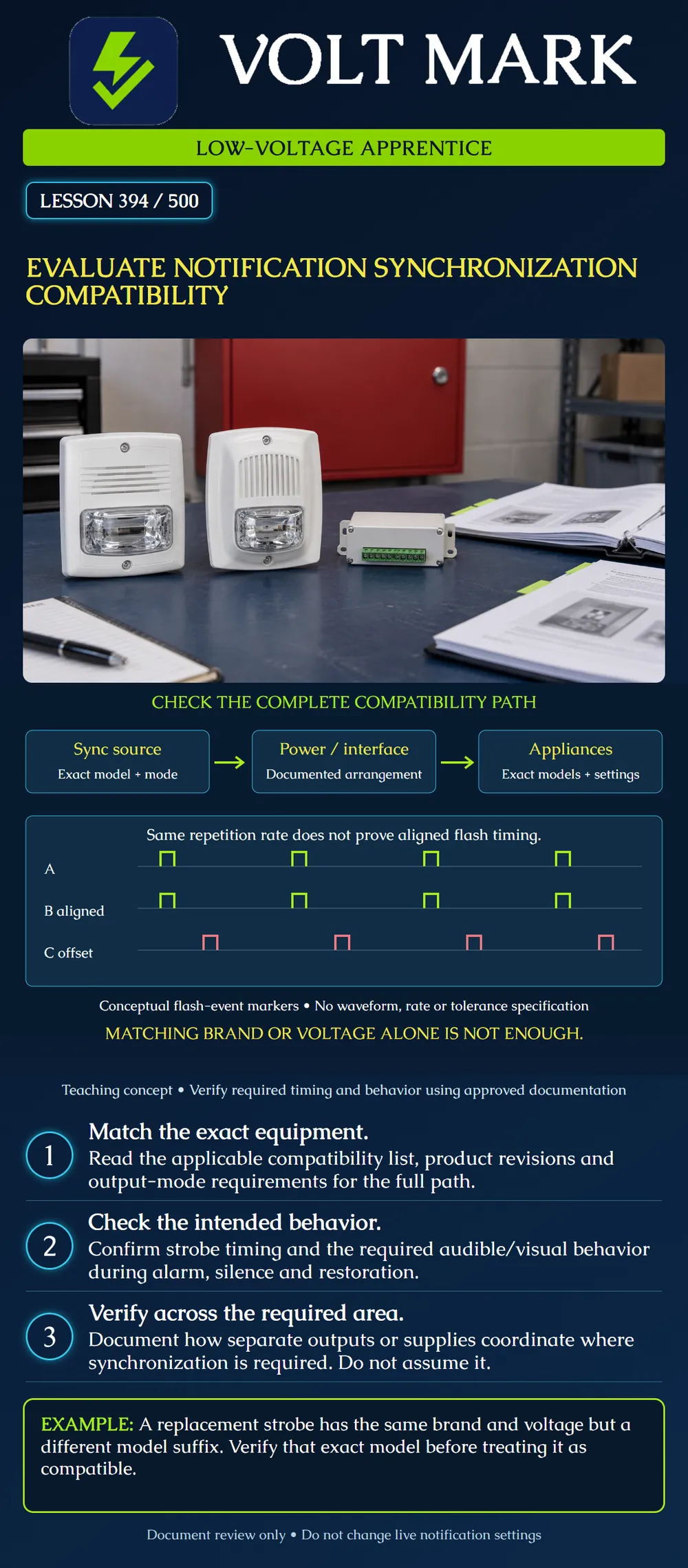
Trace the full synchronization arrangement and verify exact equipment compatibility. Distinguish matching repetition rates from aligned timing, and distinguish strobe synchronization from the required behavior of audible notification.
The Altronix AL602ULADA installation guide includes a synchronization-mode table and an appendix naming compatible appliance models. Its notes state that appliances must have synchronization capability and that the same synchronization mode must be selected for all its outputs. Those are model-specific conditions; support for several named protocols does not mean this unit permits a different protocol on every output.
The appendix lists model designations and variants, demonstrating why a brand name alone is insufficient evidence. Verify the applicable documentation for the equipment revision in use rather than treating this lesson as a replacement compatibility list.
On the review drawing, identify where the required timing originates. Then follow the documented path to every affected output. If there is an expander, interface or synchronization module, record its function and operating mode.
Ask whether it generates timing or follows an upstream signal in the specified arrangement. Do not assume a device does both simultaneously. An added supply creates a new question about coordination; its presence alone does not establish it.
Record which notification areas and outputs must coordinate according to the approved design and applicable requirements. Devices sharing a required synchronization area may be fed from different circuits. Conversely, a circuit label by itself does not establish the complete visual relationship of the spaces served.
Imagine four abstract observation slots on a classroom timeline. Row A has events at positions 0, 10, 20 and 30. Row B has events at positions 0, 10, 20 and 30. Row C has events at positions 3, 13, 23 and 33.
All three rows have an interval of 10 arbitrary units between successive events. B has zero offset from A in this example. C has an offset of 3 units from A. Equal intervals therefore do not prove alignment.
These are arbitrary positions, not seconds or a prescribed test tolerance. The exercise teaches the difference between repetition and relative timing. Use the applicable documented verification criteria for real appliances.
Record the intended audible and visual responses separately. A system's silence function may have specific requirements for horns and strobes; a learner should not assume that stopping one must stop the other, or that one generic silence command describes every arrangement.
Identify the expected alarm, silence, resound and restoration behavior in the approved system documentation. Keep temporal audible coding, voice messages and visible flash timing distinct in the review record. A visually aligned pair of strobes does not establish correct audible behavior.
An original classroom schedule calls for appliance model “Example-S1.” A proposed replacement is “Example-S1X.” These are invented identifiers. The contractor states that they share a brand and nominal voltage.
A useful review asks for the exact replacement's compatibility evidence, applicable settings, current draw and other required characteristics. An extra suffix may or may not matter; do not decide from the name alone. If the evidence is absent, mark compatibility unresolved rather than asserting either universal compatibility or definite incompatibility.
If the substitute is accepted through the responsible process, update the schedule and related calculations. Matching the protocol does not automatically resolve loading, voltage drop, candela, sound output, mounting or supervision.
For each of three proposed output arrangements, require four evidence categories:
There are 3 x 4 = 12 category records. If two arrangements have all four records and the third has only three, the file contains 4 + 4 + 3 = 11, leaving one unresolved.
This count is not a compliance score. Eleven records do not compensate for a missing critical compatibility condition. Also, a complete folder can still contain incorrect evidence; review relevance and revision, not just presence.
Identify the affected outputs and spaces, source and interface models, appliance list, configuration references, expected behavior, supporting documents and responsible review disposition. Keep proposed settings distinguishable from confirmed installed settings.
This lesson is completed on drawings and documentation. Do not trigger an occupied building's notification appliances, change operating modes or attempt synchronization adjustments as part of the exercise. Any actual verification must follow the site's approved process.
Consulted October 1, 2026; opened: Altronix AL602ULADA Installation Guide, cover revision 111519, printed page 5 and Appendix A: https://www.altronix.com/library/pdf/installation_instructions/AL602ULADA_DIP.pdf Altronix official product page, used to locate the current linked documentation: https://www.altronix.com/products/AL602ULADA The linked application guide was also opened as a document reference; no additional interconnection limits are asserted from it: https://www.altronix.com/library/pdf/installation_instructions/AppGuide_AL602_802_1002ULADAJ(R).pdf
The diagram, abstract timing exercise and evidence-count exercise are original. No universal synchronization tolerance, flash rate or cross-brand approval is claimed.
Mistake: Calling equal flash intervals proof of synchronized timing. Correction: Compare relative event positions as well as repetition intervals; row C retains the three-unit offset in this exercise.
Mistake: Approving compatibility from brand and nominal voltage alone. Correction: Check the complete source, interface, mode and exact appliance model against the applicable compatibility documentation.
Mistake: Assuming a supply that supports several protocols can mix them freely across outputs. Correction: Read the equipment's mode restrictions and document the complete required arrangement.
Texas journeyman, 15 questions, scored by topic against the 70% mark. No card, and no account needed to start.
Free study material for low-voltage apprentices. This is a national foundation course: requirements differ by state and by local jurisdiction, and a practice that is common in one place is not a rule everywhere. Nothing here is a licence, a certification, or authority to work unsupervised, and completing it does not count as apprenticeship hours or continuing-education credit. Check the codes adopted where you are working, the licensing authority for that work, and your employer's safety programme. VoltMark is not affiliated with, endorsed by, or sponsored by NFPA, OSHA, NICET, BICSI, FOA, or any state or local licensing authority.

Electrician licensing exam prep: practice questions, timed exam simulations, and step-by-step help finding every answer in the NEC.