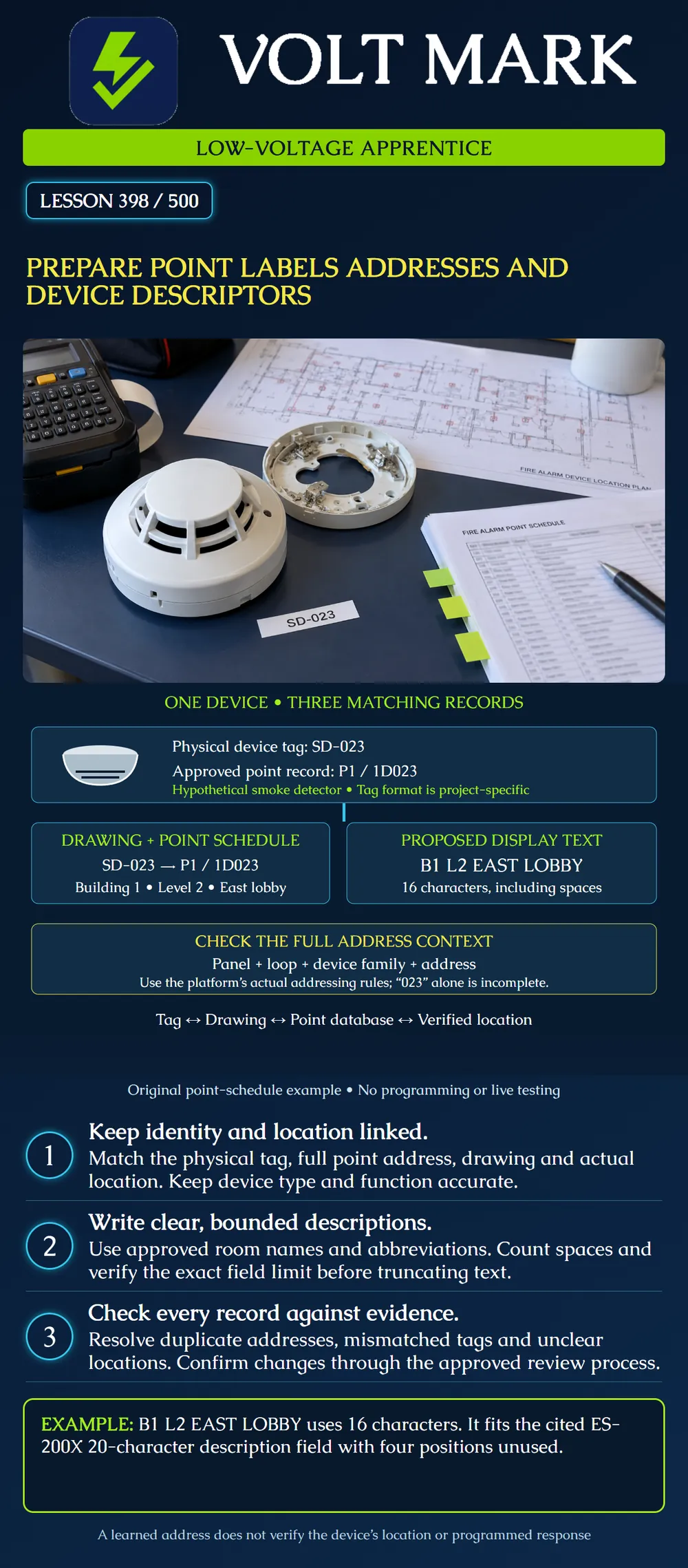
Prepare a coordinated device identity record: physical tag, full point address, drawing reference and useful location description. Check that a reader can find the intended device without confusing its address, location and assigned function.
A physical tag identifies equipment on the project. A point address identifies a device or point within the control system's addressing scheme. A descriptor supplies human-readable information such as location. These are related, but one does not automatically supply the others.
A hypothetical smoke detector has tag SD-023. Its schedule associates it with panel P1 and point 1D023. Its full location is Building 1, Level 2, East lobby. The proposed short description is B1 L2 EAST LOBBY. These names are exercise data, not a required nationwide labeling convention or a real installation record.
The Fire-Lite ES-200X Series Manual, LS10131-000FL-E:F, May 23, 2022, describes point notation with loop, detector designation and numeric address. Its device description fields allow 20 characters including spaces. It distinguishes detector and module capacity and describes reporting duplicate addresses during auto-programming. These are product-specific facts; confirm the installed platform, firmware and exact field. A screen's total character capacity is not necessarily a single description field's limit.
In the classroom schedule, P1 identifies the panel. The example point follows the cited product's loop/device notation. Do not reduce the entire record to 023. On a system with multiple panels, loops or address families, the same numeric suffix can occur in different valid contexts. Conversely, two devices assigned the same full identity within a namespace can create a conflict.
Apply the actual manufacturer's addressing rules. Some products have multiple points or consume multiple addresses, and not every platform separates device families in the same way. A software zone, a network node and an individual field-device address are not automatically the same identifier. Retain these as distinct fields when the design requires them.
For each device, record:
Use the approved project format. Do not replace a manufacturer's serial number or product label with an invented point tag. Plan tag placement and materials according to the product instructions and project requirements; do not obscure indicator lights, sensing openings, required markings or service access.
“SMOKE” says little about location. “EAST LOBBY” may still be ambiguous on a campus. A useful descriptor retains the distinctions needed to locate the correct device. Building and floor information may be essential. Use the same room names shown on the approved plans and used by the facility.
Abbreviations need a shared meaning. In this exercise B1 means Building 1 and L2 means Level 2. If a site uses B1 for Basement 1, that abbreviation is unsuitable until the naming standard resolves the conflict. Do not assume a character count alone makes wording clear.
Do not quietly truncate a long phrase if doing so removes the room number, floor or direction that distinguishes two devices. Draft a shorter, approved expression and check its meaning with the responsible reviewer.
B1 L2 EAST LOBBY: B1 = 2 characters. Three spaces = 3 characters. L2 = 2 characters. EAST = 4 characters. LOBBY = 5 characters. Total: 2 + 3 + 2 + 4 + 5 = 16. Against the cited 20-character field: 20 − 16 = 4 unused positions.
BLDG1 LEVEL2 EAST LOBBY: 5 + 6 + 4 + 5 letters/digits, plus 3 spaces = 23 characters. It exceeds that example field by 3.
These counts do not validate the vocabulary, device type, room assignment or programming. They only test length. The descriptor must still be reviewed in its actual display context.
Compare the physical tag, point schedule, drawing and database record. A field observation or test record must establish that the actual device matches the intended location and displayed identity through the approved process. Auto-discovery alone cannot know which room a device occupies.
Suppose the schedule shows SD-023 in the east lobby while a drawing places it in the west lobby. Mark the mismatch and obtain an approved correction. Do not change a descriptor merely to hide the disagreement. Preserve the revision and who authorized it. If a label changes, identify every affected record so the drawing, database and field identifier remain coordinated.
A correct descriptor also does not prove correct cause-and-effect behavior. The next lesson addresses that separate relationship. Keep identity validation and response verification linked but distinct.
Create three fictional point records. Make one numeric suffix repeat under a different panel identity, and make another record repeat the same complete identity. Use the selected platform's rules to distinguish a possible valid reuse from a conflict. Then give one record an ambiguous room description. Identify each issue without touching a live system.
Q1. Is SD-023 necessarily the control panel's address syntax?
Q2. Is a numeric suffix alone always enough to identify a point?
Q3. How many spaces are counted in B1 L2 EAST LOBBY?
Q4. Does a successful auto-learn prove the room description?
Q5. May the 20-character limit be applied to every fire-alarm product?
Fire-Lite ES-200X Series Manual, LS10131-000FL-E:F, May 23, 2022; device-description sections, Device Addressing, and Read Status point notation: https://prod-edam.honeywell.com/content/dam/honeywell-edam/hbt/en-us/documents/manuals-and-guides/installation-guides/ba-fire-ES-200X-Manual-LS10131-000FL-E-F.pdf
Identifiers, descriptor wording, schedule and exercises are original. No national tag format or universal address range is asserted.
Mistake: Reducing a point identity to its numeric address suffix. Correction: Retain the relevant panel, loop and device-family context when checking duplicates.
Mistake: Counting letters but omitting spaces in a descriptor field. Correction: Count every stored character; the short example uses 16 positions including three spaces.
Mistake: Truncating a description until its length fits while losing location meaning. Correction: Write an approved shorter description that preserves the building, floor and distinguishing location.
Texas journeyman, 15 questions, scored by topic against the 70% mark. No card, and no account needed to start.
Free study material for low-voltage apprentices. This is a national foundation course: requirements differ by state and by local jurisdiction, and a practice that is common in one place is not a rule everywhere. Nothing here is a licence, a certification, or authority to work unsupervised, and completing it does not count as apprenticeship hours or continuing-education credit. Check the codes adopted where you are working, the licensing authority for that work, and your employer's safety programme. VoltMark is not affiliated with, endorsed by, or sponsored by NFPA, OSHA, NICET, BICSI, FOA, or any state or local licensing authority.

Electrician licensing exam prep: practice questions, timed exam simulations, and step-by-step help finding every answer in the NEC.