Recognize two BACnet network arrangements, trace a message path through a BACnet router, and avoid confusing device identification with network and link addressing.
This is a conceptual topology and document-reading lesson. It does not authorize connecting a laptop to a live controls network, discovering devices, changing addresses, moving conductors, resetting a router or modifying building commands. The diagram omits power, terminal numbers, bias components and terminating resistors. It is not a field wiring drawing.
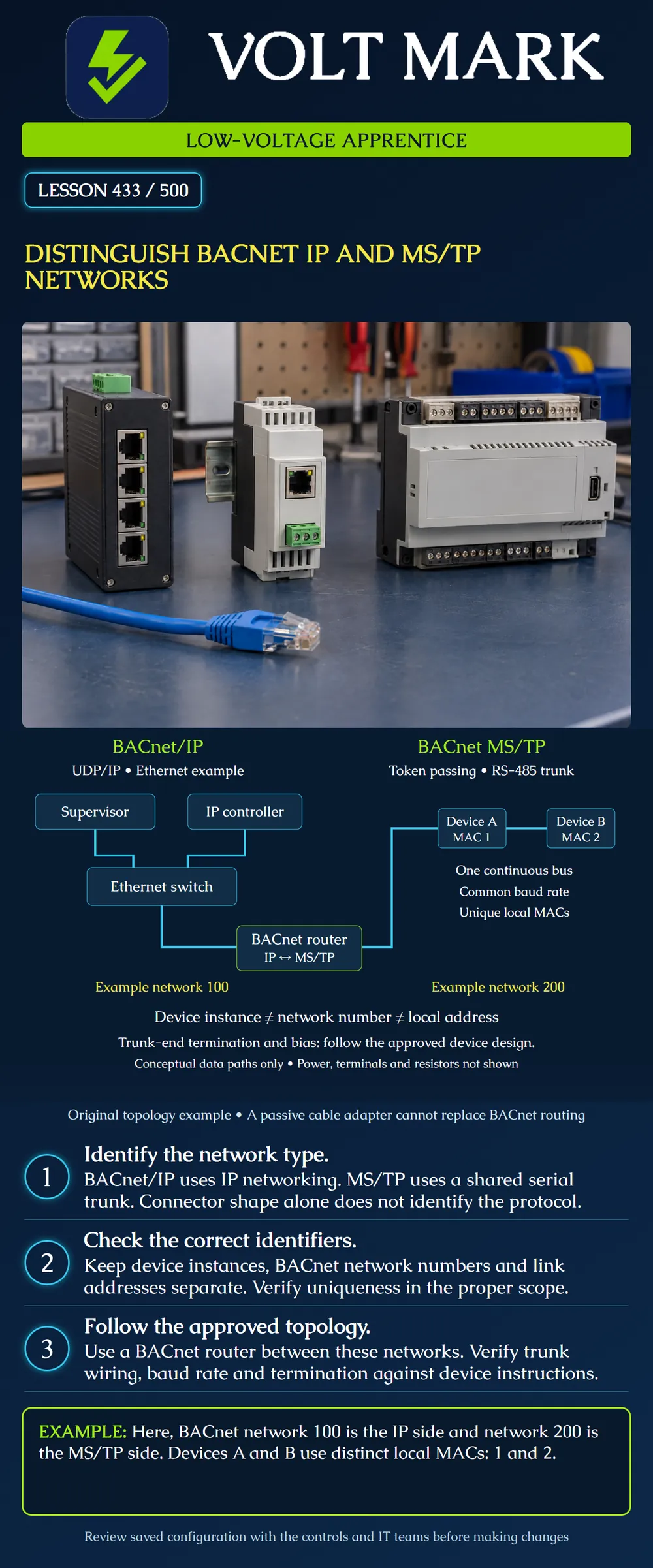
The left side illustrates BACnet/IP carried on a wired Ethernet network. A supervisor and an IP controller each connect to an Ethernet switch. The switch also connects to the IP side of a BACnet router. BACnet/IP uses UDP/IP; the drawing is an Ethernet example, not a statement that every IP transport must use this exact physical arrangement.
The right side illustrates BACnet MS/TP over an RS-485 shared serial trunk. The router and devices share that trunk. Token passing governs access among participating token-passing nodes. The boxes along the line are network connections, not series electrical loads. The drawing does not mean that signal current must pass through a device's internal electronics to reach the next cable section.
BACnet is the communication framework common to both sides. A device's supported link type, services and configuration still matter. An Ethernet connector does not prove BACnet/IP support, and RS-485 hardware alone does not prove MS/TP support.
For this original example, trace a supervisor request toward Device B: Supervisor → Ethernet switch → BACnet router → MS/TP trunk → Device B. The reply travels back through the corresponding networks. The router handles BACnet routing between different link types. It is not merely a passive change of connector.
Device A is attached to the same trunk as Device B. It is not a router that converts Device B's message. The Ethernet switch is also not the BACnet/IP-to-MS/TP router. Keep each component's role explicit.
A controller may contain BACnet routing functionality, so a real project does not always have a separate router box. Identify the documented function rather than requiring the same enclosure arrangement as this poster.
The poster assigns fictional BACnet network number100 to the IP side and200 to the MS/TP side. These numbers identify BACnet networks. They are not IP subnet numbers or device instances.
Device A uses local MS/TP MAC1; Device B uses MAC2. The router also needs an appropriate, nonconflicting MS/TP address, though its value is omitted from the picture. The numbered local MAC is not the Ethernet adapter's familiar six-byte hardware address.
A BACnet device instance identifies a device across the BACnet internetwork. Record it separately from the local link address. The Contemporary Controls manual distinguishes these fields and requires unique device instances within the internetwork, distinct network numbers for the connected BACnet networks and appropriate local MS/TP addressing.
Original inventory exercise: Network100: supervisor device instance1001; IP controller device instance1002. Router: device instance1003, with ports on networks100and200. Network200: Device A instance2001, local MAC1; Device B instance2002, local MAC2.
These are illustrative records only. Do not copy them into equipment. The numbers are chosen to make the fields easy to compare; real sites need not encode network membership into device-instance digits.
On the Ethernet side, review the approved port, cabling, IP assignment, subnet and permitted communication path. On the MS/TP side, review the bus arrangement, cable specifications, signal polarity/reference instructions, common baud rate, allowed device loading, termination and bias.
MS/TP is a shared trunk rather than a set of independent Ethernet switch ports. A star of arbitrary serial branches cannot be assumed acceptable simply because a star of switched Ethernet links is common. Follow the exact manufacturer's network design and any approved repeaters or segmenting equipment.
Termination belongs at the actual segment ends according to the approved design; do not enable it at every device. Bias requirements are also device-dependent. This lesson supplies no universal resistor value, node maximum, trunk distance or baud setting. Those depend on the equipment and design.
A lit Ethernet link indicator is evidence about a physical link. It is not proof that BACnet messages reach the intended device. Serial traffic indication is likewise not proof that every point is correct.
For a read-only review, compare the as-built topology with saved configuration and approved records. If Device B is absent from a saved discovery report, note the observation. It could relate to configuration, routing, physical wiring, power, device state or other conditions. The observation alone does not identify the cause.
A BACnet network number is not interchangeable with an IP subnet. Communication across IP subnets can require planned BACnet broadcast-management arrangements. Coordinate that design with the authorized controls and IT teams rather than adding devices or enabling broadcast features opportunistically. BACnet/SC is a separate secure-connect option and is outside this basic BACnet/IP-versus-MS/TP comparison.
Contemporary Controls BASrouter User Manual, firmware3.0and later, UM-BASRTB03-AA9, copyright2025; introduction, ports and configuration sections: https://www.ccontrols.com/pdf/um/BASrouter-usermanual.pdf Supports router roles, physical-link distinctions and separate addressing fields. Model-specific defaults, node limits and reset instructions are not generalized or reproduced.
ABB AC500 help, Configuration of datalinks: https://help.plc.abb.com/bacnet_configuration_datalinks.html Distinguishes IP and MS/TP datalinks and their configuration, including RS-485 and local MAC uniqueness. Its controller-specific setup behavior is not a universal configuration procedure.
The topology, example numbers, inventory and exercises are original educational material.
Mistake: Using an Ethernet switch or passive connector as an IP-to-MS/TP router. Correction: Identify the documented BACnet routing function that connects the different link types.
Mistake: Resolving a duplicate device instance only by changing a local MS/TP MAC. Correction: Keep device instance, BACnet network number and local MAC separate and check each within its proper scope.
Mistake: Copying an Ethernet star topology onto a serial trunk. Correction: Review the MS/TP physical segment, permitted branches and equipment requirements before proposing the arrangement.
Texas journeyman, 15 questions, scored by topic against the 70% mark. No card, and no account needed to start.
Free study material for low-voltage apprentices. This is a national foundation course: requirements differ by state and by local jurisdiction, and a practice that is common in one place is not a rule everywhere. Nothing here is a licence, a certification, or authority to work unsupervised, and completing it does not count as apprenticeship hours or continuing-education credit. Check the codes adopted where you are working, the licensing authority for that work, and your employer's safety programme. VoltMark is not affiliated with, endorsed by, or sponsored by NFPA, OSHA, NICET, BICSI, FOA, or any state or local licensing authority.

Electrician licensing exam prep: practice questions, timed exam simulations, and step-by-step help finding every answer in the NEC.