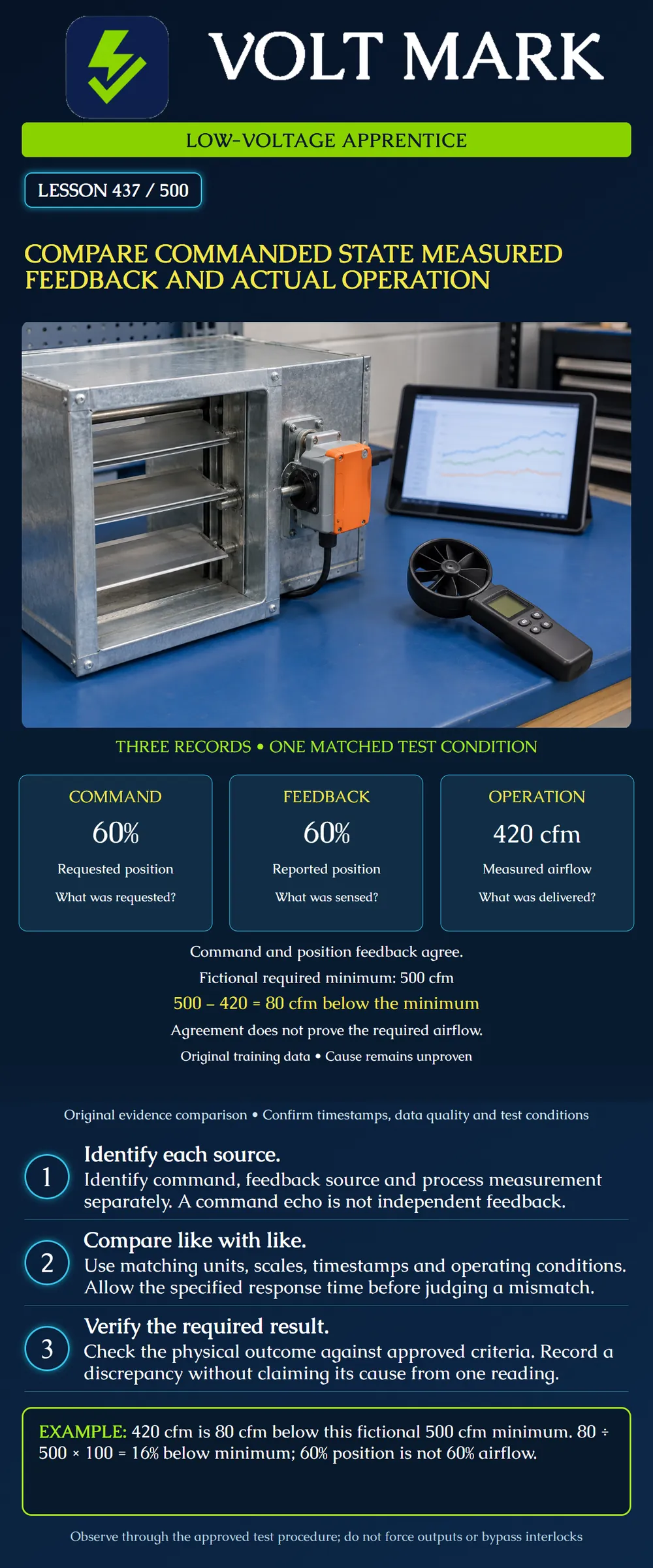
Compare requested state, measured feedback and delivered performance as separate pieces of evidence. Explain why two agreeing display values do not prove that equipment achieved its required result.
This lesson uses fictional saved building-control data. No actuator is moved, no output is forced and no interlock is bypassed. Field observations and measurements must follow the actual approved test procedure. The airflow requirement below is invented for the exercise; it is not a code minimum or a recommendation for any room or building.
A command states what the system requests. Confirm whether the displayed value is the effective command after the applicable logic, priorities and operating mode, or merely an upstream request.
Feedback reports a sensed or calculated condition. Identify its source. A value copied from the command is an echo, not independent position feedback. A point labeled position may indicate the actuator's own position rather than the driven damper blade's actual position.
Actual operation describes the physical outcome relevant to the requirement. For this lesson's example, that outcome is delivered airflow. Other projects may require verified movement, pressure, temperature response or another defined result. Name the result instead of writing only equipment works.
The original training record assumes matched test conditions, usable data quality, adequate specified settling time and an approved airflow measurement method.
Effective position command:60%. Reported actuator position feedback:60%. Measured delivered airflow:420cfm. Fictional required minimum under this particular test condition:500cfm.
The first two records agree numerically. The delivered airflow is80cfm below the stated minimum: 500−420=80cfm. Relative shortfall against that minimum: 80/500×100=16%.
The position percentage and airflow are different quantities. Do not subtract60%from420cfm, or interpret60%position as60%of design airflow.
An appropriate classroom finding is: Command and reported position agree at60%. Measured airflow is420cfm under the recorded condition, below the fictional500cfm minimum by80cfm. Cause not established.
An inappropriate finding is: The actuator has failed. Another inappropriate finding is: Everything passed because command equals feedback.
The recorded mismatch could require review of the measurement, operating conditions, system restrictions, source mapping, equipment response or other factors. The data do not distinguish all possibilities. Record the discrepancy before assigning corrective work.
Belimo's LMB24-SR-T data sheet distinguishes a control input, position feedback, running time and mechanical position indication. These are separate characteristics of that model. They illustrate why the reader must identify a feedback signal's actual meaning instead of treating every return signal as proof of airflow.
Belimo's damper applications guide explains that damper-position-to-flow characteristics are not generally linear, and installed system conditions affect them. The guide also discusses linkage. These concepts support the lesson's distinction between command, mechanism and process outcome. The poster's60%,420cfm and500cfm are original values and are not manufacturer performance data.
A correctly reported actuator position can coexist with an issue elsewhere in the driven assembly or system. Conversely, an apparent feedback mismatch can originate in scaling or data quality. Inspect the evidence needed for the actual question instead of treating the screen as a direct view of every physical component.
A command recorded at10:00:00 and feedback saved before that command change do not represent a settled simultaneous condition. Capture timestamps or an approved synchronized record. Record the operating mode, relevant enabling conditions and elapsed response time.
Do not invent a universal delay. Use the equipment and test requirements. A slowly moving actuator may legitimately lag a new request. A point reported as stale or unavailable must not silently be treated as a fresh measurement.
Likewise, the command and feedback need matching scales. Sixty percent of one configured travel range is not automatically comparable to sixty percent of a different range. Preserve raw readings and conversions where they are needed to reproduce the comparison.
A visible shaft movement establishes an observed movement at that location and time. It does not by itself establish the intended blade travel throughout the assembly, airflow quantity or leakage performance. Record exactly what was observed and how.
An airflow result needs its method, location, instrument identification, relevant quality checks and test condition. This lesson assumes adequate measurement evidence for its arithmetic. On a real project, uncertainty and the approved acceptance method matter when determining pass or fail.
A fan run status deserves the same discipline: identify whether it is a software state, contact, current-based indication or another source. A status label alone does not describe all the physical performance that may need verification.
Use separate fields for: Equipment and point identifiers. Command source and effective value. Feedback source and engineering scale. Physical/process observation and method. Timestamps, quality and operating mode. Required response time and acceptance criterion. Observed difference and unresolved questions. Reviewer and follow-up reference.
Required criteria must come from the approved project documentation. If the minimum or tolerance is missing, record it as missing; do not invent a pass threshold to close the task.
Belimo Damper Actuator Applications Guide, U_11010,02/19; flow characteristics, system effects and linkage: https://www.belimo.com/mam/americas/technical_documents/Support%20material/belimo_damper-applications_guide_en-us.pdf Belimo LMB24-SR-T technical data sheet,2025-12-23: https://www.belimo.com/mam/general-documents/datasheets/en-us/belimo_LMB24-SR-T_datasheet_en-us.pdf
The evidence cards, numerical case, findings and exercises are original. Model-specific source descriptions are not generalized as installation or acceptance requirements.
Mistake: Passing airflow because command and position both read 60%. Correction: Compare the independent flow measurement against its stated criterion; this case is 80 cfm below its minimum.
Mistake: Comparing fresh command with stale feedback as a settled condition. Correction: Match timestamps, quality, scales and required response time before evaluating the difference.
Mistake: Assigning an actuator failure from a process shortfall alone. Correction: Record the measured discrepancy and investigate the relevant measurement, mechanism and system conditions before naming a cause.
Texas journeyman, 15 questions, scored by topic against the 70% mark. No card, and no account needed to start.
Free study material for low-voltage apprentices. This is a national foundation course: requirements differ by state and by local jurisdiction, and a practice that is common in one place is not a rule everywhere. Nothing here is a licence, a certification, or authority to work unsupervised, and completing it does not count as apprenticeship hours or continuing-education credit. Check the codes adopted where you are working, the licensing authority for that work, and your employer's safety programme. VoltMark is not affiliated with, endorsed by, or sponsored by NFPA, OSHA, NICET, BICSI, FOA, or any state or local licensing authority.

Electrician licensing exam prep: practice questions, timed exam simulations, and step-by-step help finding every answer in the NEC.