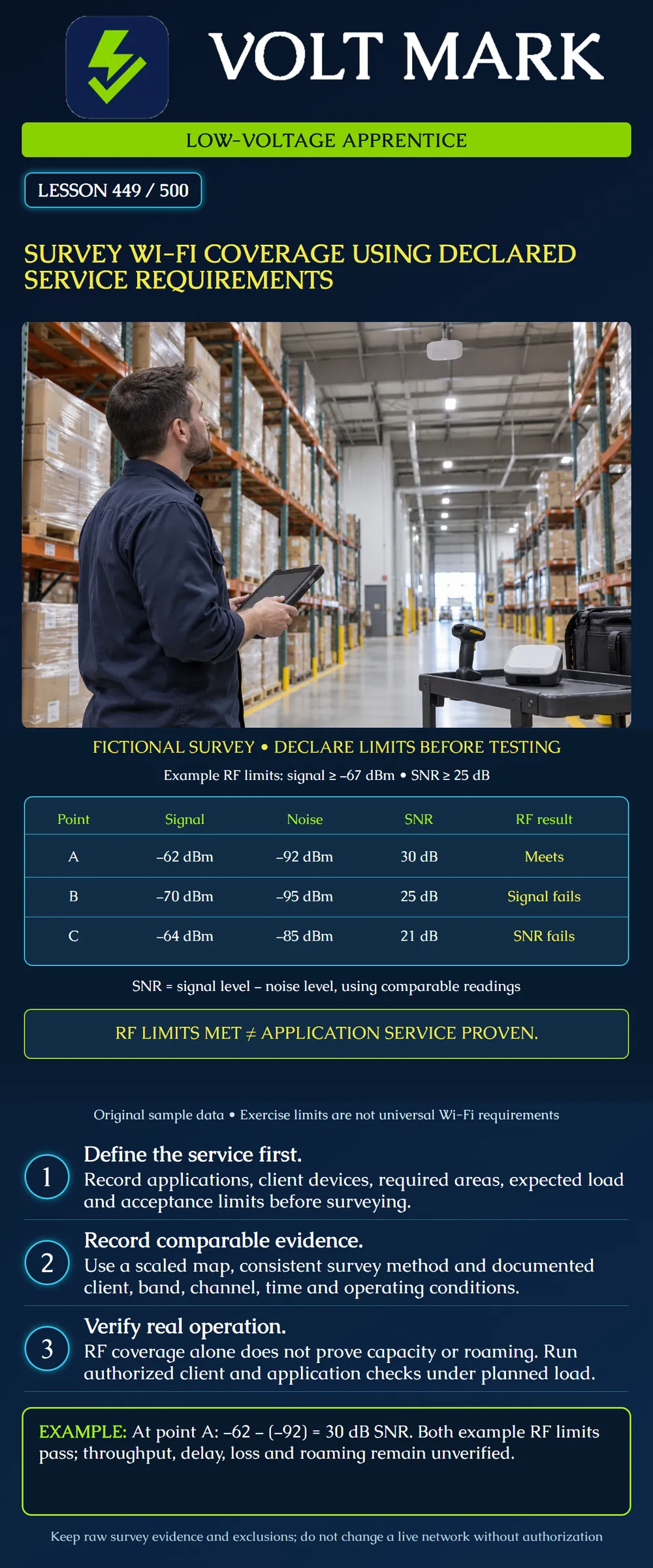
Plan and interpret a Wi-Fi survey against declared service requirements. Separate radio coverage evidence from proof that the required applications work for the intended clients and load.
The table uses original fictional measurements and deliberately stated exercise limits. It is not a universal wireless design standard. This lesson does not perform a network survey, collect traffic or authorize configuration changes. Real work requires the approved scope, site access and test arrangements.
Cisco's site-survey guidance distinguishes passive observation, associated-client active surveys and predictive modeling. It connects survey planning to client/application requirements and emphasizes map scale, documented coverage areas and retained survey data. Its particular voice-device targets should not be generalized to every Wi-Fi application.
HPE Aruba's capacity guidance treats user demand and application traffic as design inputs. A coverage result alone does not establish sufficient capacity for the intended number of clients. Use the actual service and deployment requirements to define acceptance.
For the fictional warehouse exercise, define the required area as work aisles and the dispatch desk, the client as a specified handheld scanner model, and the application as the approved inventory transaction workflow. Record expected simultaneous use, mobility, target band and relevant operating conditions. Do not begin with “make the map green.”
Each requirement needs a measurable check and an owner. RF targets may include signal and signal-to-noise ratio. Service targets may include completed transaction behavior, throughput where relevant, delay, loss, roaming continuity and supported authentication. Write the applicable criteria before taking data. Do not invent a universal threshold when the owner has not supplied one.
A predictive map is an estimate based on a model. A passive walk gathers radio observations without proving an associated client's application path. An active test uses an associated client and can examine service behavior under its particular conditions. Match the method to the question.
A survey adapter may not behave like the actual scanner. Different antennas, drivers, capabilities and placement can affect results. Identify the client and tool used, and arrange representative device validation rather than assuming any laptop stands in for every endpoint.
An internet speed test also includes paths beyond the radio link. If that is the chosen service test, record its destination and limitations. A local authorized test endpoint can answer a different question. Do not label every end-to-end delay as a Wi-Fi fault without isolating the contributing path.
Use the correct floor-plan revision and validate its scale. Label the in-scope areas, unavailable areas, sample path and observation points. Record date/time, survey method, client/tool configuration, band, channel and relevant access-point information. A missing location is unverified, not automatically passed.
Document conditions that matter to interpretation: occupancy, shelving or inventory state, moving equipment and whether the intended application load was present. An empty-site snapshot and a busy shift answer different questions. Avoid extrapolating one into the other without evidence.
Retain the underlying data and test records with the rendered report. Distinguish measured locations from interpolation and predictions. A broad colored region should not imply that every point was directly measured.
Point A has passed only two example RF checks. No throughput, delay, loss, capacity or roaming result was supplied. Mark those checks unverified. The whole service cannot be declared accepted.
For an original follow-on record, suppose the scanner completes the required workflow while stationary at A, but fails during a specified aisle transition. Keep both observations. The stationary success does not erase the mobile failure, and the mobile failure does not establish its cause without further evidence.
Likewise, a negotiated radio data rate is not the same quantity as application throughput. Use measurements and criteria that match the actual promised service.
List the failed criterion, observed location, operating conditions and next authorized investigation. Do not automatically raise transmit power or add access points based solely on a weak reading. Configuration, placement, channel use, client behavior and the wider network require responsible review.
After an approved change, repeat the affected checks and relevant adjacent-area checks. Preserve the before/after records and identify the changed variable. A visually improved map is not sufficient if application behavior was the unresolved problem.
Cisco, Understand Site Survey Guidelines for WLAN Deployment: https://www.cisco.com/c/en/us/support/docs/wireless/5500-series-wireless-controllers/116057-site-survey-guidelines-wlan-00.html Opened directly. Used for survey methods and evidence planning; legacy device-specific requirements not generalized.
HPE Aruba Networking, Bandwidth planning and capacity calculations: https://arubanetworking.hpe.com/techdocs/aos/wifi-design-deploy/design-guides/lpv/network-capacity/ Opened directly. Used for the distinction between application/client demand and coverage. Sources checked 2026-10-01. Sample data, worksheet and scenarios are original.
At fictional point C, signal is -64 dBm and noise is -85 dBm. Subtraction gives -64 - (-85) = 21 dB SNR. The signal is stronger than the exercise minimum of -67 dBm, but 21 dB is below its 25 dB SNR requirement. Enter "signal passes; SNR fails" and retain the raw readings and location. Do not turn this partial result into service acceptance; application and roaming checks still require their own evidence.
Mistake: Calling -70 dBm stronger than -62 dBm because 70 is larger. Correction: Compare the signed values; -62 dBm is the stronger power level, and the example's signal criterion must be evaluated separately from SNR.
Mistake: Reporting a passive heat map as proof of successful scanner roaming. Correction: Label the survey method and arrange representative associated-client workflow checks for the declared mobile service.
Mistake: Counting an inaccessible dispatch desk as passing coverage. Correction: Mark the location unverified and arrange the missing authorized measurement instead of silently removing it from the required area.
Texas journeyman, 15 questions, scored by topic against the 70% mark. No card, and no account needed to start.
Free study material for low-voltage apprentices. This is a national foundation course: requirements differ by state and by local jurisdiction, and a practice that is common in one place is not a rule everywhere. Nothing here is a licence, a certification, or authority to work unsupervised, and completing it does not count as apprenticeship hours or continuing-education credit. Check the codes adopted where you are working, the licensing authority for that work, and your employer's safety programme. VoltMark is not affiliated with, endorsed by, or sponsored by NFPA, OSHA, NICET, BICSI, FOA, or any state or local licensing authority.

Electrician licensing exam prep: practice questions, timed exam simulations, and step-by-step help finding every answer in the NEC.