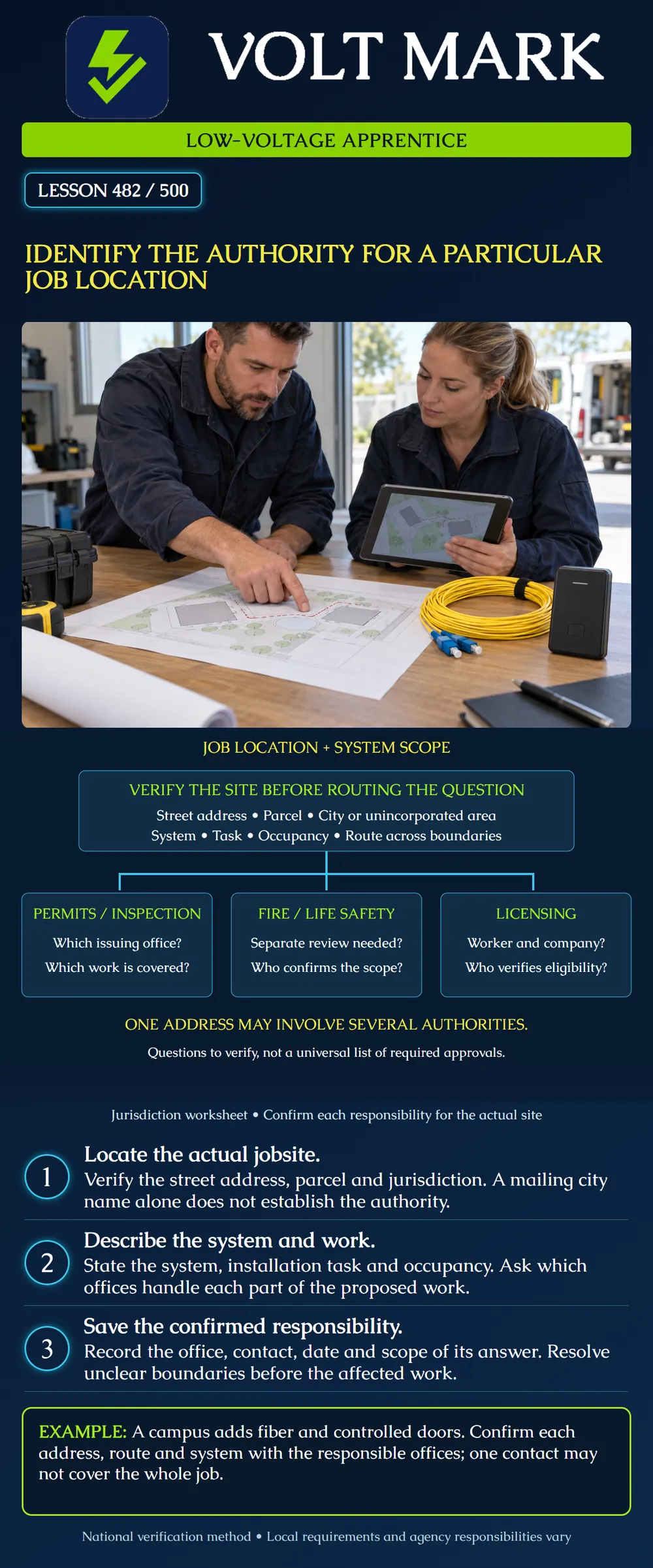
Identify the actual site instead of relying on its mailing city. Describe a low-voltage scope precisely enough to route questions. Build a record that separates permitting, inspection, fire/life-safety review and licensing responsibility.
This lesson teaches a nationwide research method. It is not a directory of all jurisdictions, a permit determination, or authority to perform work. Agency structures and exceptions differ. A school, industrial site, federal property, tribal land or project crossing boundaries may need a different routing process. Confirm the applicable authority for that property and scope instead of assuming the usual city office controls it.
Create a site record with the street address, building and suite, parcel reference where available, and a route drawing when the work leaves one building. Distinguish a postal address from a municipal boundary. A familiar city name on delivery paperwork is not enough to establish the issuing office.
Use official jurisdiction resources and confirm uncertain boundaries with the responsible office. Record the lookup date. A map is evidence for a question, not permission to proceed. If an agency refers the project elsewhere, retain the referral and obtain confirmation from the receiving office. Do not silently replace an unresolved question with the name of the first department that answers the phone.
“Low voltage” is too broad for a useful inquiry. An original classroom scope might read: “Install a fiber link between two existing campus buildings, place new pathway sections along the marked route, and add two controlled doors in Building B.” Attach the address and route description. Identify whether the proposal affects existing egress, fire-alarm interfaces, underground work or a public right-of-way. These details are questions for competent project staff and agencies; an apprentice does not resolve design or licensing classifications by guessing.
Separate installations, alterations, repair and configuration when describing the work. State the occupancy and whether the work touches operating systems. An answer for one narrowly described task should not be applied automatically to another.
The poster shows three possible responsibility groups. It does not claim that every job needs three permits or that three offices always exist. Ask who issues applicable permits and performs inspections. Ask who addresses relevant fire/life-safety review. Separately establish where the worker and company requirements are verified. An office may perform several functions, or refer a question to another agency.
Other responsibilities may exist, such as excavation or right-of-way permissions for a route outside the building. Do not treat this teaching diagram as an exhaustive approval checklist. Owner access permission and a contractor’s internal work release also serve different purposes from governmental authority. A helpful facility manager cannot be assumed to waive a public requirement.
A useful worksheet has one row per question: site identifier, proposed work, responsible office, official source, contact or reference number, date, answer, limits of that answer, and unresolved items. Keep supporting correspondence in the approved project location. Record “not yet confirmed” where needed. Do not label a permit unnecessary based only on an unanswered email or an unrelated past project.
When a response is conditional, preserve the condition. For example, “office will route after reviewing the proposed door hardware and system interface” is a pending review, not acceptance. Have the authorized project lead resolve inconsistent answers through the applicable process. Do not begin affected work on the assumption that whichever response is easiest must be correct.
Washington L&I’s city electrical inspection page explains that listed cities and Tacoma Power have distinct inspection jurisdictions and directs users to verify the location before obtaining a permit. This is a Washington example of why boundaries and service areas matter. It does not establish the low-voltage permit requirements of another state or determine the status of the fictional campus project.
The SBA explains more generally that state, county and city licenses and permits depend on activities and location. That broad guidance supports asking location-specific questions; it does not identify the particular credential or exemption for a low-voltage task.
A work order lists a campus mailing address and says “fiber and access control.” The proposed fiber route reaches a second parcel. The site contact says the last contractor used the city permit desk.
Draft the missing questions: What are the actual addresses and parcels? Does the route cross jurisdictional boundaries or a public right-of-way? What pathway and door modifications are proposed? Which offices confirm permit, inspection, fire/life-safety and licensing responsibilities for those tasks? What information is needed before those offices can answer?
Mark the former contractor’s experience as a lead to investigate, not proof. Create separate rows for the fiber route and controlled-door work where their responsibilities differ. No installation, permit application or inspection request is performed by this exercise.
Answer: No. Confirm the actual location and responsible jurisdiction.
Answer: No. Match each answer to its stated scope.
Answer: No. Confirm responsibility and the required process with the receiving office.
Answer: The unresolved question, supporting information and responsible follow-up; not a fabricated approval.
Washington State Department of Labor & Industries, City Electrical Permits & Inspections: https://lni.wa.gov/licensing-permits/electrical/electrical-permits-fees-and-inspections/city-electrical-permits-inspections U.S. Small Business Administration, Launch your business, licenses and permits guidance: https://www.sba.gov/counseling/launch-your-business/ Both primary pages opened for this lesson. Sources support the limited points attributed above. Worksheet, campus scenario and knowledge check are original instructional examples.
A project email names the postal city, gives permission to enter Building B and attaches an old permit for a neighboring site. Prepare three unresolved rows: actual property jurisdiction, the fiber route across the second parcel, and the controlled-door scope. For each, list the source or office needed and what the supplied evidence does not establish.
Answer: Confirm the actual boundaries through official resources; have the route and door work described for the responsible permit, inspection, fire/life-safety and licensing inquiries. Entry permission does not determine governmental approval, and the neighboring permit does not establish authority or requirements for this property.
Mistake: Using the mailing city as proof of permitting jurisdiction. Correction: Check the actual address, parcel and applicable service or municipal boundary with official resources.
Mistake: Applying a fiber answer to controlled-door egress work. Correction: Separate the described scopes and preserve each office's limits and conditions.
Mistake: Treating a referral as approval or an unanswered inquiry as an exemption. Correction: Record the question as unresolved and obtain confirmation through the receiving authority's process.
Texas journeyman, 15 questions, scored by topic against the 70% mark. No card, and no account needed to start.
Free study material for low-voltage apprentices. This is a national foundation course: requirements differ by state and by local jurisdiction, and a practice that is common in one place is not a rule everywhere. Nothing here is a licence, a certification, or authority to work unsupervised, and completing it does not count as apprenticeship hours or continuing-education credit. Check the codes adopted where you are working, the licensing authority for that work, and your employer's safety programme. VoltMark is not affiliated with, endorsed by, or sponsored by NFPA, OSHA, NICET, BICSI, FOA, or any state or local licensing authority.

Electrician licensing exam prep: practice questions, timed exam simulations, and step-by-step help finding every answer in the NEC.