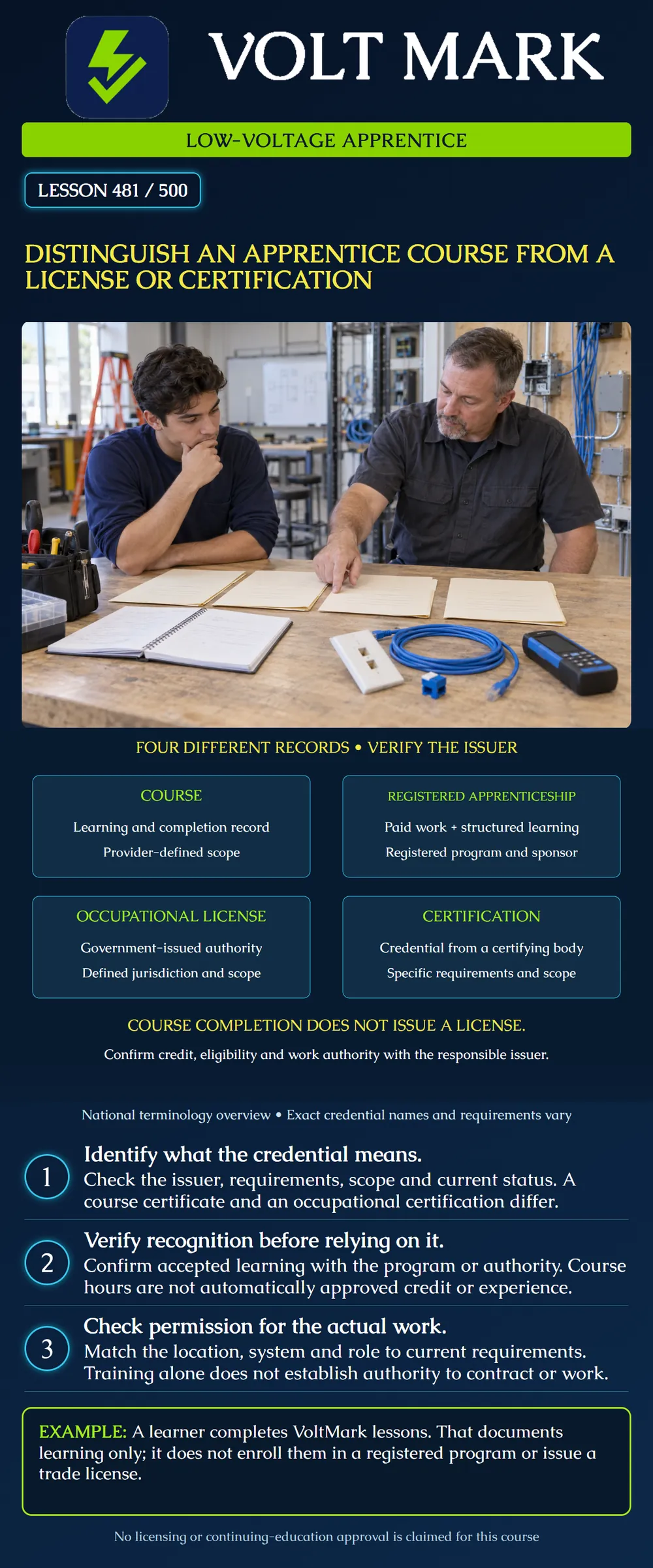
Distinguish educational course completion, registered apprenticeship, occupational licensing and certification, and identify who can verify the meaning of each.
This is a national terminology lesson, not an eligibility decision for any state, county, city or credential. Exact names, scopes and requirements vary. The VoltMark lessons are educational material; this lesson claims no registered-apprenticeship enrollment, license, certification, approved continuing-education credit or accepted experience hours from completing them.
A document's title alone may not tell you what it establishes. Identify the issuing organization, what was required to receive it, the occupation or skill covered, any limitations and its current status.
A paper labeled “certificate” might confirm attendance, course completion or another achievement. Do not assume it grants government work authority. Similarly, a credential's national recognition does not establish that it authorizes every kind of low-voltage work in every location.
Use the exact credential name when describing your qualifications. Avoid upgrading a completion record into “licensed technician” or “certified installer” unless the responsible issuer has actually granted the corresponding credential.
A course provides instruction and may assess learning under its own requirements. A completion record describes the achievement its provider actually verifies. It can support learning without being a license or an occupational certification.
In the fictional example, a learner completes VoltMark lessons and records their progress. That does not prove field experience, acceptance into a registered program or approval to perform unsupervised work.
No evidence in this lesson establishes that a licensing authority or apprenticeship sponsor accepts these lessons for required credit. Verify a specific recognition claim before relying on it. Do not turn the number of lessons into approved instructional hours or work-experience hours.
Apprenticeship.gov describes Registered Apprenticeship as combining paid employment, structured learning with a mentor, related instruction and a recognized credential, with programs approved by the Department of Labor or a State Apprenticeship Agency. [1]
Taking an online apprentice-oriented course is not the same as enrolling in such a program. A person should verify the actual sponsor, registered program and their own enrollment or completion status through the appropriate records.
The term “apprentice” can also appear in job titles or educational materials. Do not infer registered status from that word alone. Likewise, completion of one instructional component does not by itself establish completion of an entire apprenticeship.
BLS distinguishes government-issued occupational licenses, which convey legal authority within their scope, from certifications issued by non-governmental bodies. [2] This general distinction helps explain the categories; it is not a substitute for a particular licensing agency's rules.
For an actual low-voltage job, identify the location, system and role. The requirements for a business offering contracts may differ from those for an individual employee, trainee or qualifying person. Do not assume a company credential automatically answers every question about an individual's assigned work.
Confirm the exact credential and scope with the responsible authority. A license name used in one jurisdiction may not mean the same thing elsewhere. This lesson intentionally supplies no universal voltage cutoff, license classification or exemption.
An occupational certification addresses the requirements and scope of its certifying body. It may involve an examination, experience, assessment or other criteria depending on that program. Consult the actual issuer rather than assuming a course exam is the same assessment.
A credential that is voluntary to obtain in general may still be required by a particular employer, specification or applicable rule. Conversely, holding it does not automatically replace a required government license.
Distinguish product training, an attendance certificate and an independently defined certification. Describe exactly what was earned and keep any renewal or current-status requirements traceable.
Before relying on a course for a required purpose, ask the responsible program or authority whether that specific provider, course, version and delivery method are accepted. Record the applicable approval reference and conditions where available.
Acceptance for one purpose does not establish acceptance for another. A sponsor might use material as supplemental learning without granting required-hour credit. An employer may value training without treating it as an occupational credential.
Do not infer eligibility from a sales statement or an instructor's informal opinion. Use the issuer's current published requirements and clarification process. Retain the date and source of the answer because requirements can change.
For each document in a fictional career folder, ask: Who issued it? What did the person actually complete or demonstrate? What scope does it cover? What authority or recognition is explicitly established? What remains to be verified?
Suppose the folder contains a course completion record, an employer experience log and an exam registration email. These show different facts. An exam registration does not show a passing result, and an experience log does not establish that an authority accepted the hours.
Do not combine several incomplete records into a claim that a license has been granted. Verify the actual issuance and current status through the responsible agency.
Create a four-column comparison for a course, registered apprenticeship, license and certification. For each, name the kind of issuer or verifier and one fact that would require confirmation. Then write a truthful statement about completing this lesson without claiming a new credential.
Answer: No.
Answer: A government authority.
Answer: No.
Answer: No.
Answer: No.
[1] U.S. Department of Labor, Apprenticeship.gov, Registered Apprenticeship Program: https://www.apprenticeship.gov/employers/registered-apprenticeship-program Used for the program's general components and registration authorities. [2] U.S. Bureau of Labor Statistics, Data on certifications and licenses: https://www.bls.gov/cps/certifications-and-licenses.htm Used for the broad issuer and authority distinction, not a jurisdiction-specific legal classification. Both opened October 1, 2026. CareerOneStop pages were unavailable through the tool and are not relied on.
Original educational examples. No numerical calculation required.
A learner's folder contains a VoltMark completion record, an employer experience log and an exam registration email. Record course completed, experience documented but acceptance unverified, and exam registration only. None is evidence that the licensing agency issued a license or that a registered apprenticeship was completed. The next action is to identify the intended role and jurisdiction and verify the actual issuer's requirements and current status, without converting lesson count into approved credit.
Mistake: Describing a course completion certificate as an occupational license. Correction: Use the exact issued document name and verify the authority and scope directly with its issuer.
Mistake: Assuming an apprentice-oriented course creates Registered Apprenticeship enrollment. Correction: Verify the registered sponsor and the individual's enrollment separately; instruction alone does not establish program status.
Mistake: Converting 500 lessons into approved experience or continuing-education hours. Correction: Obtain explicit acceptance for the specific course and purpose from the responsible program or authority before claiming credit.
Texas journeyman, 15 questions, scored by topic against the 70% mark. No card, and no account needed to start.
Free study material for low-voltage apprentices. This is a national foundation course: requirements differ by state and by local jurisdiction, and a practice that is common in one place is not a rule everywhere. Nothing here is a licence, a certification, or authority to work unsupervised, and completing it does not count as apprenticeship hours or continuing-education credit. Check the codes adopted where you are working, the licensing authority for that work, and your employer's safety programme. VoltMark is not affiliated with, endorsed by, or sponsored by NFPA, OSHA, NICET, BICSI, FOA, or any state or local licensing authority.
Electrician licensing exam prep: practice questions, timed exam simulations, and step-by-step help finding every answer in the NEC.