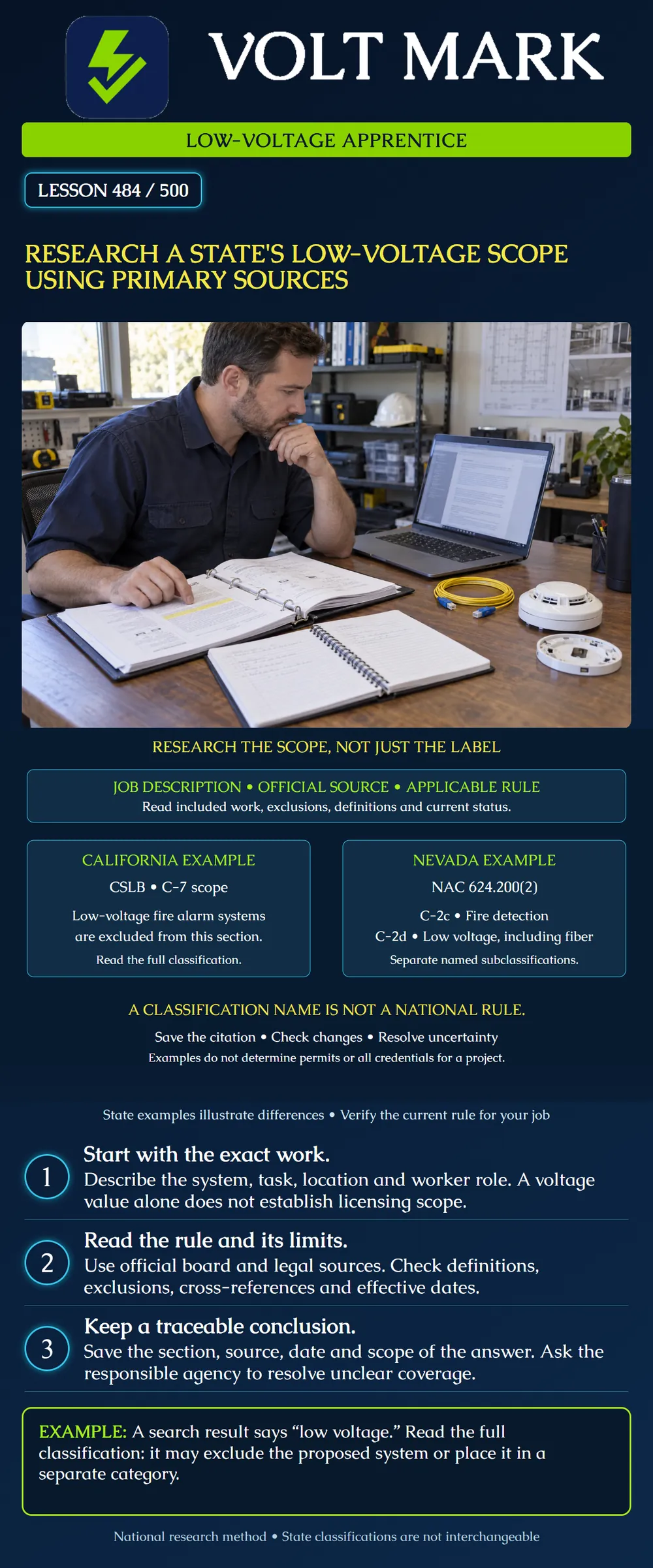
Locate official sources for a state's low-voltage licensing scope. Read a classification together with definitions and exclusions. Separate a source-backed finding from an unresolved interpretation. Keep a research record that another person can verify.
Use this research method in any state, while recognizing that each jurisdiction organizes its requirements differently. This lesson is not a fifty-state licensing directory and does not establish permission for a particular job. State licensing, local permits, worker eligibility and owner requirements are separate questions.
Write the system, proposed task, job location and role. An original example is: “Our company proposes installing a fiber link between existing campus buildings and adding a fire-alarm interface at one end.” That description contains more than one work element. Investigate each element rather than assuming everything follows the fiber classification.
Include the activity: installation, alteration, repair, maintenance, inspection, testing, design or monitoring. These words can matter within a particular licensing scheme. Do not declare them interchangeable. Also identify whether the question concerns the company, a qualifying person or the individual performing work.
Use the responsible state agency or board to locate classification information, applicable statutes and administrative rules. Follow official links to the underlying legal text. Search engines help find a page but their short excerpts are not the complete rule. A training vendor's page can suggest a useful search term; it is not the issuing authority.
Verify the source identity, page title and section identifier. Watch for archived editions, proposed rules and old forms. An official document may still be outdated. A current-looking web page may link to an older reference book. Record what you actually opened.
Read the full section and any definitions or exceptions it references. Pay attention to words that limit the scope, including conjunctions and exclusions. If a rule refers to another classification, follow that reference. Do not remove a limiting sentence because the heading sounds broad.
“Low voltage” in ordinary trade speech is not automatically the same category used by a licensing board, an electrical code or a manufacturer's specification. A voltage limit in a classification also does not prove that every system below that value belongs to that classification. Avoid importing a numeric threshold from one state into another state's answer.
California CSLB's C-7 classification page describes its communication and low-voltage classification and expressly excludes low-voltage fire alarm systems from that section. The learning point is to read the exclusion, not to assume that the classification title covers every low-voltage system. This lesson does not use that page to decide all fire-alarm credentials or permits.
Nevada NAC 624.200(2) separately names C-2c for fire detection and C-2d for low-voltage systems. Its C-2d description includes systems using fiber optics. These are Nevada state contractor subclassifications, not universal national labels or a single Clark County credential. The rule's broader C-2 provisions and the actual license scope also matter; this comparison does not claim only one subclassification can ever cover a particular project.
The examples show different source structures and named categories. They do not make California and Nevada requirements interchangeable. Do not infer that a fiber-only system is outside licensing requirements just because it carries light instead of electrical current.
Use a row for each distinct work element. Record: location; system and activity; worker or company role; official agency; source URL; exact section; included work; relevant exclusions; effective information; date checked; and conclusion or unresolved question.
A good conclusion states its limits. For example: “The reviewed California C-7 page excludes low-voltage fire alarm systems; the appropriate authority for the proposed fire-alarm work still requires separate verification.” That is a useful documented finding even though it is not complete project authorization.
Do not copy a company's license number from marketing material and call that a scope determination. After identifying applicable requirements, verify the actual entity and current credential through the proper official process.
A fictional estimator collects a search excerpt, an older study guide and a current official classification page. All use the phrase “low voltage.” The project combines fiber and a life-safety interface.
Separate the work into two research rows. Open the official page and its governing references. Identify any exclusion and unresolved interface responsibility. Record the older guide as background only until its accuracy is confirmed. Ask the responsible authority a precise scope question instead of asking whether “low voltage is allowed.”
No license application, permit application, agency message or field activity is performed in this exercise.
Answer: No. Read the full official source and relevant references.
Answer: No.
Answer: No. Record both separately where available.
Answer: Research the separate elements and resolve coverage with the responsible authority.
Answer: No. It teaches a research method.
California Contractors State License Board, C-7 classification: https://cslb.ca.gov/about_us/library/licensing_classifications/Licensing_Classifications_Detail.aspx?Class=C-7 Nevada Legislature, NAC 624.200, especially subsection 2(c) and 2(d): https://www.leg.state.nv.us/Division/Legal/LawLibrary/NAC/NAC-624.html Examples are limited to the text described above. No comprehensive review of every applicable statute, regulation or jurisdiction is claimed.
A California scope inquiry combines campus fiber with a proposed fire-alarm interface. The official C-7 page expressly excludes low-voltage fire alarm systems. Write a limited finding that the C-7 title alone does not settle the interface work, then create a separate research row for that activity and responsible authority. Do not turn the exclusion into a guessed replacement license or a project approval; resolve the precise scope using the governing references and agency clarification.
Mistake: Relying on the words low voltage in a search excerpt. Correction: Open the full official section and read its definitions, exclusions and referenced classifications.
Mistake: Copying a voltage threshold from one state into another state's answer. Correction: Use the actual jurisdiction's classification text and the proposed activity, preserving its conditions.
Mistake: Treating today's retrieval date as the rule's effective date. Correction: Record retrieval and legal effective information separately and distinguish current text from proposed amendments.
Texas journeyman, 15 questions, scored by topic against the 70% mark. No card, and no account needed to start.
Free study material for low-voltage apprentices. This is a national foundation course: requirements differ by state and by local jurisdiction, and a practice that is common in one place is not a rule everywhere. Nothing here is a licence, a certification, or authority to work unsupervised, and completing it does not count as apprenticeship hours or continuing-education credit. Check the codes adopted where you are working, the licensing authority for that work, and your employer's safety programme. VoltMark is not affiliated with, endorsed by, or sponsored by NFPA, OSHA, NICET, BICSI, FOA, or any state or local licensing authority.

Electrician licensing exam prep: practice questions, timed exam simulations, and step-by-step help finding every answer in the NEC.