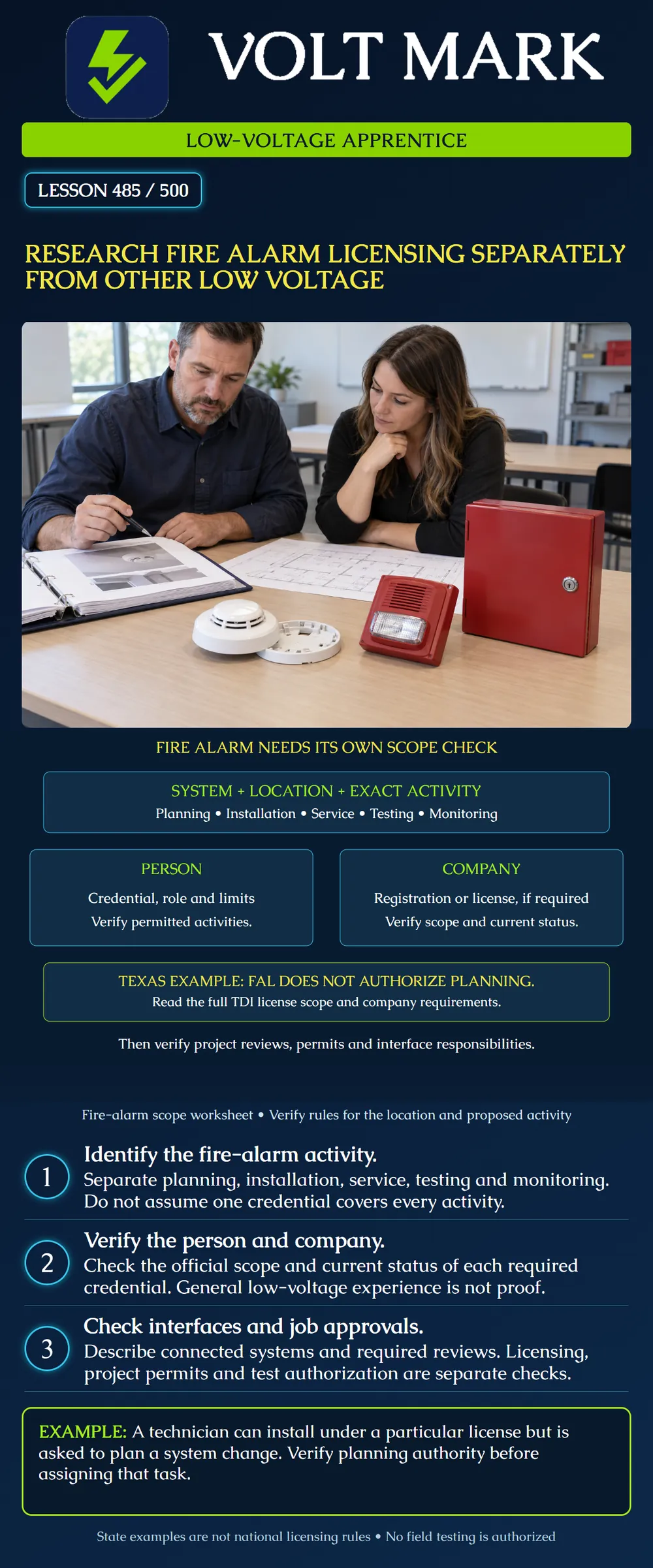
Recognize fire-alarm work as a separate licensing research question. Describe the proposed activity precisely. Check company and individual requirements without assuming that a general low-voltage credential covers all life-safety work. Identify unresolved interface and project-approval questions.
This lesson provides a research method, not a national fire-alarm license map. States and local jurisdictions organize responsibilities differently. An electrical licensing agency, contractor board, fire marshal or another responsible body may address different parts of the work. Confirm the actual authority for the site and task.
Do not interpret this lesson as permission to alter, test, disable or restore an operating fire-alarm system. Those actions require the applicable qualifications, site coordination and authorized procedures.
Start by identifying whether the proposal concerns fire detection, notification, signaling, monitoring, an interface or some combination. Describe the building and system context. Do not treat a standalone device and a connected building system as automatically equivalent under the rules.
Identify what will physically or logically change. “Help with the alarm” is not a useful licensing question. “Replace a listed field device according to the approved service plan” and “revise the system layout and sequence” are different proposed activities that require separate scope checks.
Create a task list before researching credentials. Separate planning or design, installation, alteration, service, inspection, testing, certification and monitoring as relevant. Use the terms found in the governing rules and ask for clarification if the project's terminology differs.
Do not assume that authority to install includes authority to plan a system modification. Likewise, do not assume a monitoring credential permits field installation. A person's experience and manufacturer training may be valuable, but they do not automatically establish the applicable legal authority.
The list of activities in the poster is a research aid. It is not a claim that each activity always requires a separate license or that all jurisdictions use the same names.
Find the official individual credential information and the company licensing or registration information. Verify current status, the covered activity, applicable restrictions and any required employment or designation relationship.
An application receipt, examination result, training certificate or business card is not sufficient evidence for every one of those checks. An apprentice should collect accurate information and refer unresolved eligibility to the authorized employer representative or responsible agency.
Where rules provide exemptions or permitted supervised work, verify the exact conditions rather than assuming an exemption. Do not invent a blanket rule that all apprentices may work under anyone who happens to hold a license.
Texas Department of Insurance distinguishes individual fire-alarm licenses from company registrations. Its guidance says the company's allowed work depends on the licenses held by its employees. The same official page states that a Fire Alarm Technician license, FAL, does not permit planning.
This is the narrow teaching example shown on the poster. It illustrates why an installation-related credential cannot automatically be stretched to a planning assignment. It is not a complete Texas eligibility checklist, a statement that Texas credential names apply elsewhere, or an authorization for this course's students to perform any regulated task.
A fire-alarm project can interact with other building systems. Identify the proposed interface and who is responsible for each side. Do not assume that working at a shared contact or input makes every associated activity part of the same trade scope.
Texas SFMO's FAQ provides a jurisdiction-specific example: testing that operates another protected system can bring that system's licensing requirements into the question. Use that example as a reason to describe the intended operation precisely and ask the responsible authority. Do not turn it into a universal rule or a test procedure.
A classroom review can use drawings and a fictional sequence. It should not activate equipment, transmit live signals or impair protection to discover what happens.
Licensing answers who may perform defined work. Project review, permits, inspections and site authorization answer other questions. Verify the required drawings, approved changes, inspection process and coordination through the responsible project staff and authorities.
A credential does not prove that the proposed modification is approved. An approved drawing does not prove that the assigned individual has the needed credential. Record both questions without substituting one document for the other.
A fictional campus contractor normally installs communications cable. The customer asks an employee to relocate fire-alarm equipment and revise its sequence during a fiber upgrade. The employee has general low-voltage experience.
Create separate research rows for the cable work, the proposed fire-alarm changes and any connected-system operation. Identify the location, activity, company, assigned individual, source and unresolved question for each row. Ask who is permitted to plan the revision, who may perform it, what project review applies and who controls any testing.
The correct initial conclusion is that general experience does not settle these questions. Do not declare the employee eligible or ineligible without the applicable facts and rules. Mark the questions pending and route them for resolution before the affected work.
Answer: Its activities and licensing scope may differ from other low-voltage work.
Answer: No; the reviewed TDI guidance expressly excludes planning from that license.
Answer: No.
Answer: Work or testing may affect another system with separate responsibilities or requirements.
Answer: No. Check project approvals and site authorization separately.
Texas Department of Insurance, Fire alarm registration, license, and test information: https://www.tdi.texas.gov/fire/information-fire-alarm-registration-license-test.html Texas State Fire Marshal, Frequently asked questions: https://www.tdi.texas.gov/fire/fmfaq.html Sources support the limited Texas examples only. The worksheet and campus exercise are original instruction. No exhaustive statutory or fifty-state review is claimed.
Mistake: Assuming authority to install also permits planning a fire-alarm revision. Correction: Check each activity against the actual credential scope; the limited Texas FAL example does not permit planning.
Mistake: Treating communications-cable experience as proof of fire-alarm eligibility. Correction: Verify the company's and individual's applicable requirements for the described task and location.
Mistake: Ignoring other systems operated during a fire-alarm interface test. Correction: Describe the intended connected-system operation and resolve its responsible roles and approvals before the affected test.
Texas journeyman, 15 questions, scored by topic against the 70% mark. No card, and no account needed to start.
Free study material for low-voltage apprentices. This is a national foundation course: requirements differ by state and by local jurisdiction, and a practice that is common in one place is not a rule everywhere. Nothing here is a licence, a certification, or authority to work unsupervised, and completing it does not count as apprenticeship hours or continuing-education credit. Check the codes adopted where you are working, the licensing authority for that work, and your employer's safety programme. VoltMark is not affiliated with, endorsed by, or sponsored by NFPA, OSHA, NICET, BICSI, FOA, or any state or local licensing authority.

Electrician licensing exam prep: practice questions, timed exam simulations, and step-by-step help finding every answer in the NEC.