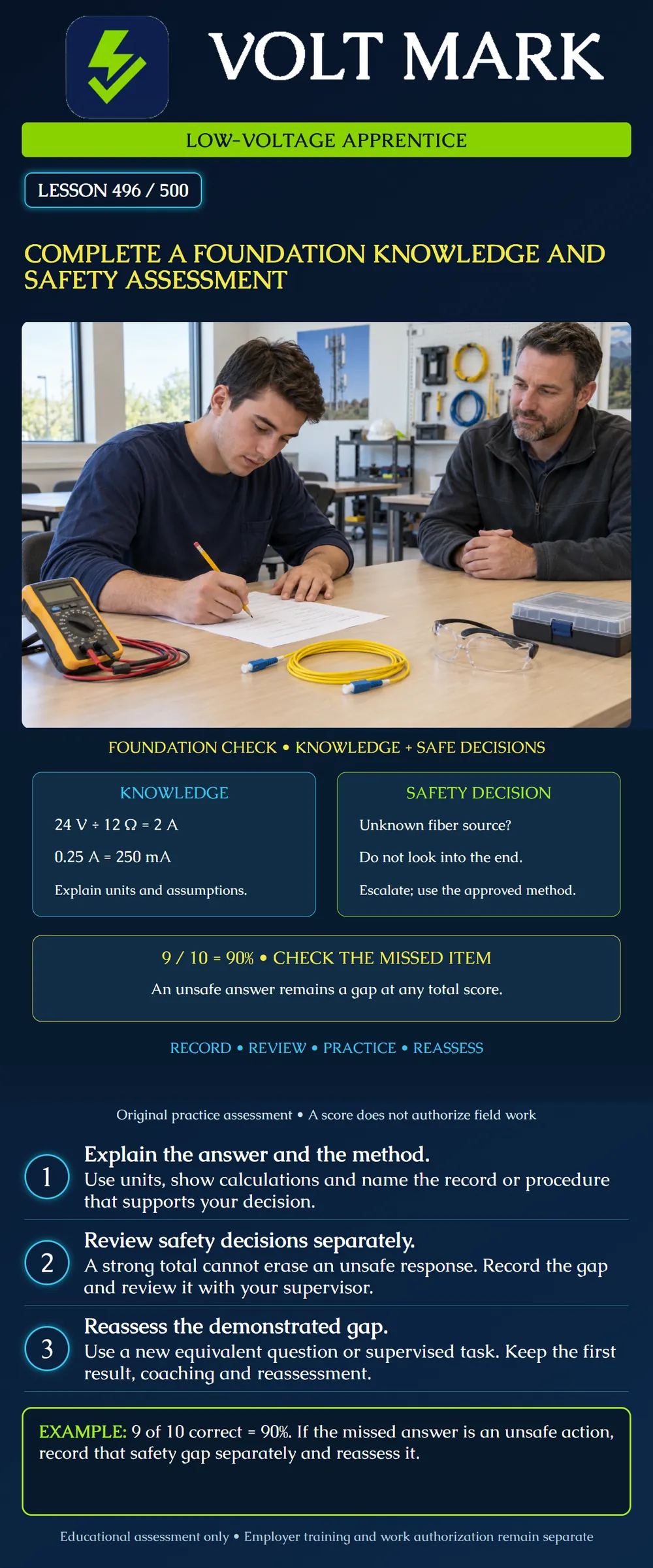
Check foundational reasoning, units, records and safety decisions. Explain answers rather than guessing. Turn missed items into supervised learning needs. This is an original educational assessment, not a licensing exam, an OSHA course or a certification examination.
Use paper, a calculator and the supplied fictional facts. State whether the exercise is completed independently or with assistance. Do not operate a real system to answer a question. Your supervisor may adapt the exercise to an approved lab, but must separately define safe conditions and authorization.
The circuit calculations below are simplified steady-state DC resistor examples. They do not size actual life-safety circuits, evaluate batteries, establish fault protection or authorize connection of equipment. Real devices require their listed ratings, instructions and project criteria.
Record each response before reading the answer key. Give one point for each complete answer, using the rubric below; ten points are possible. Also flag any unsafe proposed action. This lesson does not establish an industry passing percentage or claim that a particular total qualifies someone for work.
Add the ten item scores and report both points and percent: correct items divided by ten, multiplied by 100. For example, nine correct answers yield 9/10 × 100 = 90%.
Separately list safety-related gaps, especially questions 4, 5, 6 and 10. A 90% total with an unsafe direct-view fiber answer still needs safety remediation. A safe written answer also does not establish hands-on competence. Keep knowledge, performance and permission separate.
If an answer reveals an unsafe planned action, stop the corresponding practice and discuss it with the supervisor before resuming. Do not give the learner a real hazardous demonstration merely to make the consequence memorable.
Create a row containing question number, original answer, missing concept, correction, source or procedure reviewed, practice activity and reassessment result. Include assistance and assessor feedback where applicable.
Use a new equivalent problem for reassessment. For example, changing the fictional resistor to 24 ohms at 24 V produces 1 A and 24 W. Confirm the method rather than memorization of the first numerical answer. No real resistor or power supply is needed.
For the fiber question, ask the learner to identify the safe decision from a new fictional work order and explain why visible darkness is inconclusive. Any actual lab activity requires the employer's safe setup and qualified supervision.
OSHA 1926.21(b)(2), a construction provision, requires employer instruction in recognizing and avoiding unsafe conditions and applicable work-environment regulations. This quiz does not satisfy every employer training obligation.
FOA's fiber safety guidance addresses invisible optical energy, fiber scraps, eye protection, work-area cleanliness and nearby electrical hazards. The lesson uses these limited concepts; it does not reproduce that page's full procedures or medical advice.
https://www.osha.gov/laws-regs/regulations/standardnumber/1926/1926.21 https://www.thefoa.org/tech/safety.htm All questions, scoring and remediation examples are original educational material. No issuer passing standard or credential credit is implied.
Suppose the learner answers nine of the ten items correctly but proposes direct viewing into the unidentified fiber on question 4. The score is 9 / 10 x 100 = 90%. Record both that numerical result and the unsafe answer; the percentage does not close the safety gap. The remediation row names invisible optical energy as the missing concept, records the safe decision and assigns a new paper scenario for reassessment. Any practical follow-up requires an approved setup and supervision. No numerical passing rule in this lesson converts the written score into field competence or work authorization.
Using only paper and the ideal steady-state DC assumptions, calculate current and power for 12 V across 24 ohms. Convert the current to milliamperes. Then score eight correct answers out of ten and explain whether a correct total can excuse an unsafe alarm-disable answer.
Answer: I = 12 / 24 = 0.5 A = 500 mA. P = 12 x 0.5 = 6 W. Eight out of ten is 80%. An unsafe proposed impairment still requires separate remediation; the score supplies no authorization to disable equipment.
Mistake: Writing 0.25 mA when converting 0.25 A. Correction: Multiply amperes by 1,000: 0.25 A is 250 mA. Carry units through the calculation so a thousandfold error is visible.
Mistake: Accepting a high total while leaving an unsafe fiber-inspection or alarm-disable answer unresolved. Correction: Record the score and each safety gap separately. Address the unsafe decision and reassess before related practice resumes under the approved process.
Mistake: Treating the ideal resistor result as a design for a real alarm circuit or battery. Correction: Keep this calculation within its stated DC resistor assumptions. Real equipment selection needs the applicable device ratings, instructions and project criteria.
Texas journeyman, 15 questions, scored by topic against the 70% mark. No card, and no account needed to start.
Free study material for low-voltage apprentices. This is a national foundation course: requirements differ by state and by local jurisdiction, and a practice that is common in one place is not a rule everywhere. Nothing here is a licence, a certification, or authority to work unsupervised, and completing it does not count as apprenticeship hours or continuing-education credit. Check the codes adopted where you are working, the licensing authority for that work, and your employer's safety programme. VoltMark is not affiliated with, endorsed by, or sponsored by NFPA, OSHA, NICET, BICSI, FOA, or any state or local licensing authority.

Electrician licensing exam prep: practice questions, timed exam simulations, and step-by-step help finding every answer in the NEC.