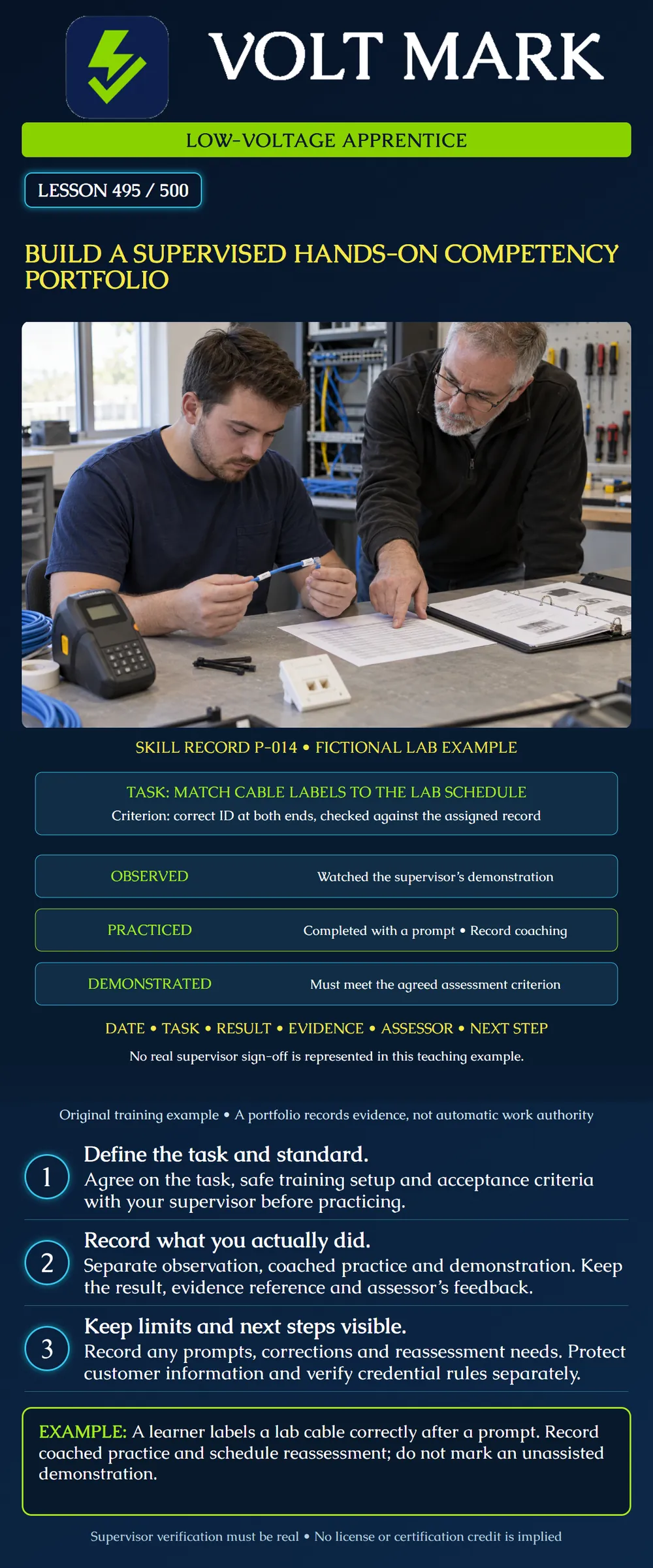
Document a specific low-voltage task with evidence and genuine supervisor feedback. Distinguish watching, practicing and demonstrating. Preserve limits, corrections and reassessment needs without exposing customer information or claiming unsupported credential credit.
A competency portfolio is an organized record of learning and demonstrated work. It can help a learner and supervisor identify progress and remaining gaps. It is not a substitute for an issuer's official forms, a license, a certification or permission to perform unsupervised work.
Use the employer's approved process where one exists. The status labels and sample record in this lesson are original teaching tools, not a universal assessment standard.
Choose a task within the learner's authorized training scope. Define the equipment, setting and conditions. A controlled lab task is different from work on a live customer system, and the portfolio must preserve that distinction.
Agree on observable acceptance criteria before practice. “Good at cabling” is too broad. A more useful lab task is matching the assigned cable ID at both ends against a supplied schedule. The assessor can then check the actual work against the stated requirement.
Identify the safe setup and any prerequisites. Do not perform live-system work, impair protection or use hazardous equipment merely to obtain portfolio evidence. The supervisor and employer determine suitable training arrangements and required supervision.
A useful entry includes a record ID, date, task, training or job setting, applicable procedure or drawing revision, acceptance criteria, learner activity, result, evidence reference, assessor feedback and next step.
Record the actual assessor and verification through the approved process. Do not insert a supervisor's name, signature or approval without their genuine verification. This lesson's P-014 example has no real sign-off.
Keep the evidence retrievable. A file called “test result” is less useful than a controlled reference linked to the exact task and cable ID. Preserve native evidence where the employer's process requires it.
A passing cable test can show something about the tested cable under the recorded method. It does not by itself prove who performed the work, whether the learner chose the correct method or whether the task was completed without coaching.
Pair technical results with observation and questions appropriate to the skill. The assessor may ask the learner to explain the ID, procedure, result and escalation point. This is an educational assessment, not a claim that a particular credential issuer accepts the record.
When a task needs improvement, preserve the initial result and feedback. Record the correction and any later assessment as separate evidence. Do not erase an unsuccessful attempt to make the portfolio look stronger.
Set a specific next step. “Practice more” is vague. “Repeat the lab labeling task against a new schedule without the previous prompt” gives the learner and assessor a concrete follow-up.
A portfolio is useful when it makes gaps visible, not when every row is marked complete.
Use employer-approved storage and evidence collection. Do not copy customer drawings, credentials, security layouts, video, personal data or device access details into a personal public portfolio without authorization.
Where a shareable summary is appropriate, use a permitted task description and remove sensitive project identifiers according to the employer's process. Do not alter required official evidence or falsify a result while preparing a sanitized summary. Retain the authoritative record in its approved location.
NICET's Fire Alarm Systems requirements include supervisor verification of performance measures and detailed work-history information. This illustrates that a certification process may require evidence beyond examination results. Follow the issuer's exact forms and verifier rules when applying.
FOA describes fiber knowledge, skills and abilities and distinguishes broad foundational knowledge from specialized job skills. This supports recording what a learner actually demonstrated and the context, rather than claiming mastery of every fiber application from one exercise.
The portfolio method here is original instruction. It is not an approved NICET or FOA submission and does not promise credit.
Record P-014 covers a labeling task using a fictional lab schedule. The learner initially puts the wrong ID at one end. A supervisor prompts the learner to recheck the schedule; the learner corrects it.
Record the initial mismatch, coaching, corrected result and evidence reference. Mark practiced with coaching. Plan a new assessment under the agreed conditions. Do not mark an unassisted demonstration or invent a supervisor signature.
If the learner later meets the criterion without the prompt, add a dated assessment entry. Keep the original practice record so the development remains traceable. No actual assessment of a real learner has occurred in this lesson.
Answer: No.
Answer: Yes.
Answer: No; task and assessor evidence are also needed.
Answer: No; retain it with corrections and reassessment.
Answer: No.
Answer: No.
NICET Fire Alarm Systems Certification Requirements: https://www.nicet.org/certification-programs/electrical-and-mechanical-systems/fire-alarm-systems/certification-requirements/ FOA Knowledge, Skills and Abilities: https://www.thefoa.org/KSAs.html Sources support limited evidence and skill-scope concepts. The task record, status labels and exercise are original, not issuer forms.
For P-014, enter the lab schedule revision and the criterion: both cable ends match the assigned ID without an answer prompt. Record that the first attempt had one mismatched end. Add the supervisor's prompt and the learner's correction, linked to the permitted evidence record. The result is correct labeling after assistance, so the status is practiced with coaching. The next step is a new schedule-based assessment under the same stated conditions. Leave verifier approval unclaimed until genuine verification exists. A later successful assessment becomes a new dated entry; it does not replace P-014's learning history.
Mistake: Marking P-014 demonstrated because the labels were eventually correct. Correction: Compare performance with the agreed criterion and record the prompt. A corrected product after coaching is not evidence of an unassisted performance.
Mistake: Using a passing cable report as the only proof that the learner selected and performed the method correctly. Correction: Link the result to the exact task and include assessor observation, relevant questions and recorded assistance. Preserve the distinction between product condition and learner performance.
Mistake: Deleting the first unsuccessful attempt or inserting a supervisor signature to make the portfolio look complete. Correction: Retain the initial result, correction and later reassessment as traceable entries. Use only genuine verification and keep any missing sign-off pending.
Texas journeyman, 15 questions, scored by topic against the 70% mark. No card, and no account needed to start.
Free study material for low-voltage apprentices. This is a national foundation course: requirements differ by state and by local jurisdiction, and a practice that is common in one place is not a rule everywhere. Nothing here is a licence, a certification, or authority to work unsupervised, and completing it does not count as apprenticeship hours or continuing-education credit. Check the codes adopted where you are working, the licensing authority for that work, and your employer's safety programme. VoltMark is not affiliated with, endorsed by, or sponsored by NFPA, OSHA, NICET, BICSI, FOA, or any state or local licensing authority.

Electrician licensing exam prep: practice questions, timed exam simulations, and step-by-step help finding every answer in the NEC.