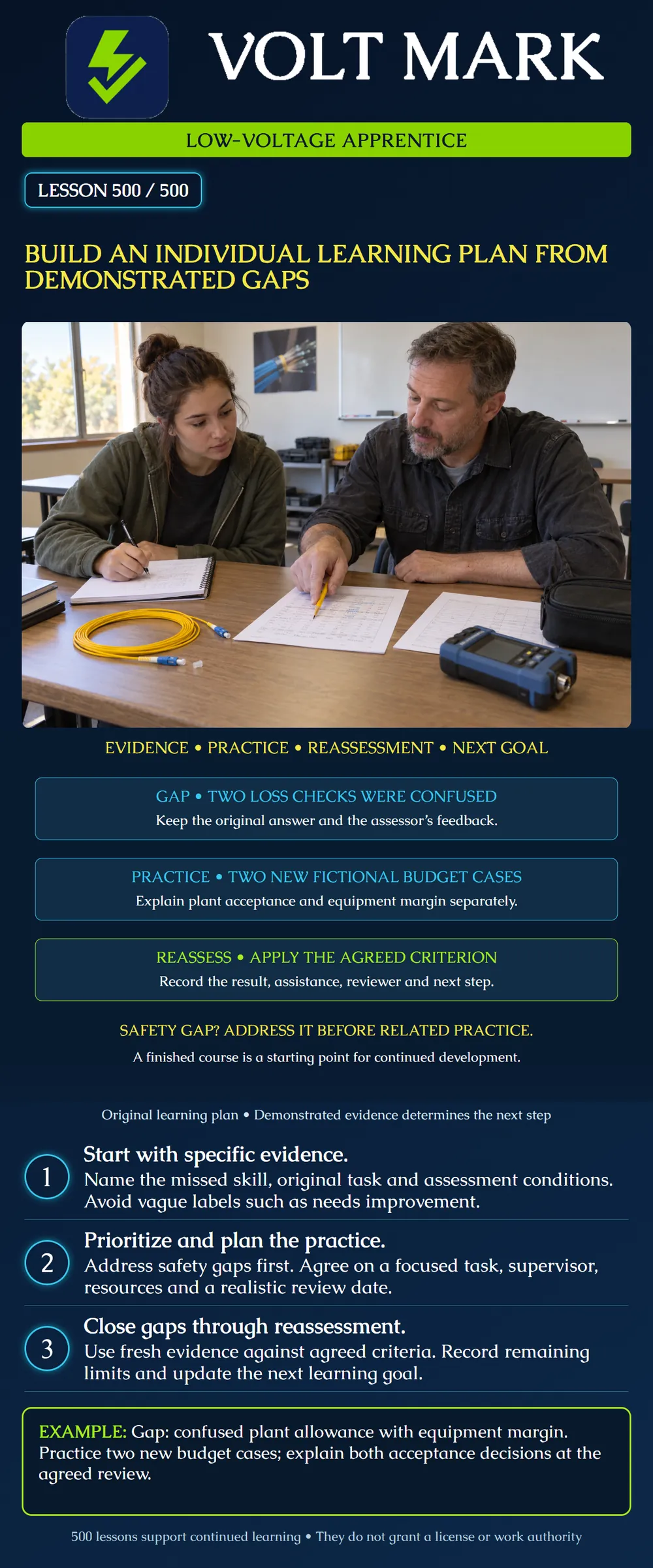
Use assessment evidence to choose the next learning task. Prioritize safety and foundational gaps, arrange supported practice and define how reassessment will show improvement. Carry this process into the learner's chosen low-voltage specialty.
Reaching the end of a learning sequence does not prove every skill has been demonstrated. Reading, explaining, practicing and performing under supervision are different forms of evidence. A useful individual plan makes the remaining work specific.
The plan in this lesson is an original educational tool. It does not issue a license, certify a technician, authorize unsupervised work or replace employer training. Credential requirements and project authority remain separate decisions.
Review the learner's own assessment answers, supervised portfolio, lab results and feedback. Record what was observed rather than assigning a broad label such as “bad at fiber” or “good at security.”
For each gap, capture the task, date, expected criterion, actual result and assistance provided. If there is no assessment evidence, use not yet assessed rather than failed or competent. Do not fabricate a score, witness or supervisor approval to complete the form.
Separate a knowledge gap from a performance gap. Someone may explain a reference method correctly but not yet demonstrate setting it under supervision. Another learner may follow a lab sequence but be unable to explain what its result establishes.
Learner A's fictional lesson498 record shows that the learner accepted a cable plant solely because equipment headroom remained. The recorded gap is distinguishing plant acceptance from equipment budget.
Objective: given two new fictional cases, calculate the plant comparison and equipment margin separately and explain both conclusions. Practice: review the earlier worked example, then solve two new cases on paper with supervisor feedback. Resources: supplied case sheets, calculator, original feedback and the applicable calculation worksheet. Reviewer: an actual supervisor or instructor to be assigned; no person's approval is represented here. Review date: a date agreed by the real learner and reviewer, not an invented completed appointment. Evidence: written calculations, stated assumptions, explanation and assessor feedback. Success criterion for this exercise: both comparisons and conclusions are correct under the supplied facts, with assistance recorded. Next decision: either close this educational gap under those conditions or set targeted further practice.
Case A: plant allowance 7.0 dB; validated measured loss 7.4 dB; equipment budget 12.0 dB; required reserve 3.0 dB. Plant comparison: 7.4 − 7.0 = 0.4 dB over the allowance. Equipment comparison: 12.0 − 7.4 = 4.6 dB remaining, which exceeds the required reserve by 1.6 dB. Conclusion: the stated plant criterion fails even though equipment reserve remains. Do not erase the failure.
Case B: plant allowance 7.0 dB; validated measured loss 6.5 dB; equipment budget 9.0 dB; required reserve 3.0 dB. Plant comparison: 7.0 − 6.5 = 0.5 dB below the allowance. Equipment comparison: 9.0 − 6.5 = 2.5 dB remaining, which falls short of the required reserve by 0.5 dB. Conclusion: the stated plant criterion passes, but the stated equipment reserve requirement is not met.
These are fictional arithmetic exercises with supplied validated measurements and decision rules. Real uncertainty, wavelengths, boundaries, service limits and equipment compatibility require separate verification. These two answers are not real link approvals.
Agree on the time, materials, safe setting and supervision needed. If the necessary equipment or assessor is unavailable, record waiting for resources. Do not convert unavailable resources into a learner failure or authorize unsafe improvisation.
Use explanations and materials the learner can understand. Invite questions and ask the learner to explain their reasoning. Record coaching honestly; it is useful learning evidence, not something to conceal.
Use a fresh equivalent task so success shows understanding rather than memorizing the supplied answers. Decide beforehand which references and assistance are permitted.
Keep the first result and later reassessment linked. If the criterion is met, state the conditions and remaining limits. If not, identify the specific remaining difficulty and revise the practice. Neither outcome justifies a false signature or blanket mastery claim.
After closure, choose the next relevant goal. A learner moving into long-distance fiber may need supervised optical testing or route documentation. A learner moving into access control may need door schedules, event records and approved egress coordination. The employer and responsible specialists determine the actual task boundaries.
OSHA Recommended Practices, Education and Training: https://www.osha.gov/safety-management/education-training Supports role-appropriate hazard education, understandable training, questions and additional training for changed tasks or hazards. This is recommended-practice guidance, not a claim that this plan fulfills all legal training obligations.
FOA Knowledge, Skills and Abilities: https://www.thefoa.org/KSAs.html Supports distinguishing foundation knowledge from job-specific skills and applications. No FOA credit or approval is claimed.
The plan, practice cases, rubric and workflow examples are original. Review actual credential programs and employer procedures separately.
Mistake: Marking a skill failed when there is no assessment record, or competent because all lessons were read. Correction: Use not yet assessed when evidence is absent. Record knowledge, coached practice and verified performance separately, with the actual task conditions and assistance.
Mistake: Giving both fiber practice cases the same overall pass because one comparison looks favorable. Correction: Keep plant and equipment conclusions separate. Case A exceeds its plant allowance despite reserve; Case B meets the plant allowance but misses reserve. Use the specific mistaken comparison to choose the next learning task.
Mistake: Closing the learning plan after repeating the supplied answers or inventing a review date and sign-off. Correction: Arrange a real reviewer and fresh equivalent task with agreed conditions. Keep the original result, coaching and reassessment evidence linked; mark unavailable resources or verification honestly rather than fabricating completion.
Texas journeyman, 15 questions, scored by topic against the 70% mark. No card, and no account needed to start.
Free study material for low-voltage apprentices. This is a national foundation course: requirements differ by state and by local jurisdiction, and a practice that is common in one place is not a rule everywhere. Nothing here is a licence, a certification, or authority to work unsupervised, and completing it does not count as apprenticeship hours or continuing-education credit. Check the codes adopted where you are working, the licensing authority for that work, and your employer's safety programme. VoltMark is not affiliated with, endorsed by, or sponsored by NFPA, OSHA, NICET, BICSI, FOA, or any state or local licensing authority.
Electrician licensing exam prep: practice questions, timed exam simulations, and step-by-step help finding every answer in the NEC.