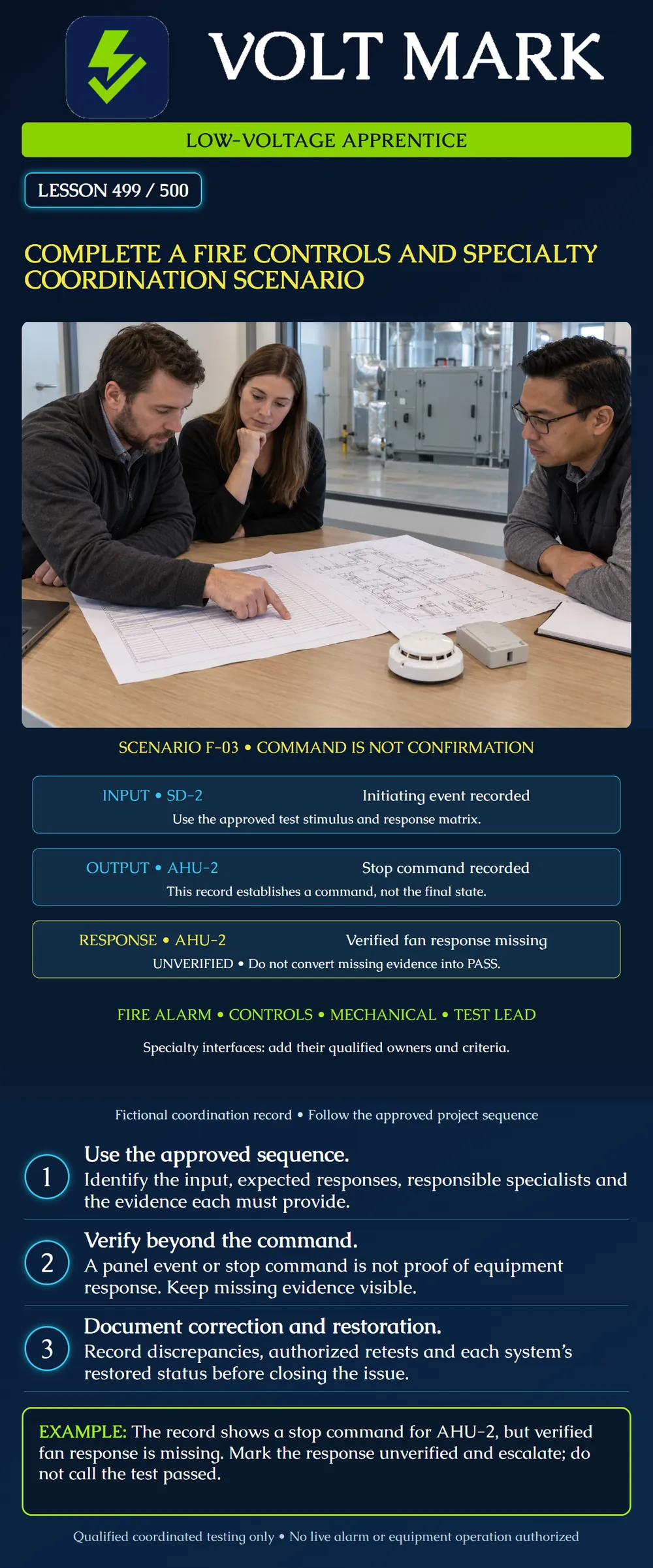
Read a fictional coordination matrix, distinguish a commanded action from verified equipment response, assign unanswered questions to the responsible specialist and document a controlled closeout.
This is a tabletop record review. It is not a test procedure, wiring diagram, impairment permit or authorization to operate a fire alarm, air handler, smoke-control system, elevator or suppression system. All actions described below belong to an approved project plan carried out by qualified, authorized personnel.
The fictional approved narrative says an initiating event at SD-2 must produce the specified panel indication and request the assigned AHU-2 stop response. The actual project would define device type, signal classification, interface details, timing, proof of response and reset behavior. This lesson does not assign a universal alarm or supervisory classification to every detector.
Supplied records show:
The question is whether the record demonstrates the complete intended response. It does not. The correct conclusion is missing response and restoration evidence, not an invented diagnosis that the fan definitely failed.
For this original exercise, create four columns: required behavior, supplied evidence, unresolved item and responsible reviewer.
Row A: initiating event. Refer to its recorded ID and the supplied approved narrative. Ask the fire-alarm specialist whether the event and indication match the intended test case. Row B: stop command. Refer to the output record. Ask the controls/interface specialist to confirm its identity and meaning. Row C: final fan response. Mark unverified. Ask the mechanical/controls specialist and test lead for the approved response evidence. Row D: restored condition. Mark not documented. Ask the test lead to obtain the required system-specific restoration records.
The apprentice may organize evidence and identify gaps within assigned responsibilities. The apprentice does not assume the authority of the engineer, integrated testing lead, elevator mechanic or other specialist.
There are several possible explanations: the response may have occurred but not been documented; the wrong equipment may have been observed; the command may not have reached the intended interface; or the equipment may not have responded. The supplied facts cannot select one.
Do not change programming or substitute a new output based on a guess. Preserve the original issue and request the evidence needed to distinguish the possibilities. When an actual fault is found, its authorized correction and retest should be linked to the original finding.
An indicator that says “commanded off” is not automatically measured fan status. Conversely, a feedback point also needs an understood source and acceptance criterion. The approved plan determines what evidence establishes the required response.
If the project includes elevator recall, smoke control, suppression release, door release or emergency communications, add the correct specialist and the exact approved response to the coordination plan. Do not assume that all fans stop for every fire event; some engineered sequences intentionally operate selected equipment.
Do not treat a general-purpose building automation display as the whole fire-safety system. The approved architecture and listed equipment instructions govern the interface. This exercise proposes no terminals, bypasses, software changes or release commands.
System Sensor's D4120 instructions discuss model-specific fan-shutdown arrangements and notification before maintenance. Its duct-detector instructions also distinguish duct detection from open-area protection. These limited examples show why the actual product manual matters. They do not establish that the fictional SD-2 is that model or that its wiring applies to this case.
Before any real test, the responsible team must resolve authorization, affected occupants and systems, monitoring arrangements, required notifications, safe conditions and the approved test method. The test lead assigns who observes each response and when to stop if unexpected conditions occur.
A successful command record does not close an unresolved response. A later correction does not erase the initial discrepancy. Link the original record, correction, retest and restoration evidence.
Do not mark all systems restored because one panel appears normal. The responsible specialists must confirm their assigned equipment states and the required monitoring/notification closeout under the approved process. No real restoration is represented by this lesson.
UCSF Environment, Health & Safety, Fire Prevention Design Bulletin #0003, revised January2026: https://ehs.ucsf.edu/fire-prevention-design-bulletin-0003-integrated-fire-protection-and-life-safety-system-testing This primary institutional example discusses coordinated response testing, identified responsibilities, matrices and discrepancy records. Its California/UCSF requirements and edition references are not presented as law for all states. The fictional case and review matrix above are original instruction.
System Sensor/Honeywell D4120 installation instructions: https://prod-edam.honeywell.com/content/dam/honeywell-edam/hbt/en-us/documents/manuals-and-guides/installation-guides/I56-2967-002R.pdf Primary manufacturer search text reviewed for the limited notification/fan-shutdown concepts. Use the correct current manual for the installed model and revision.
Access note: NFPA's standard-development page returned no extractable substantive text. Committee revision reports found in search were not used as adopted final requirements.
Use the fictional F-03 packet. A new note says AHU-2 was commanded off, while a photo shows an unidentified fan display. The restoration row is still blank. Write the unresolved items and assign the next evidence request without operating any equipment.
Answer: The command remains evidence of an output, not proof of AHU-2's actual response. The photo needs equipment identity, time and an understood indication before it can support the approved response criterion. Ask the mechanical/controls specialist and test lead for the required response evidence, and ask the responsible specialists for restoration and monitoring closeout records. Keep both response and restoration unresolved until verified; do not label the fan failed solely because evidence is absent.
Mistake: Accepting commanded off on a controls screen as verified fan stoppage. Correction: Identify what the point actually represents and compare the approved response criterion with independently appropriate response evidence. An output request and the resulting equipment state are different records.
Mistake: Diagnosing a failed fan from the missing response record and changing programming immediately. Correction: Mark the response unverified. Resolve equipment identity, interface meaning and missing evidence through the responsible specialists before deciding a cause or authorizing correction.
Mistake: Closing F-03 when the fire panel looks normal while the restoration row remains blank. Correction: Obtain the system-specific restoration and required monitoring/notification closeout evidence from the assigned specialists. Preserve the original discrepancy and link any correction and retest.
Texas journeyman, 15 questions, scored by topic against the 70% mark. No card, and no account needed to start.
Free study material for low-voltage apprentices. This is a national foundation course: requirements differ by state and by local jurisdiction, and a practice that is common in one place is not a rule everywhere. Nothing here is a licence, a certification, or authority to work unsupervised, and completing it does not count as apprenticeship hours or continuing-education credit. Check the codes adopted where you are working, the licensing authority for that work, and your employer's safety programme. VoltMark is not affiliated with, endorsed by, or sponsored by NFPA, OSHA, NICET, BICSI, FOA, or any state or local licensing authority.
Electrician licensing exam prep: practice questions, timed exam simulations, and step-by-step help finding every answer in the NEC.