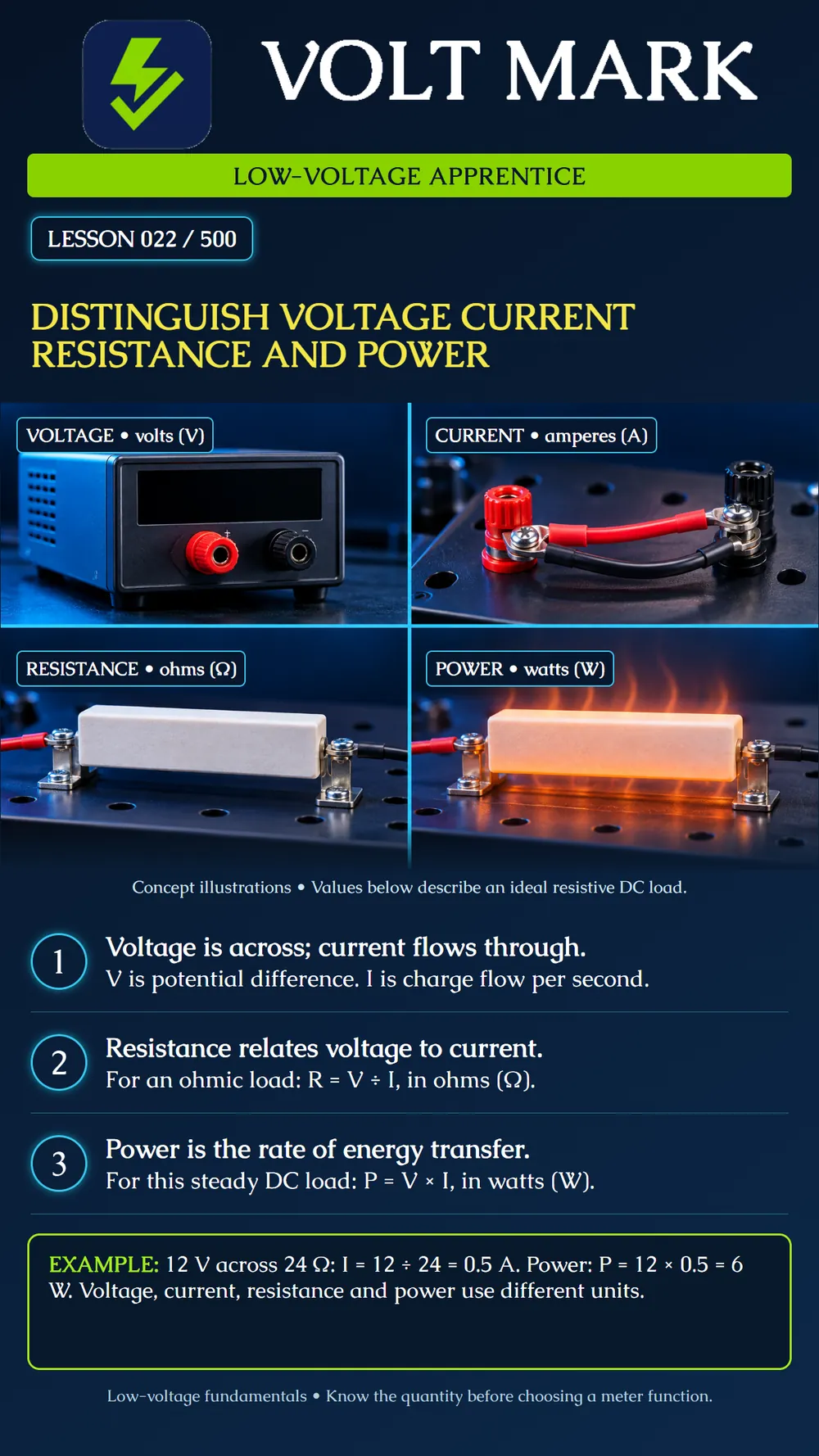
Identify four electrical quantities, state their units and use a simple resistive DC example to explain how they relate.
Voltage (symbol V in this lesson) is potential difference between two points, measured in volts (V). Current (I) is the rate of electric charge flow, measured in amperes (A). Resistance (R) describes opposition to current and, for an ohmic load, relates voltage and current through V = I × R. Its unit is the ohm (Ω). Power (P) is energy transferred per unit time, measured in watts (W). For the steady DC load here, P = V × I. A watt is one joule per second.
The supply terminals represent two points with a potential difference. The conductors represent a current path. The ceramic resistor represents a resistive load. The pale arrows represent energy leaving that resistor as heat. The artwork illustrates concepts; it does not provide component ratings or measured readings. These are four views of ideas, not a wiring instruction.
A fictional classroom worksheet specifies an ideal 12 V DC source and an ideal 24 Ω resistive load, neglecting conductor resistance. The source maintains 12 V across that load. First identify the quantity requested: current. I = V ÷ R = 12 V ÷ 24 Ω = 0.5 A. Next identify a different requested quantity: power. P = V × I = 12 V × 0.5 A = 6 W. Write four separate lines on the worksheet: Voltage across load: 12 V. Current through load: 0.5 A. Load resistance: 24 Ω. Power transferred to load: 6 W. The resistor converts that electrical energy to heat. Its temperature depends on construction, mounting and cooling, not just the number printed in the calculation.
Rewrite each fictional note: “The device has 12 amps of voltage.” Correct: “The voltage across the device is 12 V,” if that is the verified quantity. “This 24-watt resistance gives half a volt of current.” Correct for this worksheet: “The load resistance is 24 Ω, and the calculated current is 0.5 A.” “The 6 W result tells us its temperature.” Correct: “The load dissipates 6 W; its temperature has not been calculated.” These corrections show why a bare number is inadequate in a work note.
The worksheet uses a resistor whose resistance is treated as constant. Do not assume every camera, reader, controller, motor or LED assembly acts like that resistor. Electronic loads can change operating state and draw different current. The calculated 6 W is dissipation in this example, not an instruction to choose a resistor with exactly a 6 W maximum rating. Real selection requires the manufacturer's operating limits and thermal conditions. This lesson identifies quantities; meter connection procedures belong in their own supervised lessons.
Q: Which quantity is described between two points? A: Voltage. Q: Which quantity describes charge flow per second? A: Current. Q: Which unit belongs beside resistance? A: Ohms, written Ω. Q: What is the power in this 12 V, 0.5 A example? A: 6 W. Q: Why include units in a job note? A: They identify what the number actually describes.
Treating V, A, Ω and W as interchangeable labels. Read the full quantity and unit before interpreting a number or selecting a meter function.
Voltage is potential difference. Current is charge flow. Resistance relates voltage and current for an ohmic load. Power is the rate of energy transfer. In our example, 12 volts across 24 ohms produces half an ampere and six watts of heat.
SparkFun, Voltage, Current, Resistance, and Ohm's Law: https://learn.sparkfun.com/tutorials/voltage-current-resistance-and-ohms-law OpenStax, Physics, 19.4 Electric Power: https://openstax.org/books/physics/pages/19-4-electric-power The worksheet and note-correction exercise are original instructional examples.
Free study material for low-voltage apprentices. This is a national foundation course: requirements differ by state and by local jurisdiction, and a practice that is common in one place is not a rule everywhere. Nothing here is a licence, a certification, or authority to work unsupervised, and completing it does not count as apprenticeship hours or continuing-education credit. Check the codes adopted where you are working, the licensing authority for that work, and your employer's safety programme. VoltMark is not affiliated with, endorsed by, or sponsored by NFPA, OSHA, NICET, BICSI, FOA, or any state or local licensing authority.

Electrician licensing exam prep: practice questions, timed exam simulations, and step-by-step help finding every answer in the NEC.