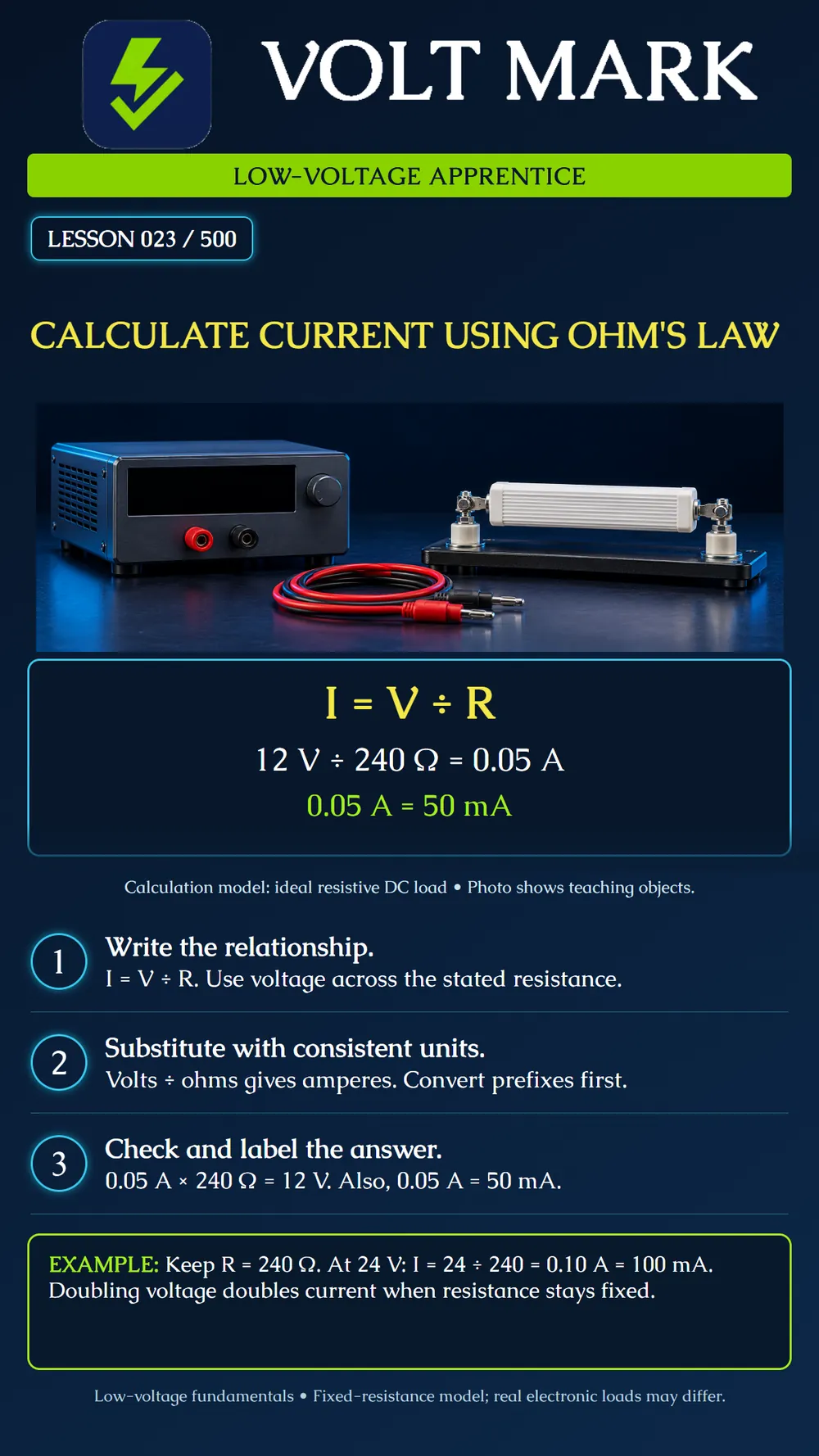
Calculate current through a resistive DC load from the voltage across it and its resistance. Label the result in amperes and convert it to milliamperes.
For an ohmic load, V = I × R. Rearrange this as I = V ÷ R. Use voltage across the load, not an unrelated voltage elsewhere. Use that load's resistance. Volts divided by ohms gives amperes. Identify the unknown, write the equation, substitute values with units, calculate, then check whether the answer makes sense.
A classroom worksheet specifies an ideal 12 V DC source connected across an ideal 240 Ω resistor. Neglect wire resistance for this calculation. Known: V = 12 V; R = 240 Ω. Unknown: I. Equation: I = V ÷ R. Substitute: I = 12 V ÷ 240 Ω. Calculate: I = 0.05 A. Convert: 0.05 A × 1,000 mA/A = 50 mA. The two current values are the same quantity written in different units. Do not report 0.05 mA; that would be 1,000 times too small.
Multiply calculated current by resistance: 0.05 A × 240 Ω = 12 V. That returns the stated load voltage. Now keep the same 240 Ω resistance but change the worksheet voltage to 24 V: I = 24 ÷ 240 = 0.10 A = 100 mA. With resistance fixed in this model, doubling the voltage doubles current. The example does not authorize applying a higher voltage to real equipment.
Answer: 24 ÷ 480 = 0.05 A = 50 mA.
Answer: 12 ÷ 1,200 = 0.01 A = 10 mA.
Answer: They reversed the division. Current is voltage divided by resistance.
Answer: The current unit; this result is 50 mA, not 50 A.
These are steady-state resistor calculations. A powered camera, reader, sounder or controller may not behave like a fixed resistor. Use its documented operating and startup current when planning system demand. Also distinguish voltage at a supply from voltage actually across a distant load; cable voltage drop is addressed later. The resistor's power rating and operating temperature are separate checks. A resistance value alone does not establish that a component can dissipate the resulting power. Lesson 024 addresses component loading. This is a calculation lesson, not instructions for inserting a meter into an energized circuit.
Mixing kilo-ohms with ohms or milliamps with amps without converting. Write units in every calculation line.
To calculate current in our resistive DC example, divide volts by ohms. Twelve volts divided by 240 ohms is 0.05 amperes, or 50 milliamperes. Check by multiplying current by resistance. Use the right model, the right voltage, and the right units.
SparkFun, Voltage, Current, Resistance, and Ohm's Law: https://learn.sparkfun.com/tutorials/voltage-current-resistance-and-ohms-law The numerical worksheet, checks and practice questions above are original teaching examples.
Free study material for low-voltage apprentices. This is a national foundation course: requirements differ by state and by local jurisdiction, and a practice that is common in one place is not a rule everywhere. Nothing here is a licence, a certification, or authority to work unsupervised, and completing it does not count as apprenticeship hours or continuing-education credit. Check the codes adopted where you are working, the licensing authority for that work, and your employer's safety programme. VoltMark is not affiliated with, endorsed by, or sponsored by NFPA, OSHA, NICET, BICSI, FOA, or any state or local licensing authority.

Electrician licensing exam prep: practice questions, timed exam simulations, and step-by-step help finding every answer in the NEC.