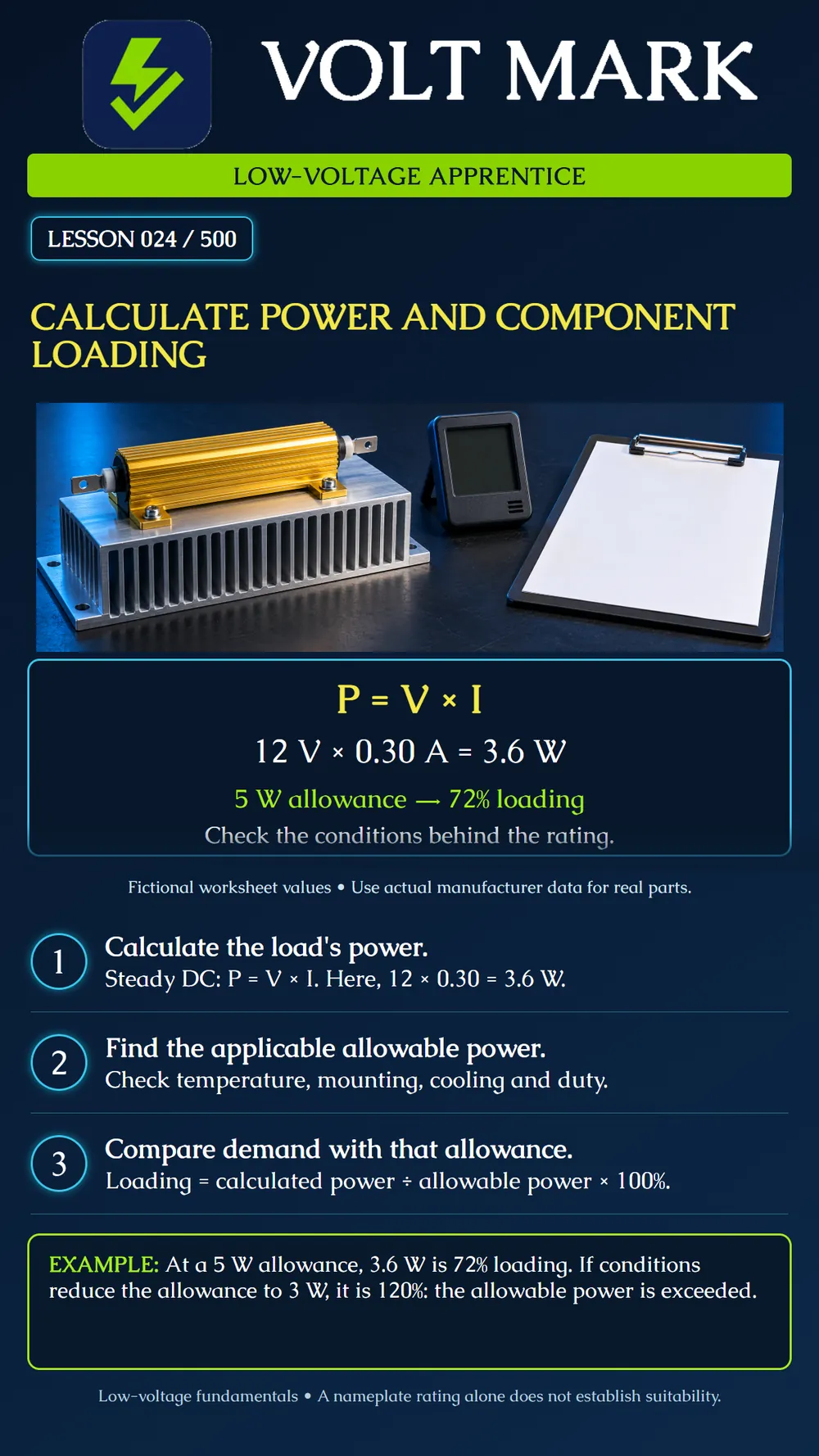
Calculate steady DC power and compare it with the component's applicable allowable dissipation. Explain why operating conditions affect that comparison.
For a steady DC load, power is P = V × I. Use volts across the load and amperes through it; the result is watts. For an ohmic resistor, equivalent forms are P = I²R and P = V²/R. A resistor's wattage rating describes dissipation under stated conditions. It is not the amount of power that the component always consumes. Manufacturer data may require reduced allowable power at higher temperatures or specify particular mounting and cooling.
A fictional training worksheet gives 12 V across a load and 0.30 A through it: P = 12 V × 0.30 A = 3.6 W. The worksheet then supplies two hypothetical operating-condition allowances. These are invented teaching values, not specifications for the pictured component.
Condition A: the applicable allowable dissipation is 5 W. Loading = 3.6 W ÷ 5 W × 100% = 72%. The calculated dissipation is below this particular allowance. That single comparison does not approve the installation; other component limits and design requirements still apply.
Condition B: different thermal conditions reduce the applicable allowance to 3 W. Loading = 3.6 W ÷ 3 W × 100% = 120%. The calculated dissipation exceeds this allowance. The original 5 W figure cannot be used to dismiss the condition-specific restriction.
An apprentice's note for the fictional example could read: “Load voltage: 12 V. Load current: 0.30 A. Calculated dissipation: 3.6 W. Applicable allowance for Condition B: 3 W, per the supplied worksheet. Loading: 120%. This condition exceeds the supplied allowance; refer for design correction.” A real note should identify the actual part number, manufacturer document revision, applicable conditions and the source of each measured or specified value.
Answer: 24 × 0.20 = 4.8 W.
Answer: 4.8 ÷ 8 × 100% = 60%.
Answer: The load still dissipates 4.8 W under the stated electrical conditions, but loading is now 120%; it exceeds that allowance.
Answer: No. The rating describes a limit, not an automatic control of consumption.
Check continuous and pulse conditions separately where the manufacturer distinguishes them. Average power alone may not establish suitability for pulses or startup events. A source's output power capacity, a resistor's heat dissipation, and a device's input consumption describe different roles. Do not substitute one rating for another. The worksheet percentages are comparisons, not universal 72%, 80% or other design rules. Follow the particular equipment requirements and approved design. For AC or complex electronic loads, additional considerations apply; this lesson's arithmetic is explicitly steady DC.
Dividing by the largest printed wattage without checking the conditions attached to it.
Calculate the load's watts, find the allowable watts for the actual conditions, and compare them. Our load uses 3.6 watts. That is 72 percent of a five-watt allowance, but 120 percent of a three-watt allowance. The operating conditions matter.
OpenStax, Physics, 19.4 Electric Power: https://openstax.org/books/physics/pages/19-4-electric-power Vishay, Resistor frequently asked questions, power dissipation and derating: https://www.vishay.com/en/landingpage/rifaq/ The two-condition worksheet and practice values are original, fictional teaching examples; no specific Vishay rating is asserted.
Free study material for low-voltage apprentices. This is a national foundation course: requirements differ by state and by local jurisdiction, and a practice that is common in one place is not a rule everywhere. Nothing here is a licence, a certification, or authority to work unsupervised, and completing it does not count as apprenticeship hours or continuing-education credit. Check the codes adopted where you are working, the licensing authority for that work, and your employer's safety programme. VoltMark is not affiliated with, endorsed by, or sponsored by NFPA, OSHA, NICET, BICSI, FOA, or any state or local licensing authority.

Electrician licensing exam prep: practice questions, timed exam simulations, and step-by-step help finding every answer in the NEC.