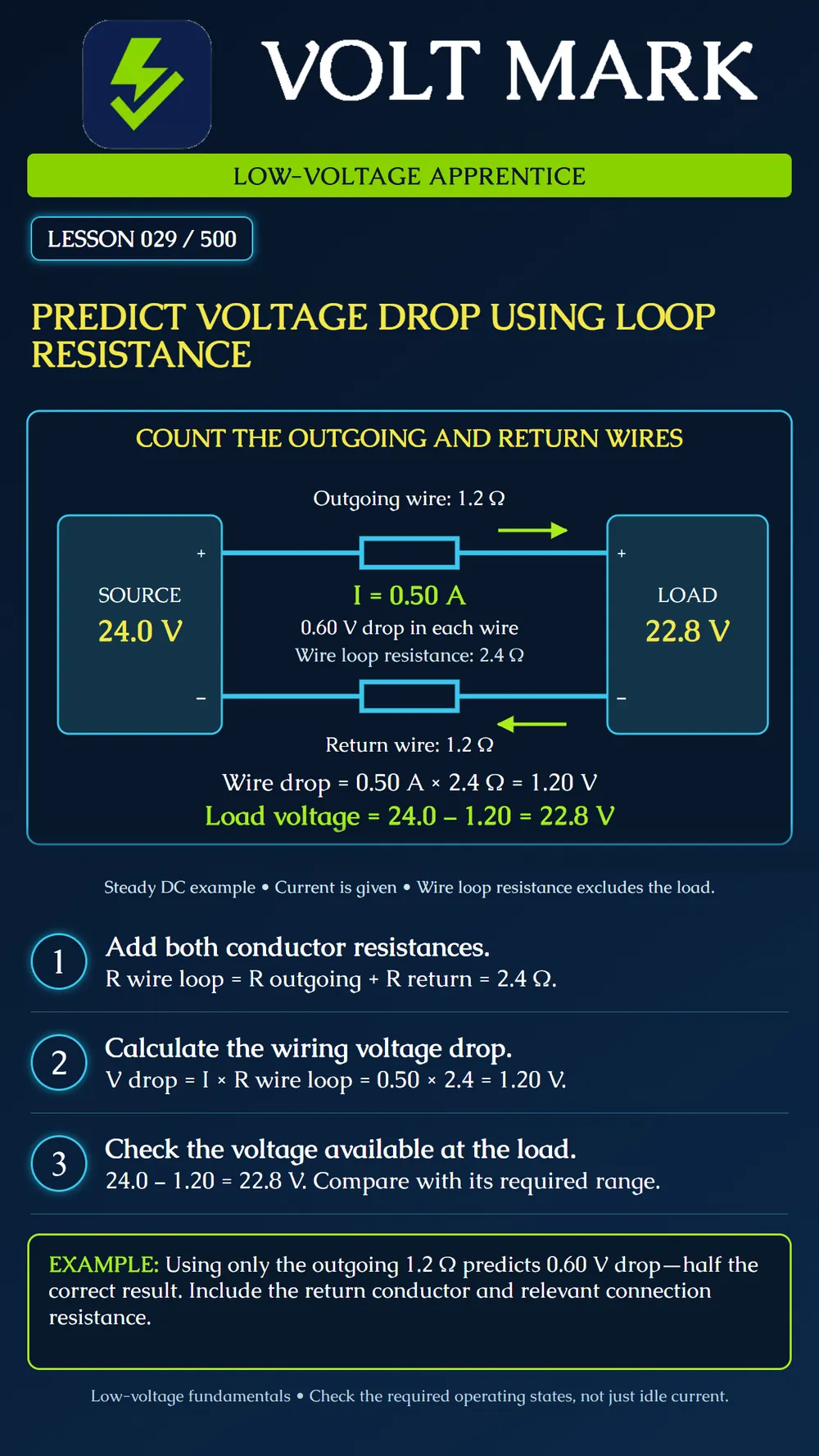
Predict wiring voltage drop in a two-conductor DC circuit and calculate the voltage remaining across the load.
Current travels through an outgoing conductor and a return conductor. Both have resistance. In this simple path, add their resistances to obtain the wire-loop resistance, then multiply by the current: R wire loop = R outgoing + R return. V wire drop = I × R wire loop. V load = V source − V wire drop. Here “wire-loop resistance” excludes the load itself. It is not the entire circuit's resistance used to derive the current in an earlier resistor-only exercise.
A fictional worksheet supplies these operating values: Source-terminal voltage under the stated load: 24.0 V DC. Load current in the stated operating condition: 0.50 A. Outgoing conductor resistance: 1.2 Ω. Return conductor resistance: 1.2 Ω. For the first calculation, connection resistance is assumed negligible.
The worksheet now states that the fictional load requires at least 23.0 V at its terminals in this operating condition. Predicted load voltage: 22.8 V. Requirement: at least 23.0 V. Conclusion: the predicted voltage is 0.2 V below the stated minimum; refer the design for correction. This is not a universal minimum for 24 V equipment. Now change only the worksheet's operating current to 0.75 A: Wire drop = 0.75 × 2.4 = 1.80 V. Load voltage = 24.0 − 1.80 = 22.2 V. At the same wiring resistance, a higher current produces a larger drop.
A second fictional exercise supplies 0.20 Ω of additional total series connection resistance. Use 2.4 Ω + 0.20 Ω = 2.60 Ω. At 0.50 A, drop is 1.30 V and load voltage is 22.70 V. Do not assume actual connection resistance is zero merely because the cable calculation is complete. Abnormal connection resistance also needs investigation.
Use the cable manufacturer's applicable resistance data and the actual circuit lengths. Identify whether a listed value is per conductor or already a loop value. Do not double an already combined loop value. Evaluate the required operating conditions, including relevant startup or simultaneous demand and the source voltage available in those conditions. For electronic loads, current can change with voltage; use the approved calculation method and equipment data rather than assuming every load draws a fixed current. This lesson is a simple two-wire DC model. Branched circuits, distributed loads and AC effects can require other analysis. Voltage-drop prediction alone does not establish conductor ampacity, cable suitability, circuit classification or system compliance.
Q: Why include the return conductor? A: It carries the same loop current and contributes resistance. Q: What does the 2.4 Ω value exclude? A: The load resistance. Q: Does the example derive current from source voltage alone? A: No; current is supplied for the stated operating condition. Q: Is a universal percentage used as the acceptance limit? A: No; compare against the applicable equipment and system requirements.
Calculating only the outward path and understating the total voltage loss.
Count the outgoing wire and the return wire. Add their resistances, multiply by current, and subtract that drop from source-terminal voltage. Our two-point-four-ohm wire loop at half an amp loses one-point-two volts, leaving twenty-two-point-eight volts across the load.
Altronix, application notes and voltage-drop calculation resources: https://www.altronix.com/app_notes OpenStax, Physics, 19.2 Series Circuits: https://openstax.org/books/physics/pages/19-2-series-circuits The values and equipment minimum in the worksheet are original fictional examples, not cable specifications or universal limits.
Free study material for low-voltage apprentices. This is a national foundation course: requirements differ by state and by local jurisdiction, and a practice that is common in one place is not a rule everywhere. Nothing here is a licence, a certification, or authority to work unsupervised, and completing it does not count as apprenticeship hours or continuing-education credit. Check the codes adopted where you are working, the licensing authority for that work, and your employer's safety programme. VoltMark is not affiliated with, endorsed by, or sponsored by NFPA, OSHA, NICET, BICSI, FOA, or any state or local licensing authority.

Electrician licensing exam prep: practice questions, timed exam simulations, and step-by-step help finding every answer in the NEC.