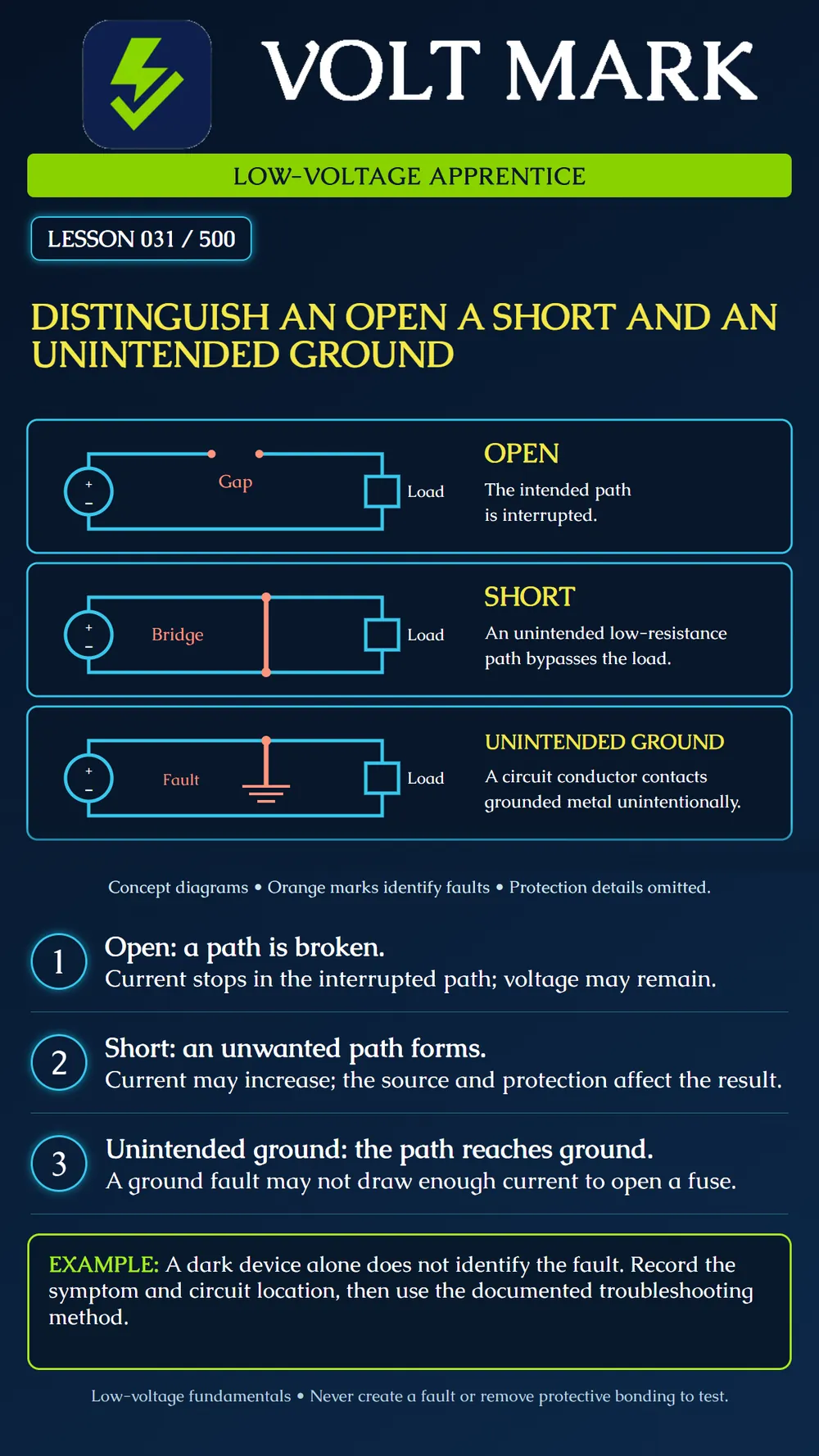
Distinguish three fault descriptions by tracing which connection is missing or unintended, rather than naming a fault from a symptom alone.
An open is an interruption in an intended conductive path. In the simple single-path example, it stops steady current, but voltage can remain across the interruption. A short is an unintended low-resistance path between points that should not be directly connected. The example bridges around the load. An unintended ground connects a circuit conductor to ground or grounded metal where the design does not intend that connection. Its effects depend on circuit grounding, available return paths, fault resistance and monitoring. These terms can overlap: a low-resistance short to grounded metal is also a ground fault.
Top: the gap in the outgoing wire is an open. The load and source are still drawn, but there is no complete intended path. Middle: the orange bridge joins outgoing and return conductors before the load, bypassing it. Source current may be limited by source impedance, current limiting or protective operation; an ideal zero-resistance/infinite-current calculation is not a real equipment prediction. Bottom: the orange branch connects a conductor to the ground symbol. No source-to-ground bond is shown. This intentionally does not assert a large complete fault-current path. A first ground fault on an otherwise isolated circuit may draw limited current while still being an important fault. The drawings omit protection details for clarity and are not installation or test instructions.
A fictional supervised trainer presents three records:
A useful fictional report says: “The trainer's outgoing conductor is visibly separated at terminal X2; device status is off. No electrical testing has been performed.” It separates observation from conclusion. A weak report says: “It's shorted because it doesn't work.” That conclusion is unsupported by the symptom.
A fuse that has not opened does not rule out a ground fault, an open, or every short. Fault current depends on the complete path and the equipment response. Some monitored systems identify faults that do not operate overcurrent protection. Likewise, an open protective device does not by itself locate the original cause. Follow the equipment's documented diagnostic process and preserve observations before changing connections.
Q: Which diagram has a missing intended connection? A: The open. Q: Which diagram has an unwanted bridge around the load? A: The short. Q: Is every ground fault guaranteed to open a fuse? A: No. Q: Can an open point still have voltage across it? A: Yes. Q: Does a continuity indication alone prove that an intended path is healthy? A: No; parallel paths and connected equipment can affect interpretation. Q: Should you create a short or disconnect protective bonding to see what happens? A: No.
The lesson concerns recognition and clear reporting in low-voltage systems. It does not prescribe resistance thresholds or live test procedures. Fire-alarm, security and control equipment can use different supervision arrangements and manufacturer-defined fault indications. Use the correct drawings and authorized test process before isolating circuits or disconnecting devices. Do not assume an intentional system bond is a fault just because it connects a conductor to ground.
Using “short” as a name for every electrical problem.
An open breaks an intended path. A short creates an unwanted low-resistance path. An unintended ground connects the circuit to ground where it should not. Trace the connection and describe the evidence; a device that stops working does not identify the fault by itself.
SparkFun, What Is a Circuit?, open and short circuits: https://learn.sparkfun.com/tutorials/what-is-a-circuit/short-and-open-circuits Fluke, ground-fault path discussion: https://www.fluke.com/en-us/learn/blog/grounding/chasing-ghost-trips-in-gfci-protected-circuits Only the general unintended-path principle is used from the Fluke article; its receptacle and GFCI application is not applied as a universal low-voltage requirement. The trainer records and reporting exercise are original fictional examples.
Free study material for low-voltage apprentices. This is a national foundation course: requirements differ by state and by local jurisdiction, and a practice that is common in one place is not a rule everywhere. Nothing here is a licence, a certification, or authority to work unsupervised, and completing it does not count as apprenticeship hours or continuing-education credit. Check the codes adopted where you are working, the licensing authority for that work, and your employer's safety programme. VoltMark is not affiliated with, endorsed by, or sponsored by NFPA, OSHA, NICET, BICSI, FOA, or any state or local licensing authority.

Electrician licensing exam prep: practice questions, timed exam simulations, and step-by-step help finding every answer in the NEC.