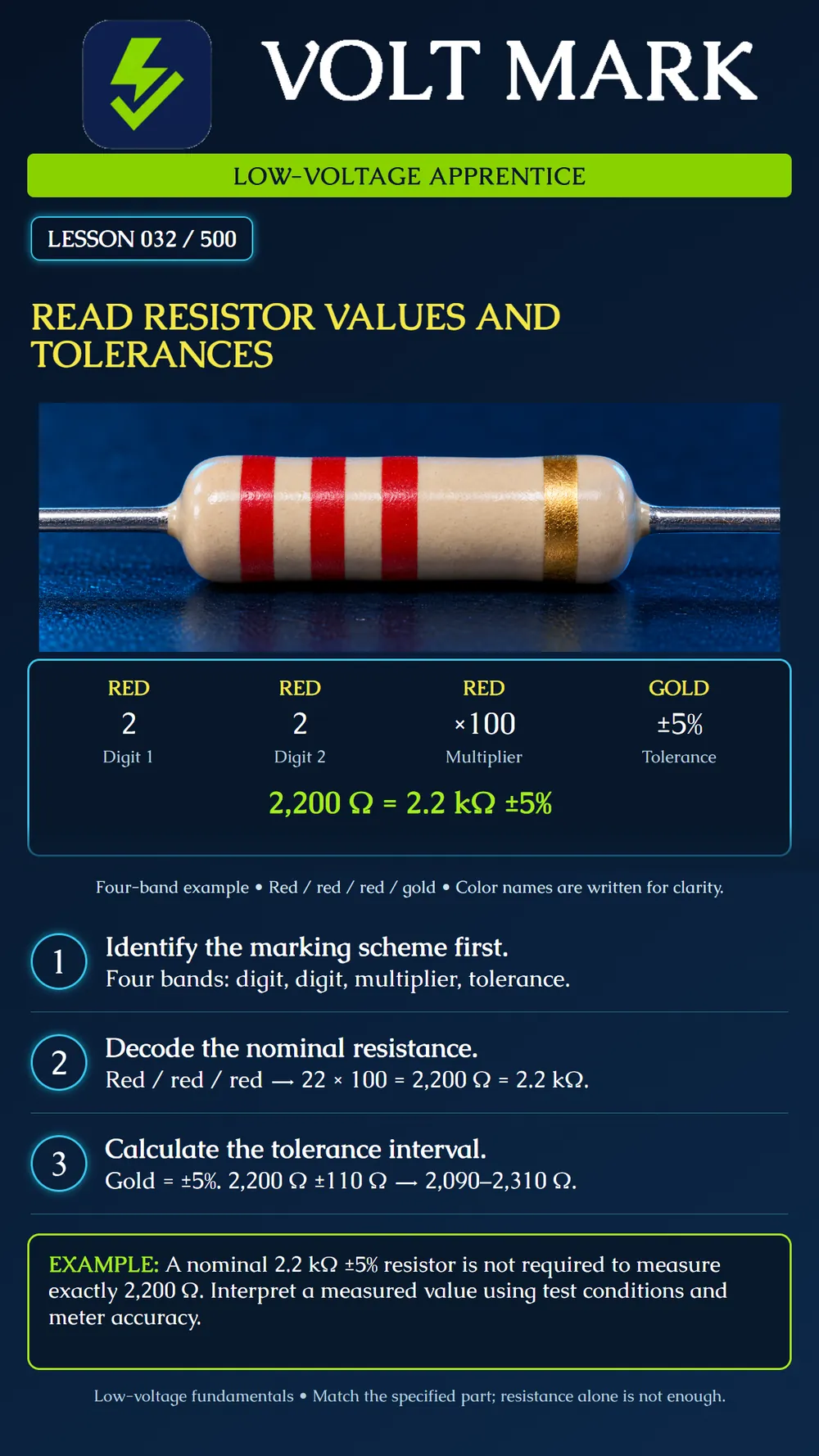
Read a standard four-band resistor example and calculate the interval represented by its stated resistance tolerance.
For the four-band scheme used here, the first two bands are significant digits, the third is the multiplier and the fourth is tolerance. The pictured example reads red, red, red, gold: First red: digit 2. Second red: digit 2. Third red: multiplier ×100. Gold: tolerance ±5%. Thus 22 × 100 = 2,200 Ω = 2.2 kΩ, with ±5% tolerance.
Identify band count and reading direction before assigning values. The separated tolerance band helps orient this example, but do not assume every component uses this exact layout. Five-band, six-band and printed markings require their applicable decoding scheme. If color is ambiguous, use good lighting, the manufacturer identification and appropriate verification. The written color names on the poster make the intended example unambiguous.
Nominal resistance: 2,200 Ω. Tolerance fraction: 5 ÷ 100 = 0.05. Deviation: 2,200 × 0.05 = 110 Ω. Lower endpoint: 2,200 − 110 = 2,090 Ω. Upper endpoint: 2,200 + 110 = 2,310 Ω. The interval is 2.09–2.31 kΩ under the applicable specification conditions. Tolerance is not an instruction to add 5% to the value whenever it is used in a circuit.
An instructor provides three fictional corrected resistance results for isolated resistors under the applicable test conditions: A: 2,180 Ω. B: 2,300 Ω. C: 2,350 Ω. For this paper exercise, treat the values as exact. A and B fall within 2,090–2,310 Ω. C is above the upper endpoint by 40 Ω. In actual testing, meter uncertainty, lead effects, temperature and connected circuit paths must be considered before declaring a component out of specification. A rounded display number at a boundary is not automatically decisive.
The worksheet states a nominal resistance of 1,000 Ω with ±1% tolerance. Deviation: 1,000 × 0.01 = 10 Ω. Interval: 990–1,010 Ω. This problem gives the value and tolerance directly; it does not ask you to infer its band colors from the previous red/gold photograph.
The nominal resistance and tolerance alone do not specify every required rating. Confirm power dissipation, voltage limits, technology and other relevant characteristics using the actual part documentation. An end-of-line resistor in a security or fire-alarm system must match the specified equipment arrangement and value. The 2.2 kΩ example is not a universal end-of-line value and is not a substitute for the system's listed instructions. Do not remove or substitute a supervised-system component solely to match a classroom example.
A clear fictional component note says: “Four-band marking: red/red/red/gold. Decoded nominal value: 2.2 kΩ ±5%. Calculated tolerance endpoints: 2.09 kΩ and 2.31 kΩ.” Keep a measured result separate from that decoded marking. A part's nominal value and a particular measurement are related but not identical records.
Q: What does the third red band mean in this four-band example? A: Multiply by 100. Q: What does the gold band mean here? A: ±5% tolerance. Q: Is 2.2 kΩ the same as 2.2 Ω? A: No; 2.2 kΩ is 2,200 Ω. Q: Does tolerance specify power rating? A: No. Q: Can the same band positions be assumed for every resistor marking scheme? A: No.
Reading the third band as another digit in a four-band resistor, or confusing kilo-ohms with ohms.
First identify the marking scheme. In our four-band example, red-red-red-gold means 22 times 100 ohms, with five percent tolerance. That is 2.2 kilo-ohms, with calculated endpoints of 2.09 and 2.31 kilo-ohms. Confirm the complete part specification before using it.
Vishay, Resistor Color Code Calculator chart: https://www.vishay.com/docs/49411/resistor_color_code_calculator.pdf The tolerance worksheet and hypothetical readings above are original teaching exercises.
Free study material for low-voltage apprentices. This is a national foundation course: requirements differ by state and by local jurisdiction, and a practice that is common in one place is not a rule everywhere. Nothing here is a licence, a certification, or authority to work unsupervised, and completing it does not count as apprenticeship hours or continuing-education credit. Check the codes adopted where you are working, the licensing authority for that work, and your employer's safety programme. VoltMark is not affiliated with, endorsed by, or sponsored by NFPA, OSHA, NICET, BICSI, FOA, or any state or local licensing authority.

Electrician licensing exam prep: practice questions, timed exam simulations, and step-by-step help finding every answer in the NEC.