Identify whether an output supplies load power or only switches another circuit, and identify the documentation needed to connect it correctly.
A dry contact has no internal power feed applied to the switched contact circuit. It can open or close a separately supplied circuit. Once connected, that external circuit can place voltage on the contact terminals. A powered output supplies a specified voltage or power from the equipment in its applicable operating state. Its voltage, polarity, current capacity and behavior must match the connected equipment. Neither description alone establishes every interface requirement.
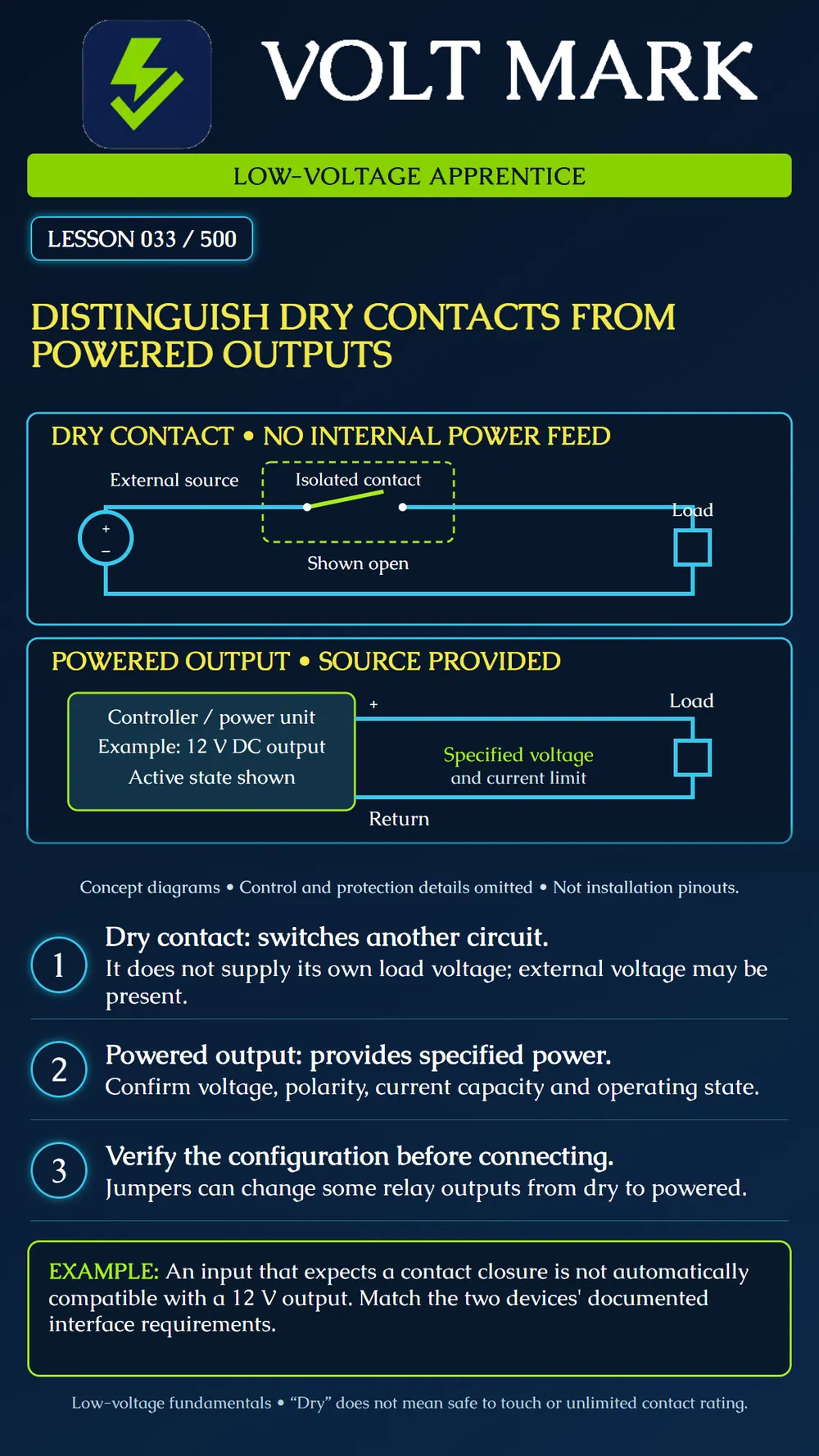
Top: an external source, an isolated switching contact and a load form the illustrated circuit. The contact is drawn open, so the intended load path is interrupted. Its control mechanism is omitted. The dashed boundary identifies the contact portion; no internal source is connected to it. Bottom: the controller/power-unit block supplies the load from its powered output. The active state is shown. The example label “12 V DC” is a teaching value, not a rating for an actual product. Protection details are omitted in both concept drawings. They are not wiring diagrams for a door, alarm panel or other real installation.
A fictional receiving device says: “Input X expects closure of an isolated external contact. Do not apply external voltage.” Candidate A is documented as an isolated dry relay contact with suitable contact ratings. Candidate B is documented as a 12 V powered output. Candidate A matches the stated type of interface, subject to confirming the remaining requirements. Candidate B is not a direct substitute: applying its voltage would conflict with the input instruction. Do not infer compatibility from connector shape or the shared word “output.”
A separate indicator requires a documented DC supply. A dry contact by itself is not that supply. An approved circuit could use the contact to switch the indicator's compatible external supply, within contact ratings and the complete design. This distinction is about where energy comes from. The controller may use power to operate a relay coil while the isolated contact circuit remains dry.
The Axis A1210 documentation provides a manufacturer-specific example: fitting its relay power jumper connects a selected DC supply to relay COM. This illustrates why a relay connector must be interpreted with its actual configuration. It is not an instruction to change jumpers on other equipment. Record the model, connector, pin function and configuration before choosing a connection.
An electronic open-drain or open-collector output may switch a path to a circuit reference and require an external source or pull-up. It is not automatically an isolated dry relay contact and not automatically a voltage-sourcing output. Read its interface specification, including reference, polarity and limits. This lesson's two concept drawings do not cover every output topology.
Identify the sending output's type and operating state. Identify what the receiving input or load requires. Check isolation/reference requirements, voltage type and level. Check current and contact ratings for the intended load type. Check documented jumper or software configuration. Use the approved interface method if the two devices do not connect directly.
Q: Does a dry contact generate its own load voltage? A: No. Q: Can voltage be present on a dry contact after connection? A: Yes, from the external circuit. Q: Does relay-coil power prove the contacts are powered outputs? A: No. Q: Is every electronic switching output an isolated dry contact? A: No. Q: Can a configuration jumper change an output's behavior on some products? A: Yes; verify the particular documentation.
Connecting a powered output to an input that expects only an isolated contact closure.
A dry contact switches another circuit; it does not supply its own load voltage. A powered output provides specified power. Check the receiving device, the output ratings and the configuration. Dry contacts can still carry externally supplied voltage, and electronic outputs may need a different interface.
Axis, AXIS A1210 Network Door Controller, relay connector, power jumper and digital-output documentation: https://help.axis.com/en-us/axis-a1210 The receiving-input and indicator exercises are original fictional examples.
Free study material for low-voltage apprentices. This is a national foundation course: requirements differ by state and by local jurisdiction, and a practice that is common in one place is not a rule everywhere. Nothing here is a licence, a certification, or authority to work unsupervised, and completing it does not count as apprenticeship hours or continuing-education credit. Check the codes adopted where you are working, the licensing authority for that work, and your employer's safety programme. VoltMark is not affiliated with, endorsed by, or sponsored by NFPA, OSHA, NICET, BICSI, FOA, or any state or local licensing authority.

Electrician licensing exam prep: practice questions, timed exam simulations, and step-by-step help finding every answer in the NEC.