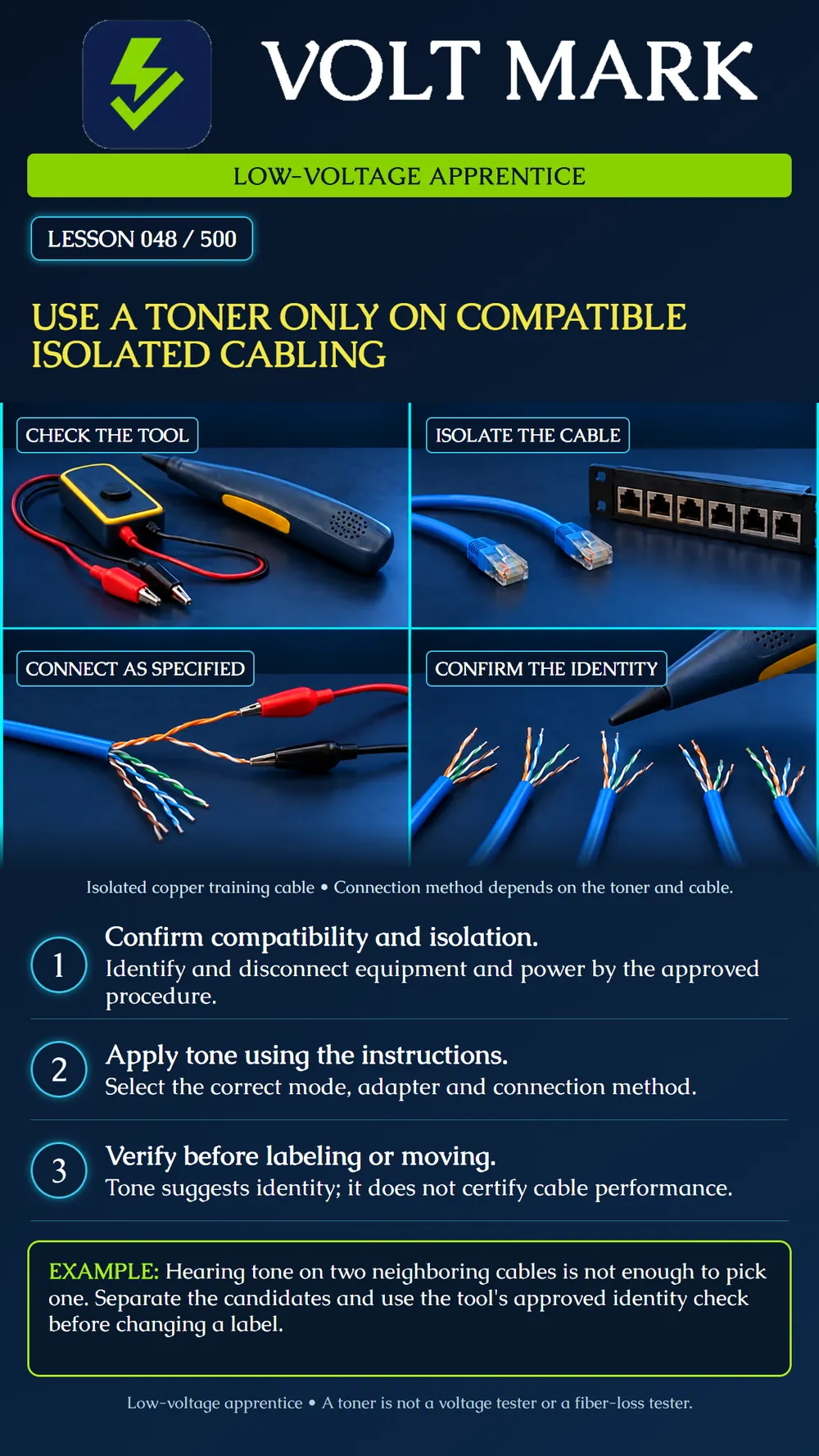
Identify an isolated copper training cable using a compatible tone generator and probe, while recognizing the limits of tone detection.
A tone generator applies an identification signal and a compatible probe detects it. Different products support different cable types, connections, operating modes, and network conditions. An analog toner intended for inactive wiring must not be treated as a universal active-network tester. Some digital systems support particular active-network tasks, but that capability belongs to the specified tool and procedure, not to every toner.
This lesson deliberately uses isolated, inactive copper training cabling. Fiber identification and optical testing use appropriate optical tools and are covered separately in the fiber sequence.
Find the cable endpoints and connected equipment through the work record and approved identification process. Consider network devices, Power over Ethernet sources, telephone equipment, control outputs, alarms, and other possible supplies. A quiet device or a dark network light is not verification that conductors are unpowered.
Coordinate any service interruption and follow the employer's isolation and verification procedure. Do not unplug an operating fire alarm, access-control, security, or network circuit simply to try a toner. If cable ownership, source, or status is unresolved, stop and involve the supervisor.
Read the actual instructions and inspect the generator, probe, leads, and adapters. Confirm the permitted voltage exposure and mode restrictions. A published protection limit is not permission to deliberately connect to an otherwise prohibited circuit. Tone and continuity modes may have different restrictions.
Use the approved connection method for the cable and tool. The poster illustrates two clips connected separately to the conductors of one isolated pair. It is an example, not a universal instruction for every cable or mode. Prevent accidental contact between clips or neighboring conductors. Do not damage insulation to make a connection unless the particular termination method is specifically permitted.
Set the generator to the specified tone mode and follow the probe instructions. Adjust sensitivity or volume appropriately. Compare candidate cable ends without disturbing unrelated conductors. Tone can couple into nearby conductors, and a loud response does not by itself establish a unique endpoint.
Use the tool's documented identity-confirmation feature or an approved independent check. Do not invent a shorting, grounding, or disconnecting step on unknown wiring. Once confirmed, record the source endpoint, destination endpoint, cable identifier, and method. Restore connections only through the approved restoration process.
Hearing a tone is not proof of electrical safety, correct pinout, absence of shorts, required bandwidth, or successful cable certification. It also does not measure optical loss in a fiber. Choose the next appropriate test for the actual question instead of treating every cable tool as interchangeable.
A technician hears a similar tone on two adjacent blue cable ends. The work order expects one cable at the remote location. Choosing the loudest cable immediately could create a false label. The technician keeps both candidates unchanged, compares them using the permitted probe settings, and applies the specified identity check. The label is assigned only after the endpoint is confirmed.
If the endpoint cannot be confirmed, the record states that the identity remains unresolved. An honest unresolved result is more useful than a confidently wrong cable number that later causes a service interruption.
Use an instructor-approved bundle of disconnected copper samples. Identify the toner model, permitted mode, cable compatibility, and isolation method. Trace the assigned sample and demonstrate its identity confirmation. Record the endpoints. Explain which separate test would be needed to answer a wiremap or performance question.
Fluke Networks, Pro3000 Tone and Probe family: https://www.flukenetworks.com/edocs/datasheet-pro3000-tone-and-probe-family Fluke Networks, Pro3000 checking continuity: https://www.flukenetworks.com/support/knowledge-base/pro3000-toner-and-probe/pro3000-checking-continuity-two-conductors-cable Product guidance reviewed September 30, 2026. Apply the manual for the exact tool.
Free study material for low-voltage apprentices. This is a national foundation course: requirements differ by state and by local jurisdiction, and a practice that is common in one place is not a rule everywhere. Nothing here is a licence, a certification, or authority to work unsupervised, and completing it does not count as apprenticeship hours or continuing-education credit. Check the codes adopted where you are working, the licensing authority for that work, and your employer's safety programme. VoltMark is not affiliated with, endorsed by, or sponsored by NFPA, OSHA, NICET, BICSI, FOA, or any state or local licensing authority.
Electrician licensing exam prep: practice questions, timed exam simulations, and step-by-step help finding every answer in the NEC.