Read a tester's local-to-remote conductor map, identify common connection faults, and explain what a wiremap result does and does not establish.
Identify the cable, endpoints, required pinout, test adapter, and remote. Confirm that the tester supports the cable and its condition. Follow the isolation and compatibility procedure. A tester that is not designed for an active or powered network must not be connected as though it were.
Use the correct remote and test leads. A missing remote, faulty patch lead, wrong adapter, or incompatible setup can affect the result. Read the actual instrument instructions rather than assuming every tester uses the same display symbols.
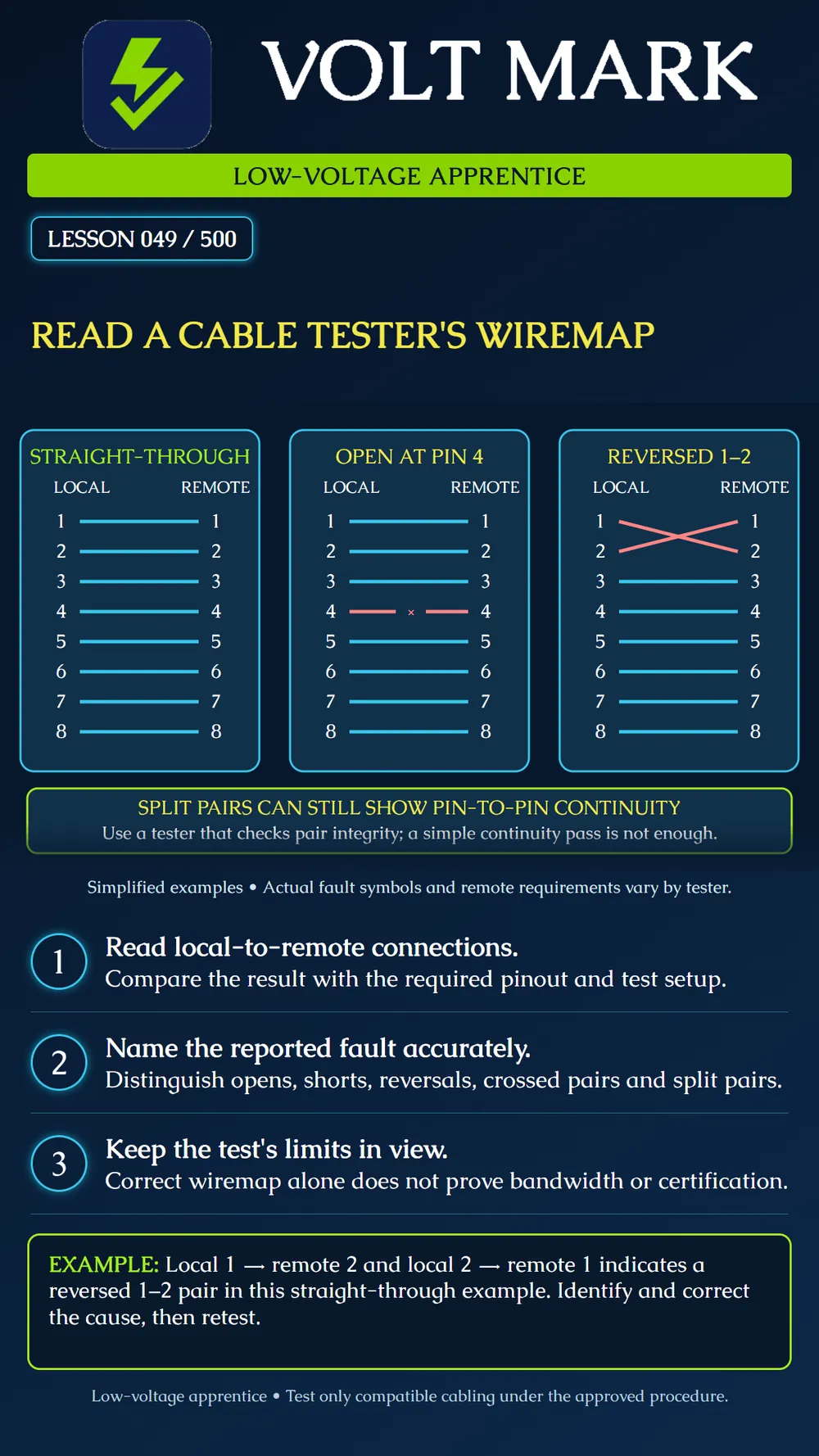
In the poster's straight-through eight-pin example, local pin 1 reaches remote pin 1, local 2 reaches remote 2, and so on through pin 8. Compare the actual map with the specified connection scheme. Straight-through is the expected arrangement for this example, not a universal rule for every specialty cable.
An open means the intended path lacks continuity. The illustrated open is at pin 4, but the diagram does not identify its physical distance or prove which end caused it. A short is an unintended connection between conductors. A reversed pair swaps the two conductors of a pair. A crossed pair maps an entire pair to another pair's position. Distinguish these names rather than calling every abnormal result a short.
A split pair uses conductors from different physical twisted pairs where the application expects the two conductors of one pair. End-to-end pin continuity can still look straight-through when the same incorrect pairing is repeated at both ends. Pair integrity matters electrically, not just the sequence of pin numbers.
A simple continuity-only tester may miss this condition. Use a tool that detects split pairs or the performance test required by the job. In the usual four-pair Ethernet assignment, the pair positions are 1–2, 3–6, 4–5, and 7–8; they are not simply every two adjacent pin numbers. Follow the specified termination scheme.
A fault indication is evidence to investigate. Confirm the test arrangement before changing a termination. The map alone may not distinguish a damaged connector from a conductor problem elsewhere. Use any distance-to-fault feature only within that instrument's limitations and the job procedure.
A passing wiremap does not prove that the cable meets its category performance requirements, supports every application, or has passed the project's certification test. Wiremap is one part of a larger acceptance process.
The result shows 1→2, 2→1, and all remaining pins mapped straight through. For the stated straight-through cable, this is a reversal of pair 1–2. Record that specific observation and the cable identifier. Inspect the relevant terminations under the approved procedure, correct the identified cause, and repeat the test. Do not merely change the record to say PASS.
A second result shows all eight pin numbers straight through but reports a split pair. These statements are compatible: electrical continuity can exist while the physical pair assignments are wrong. Check pair integrity instead of dismissing the tester because the pin numbers match.
Use instructor-prepared disconnected samples. Before testing, write the expected pinout and remote requirement. Record each displayed map and fault name. Explain one additional check needed before treating the cable as accepted. Keep the original result and the retest result linked to the same cable identifier.
Fluke Networks, Wire Map Testing: It's Not All About Color: https://www.flukenetworks.com/blog/cabling-chronicles/wire-map-testing-it-s-not-all-about-color Fluke Networks, Twisted Pair Test Results - MicroScanner2: https://www.flukenetworks.com/knowledge-base/microscanner2/twisted-pair-test-results-microscanner2 FOA, Testing UTP Premises Cabling - Wiremap: https://thefoa.org/tech/ref/premises/wiremap.html Sources reviewed September 30, 2026. Follow the actual tester and project requirements.
Free study material for low-voltage apprentices. This is a national foundation course: requirements differ by state and by local jurisdiction, and a practice that is common in one place is not a rule everywhere. Nothing here is a licence, a certification, or authority to work unsupervised, and completing it does not count as apprenticeship hours or continuing-education credit. Check the codes adopted where you are working, the licensing authority for that work, and your employer's safety programme. VoltMark is not affiliated with, endorsed by, or sponsored by NFPA, OSHA, NICET, BICSI, FOA, or any state or local licensing authority.

Electrician licensing exam prep: practice questions, timed exam simulations, and step-by-step help finding every answer in the NEC.