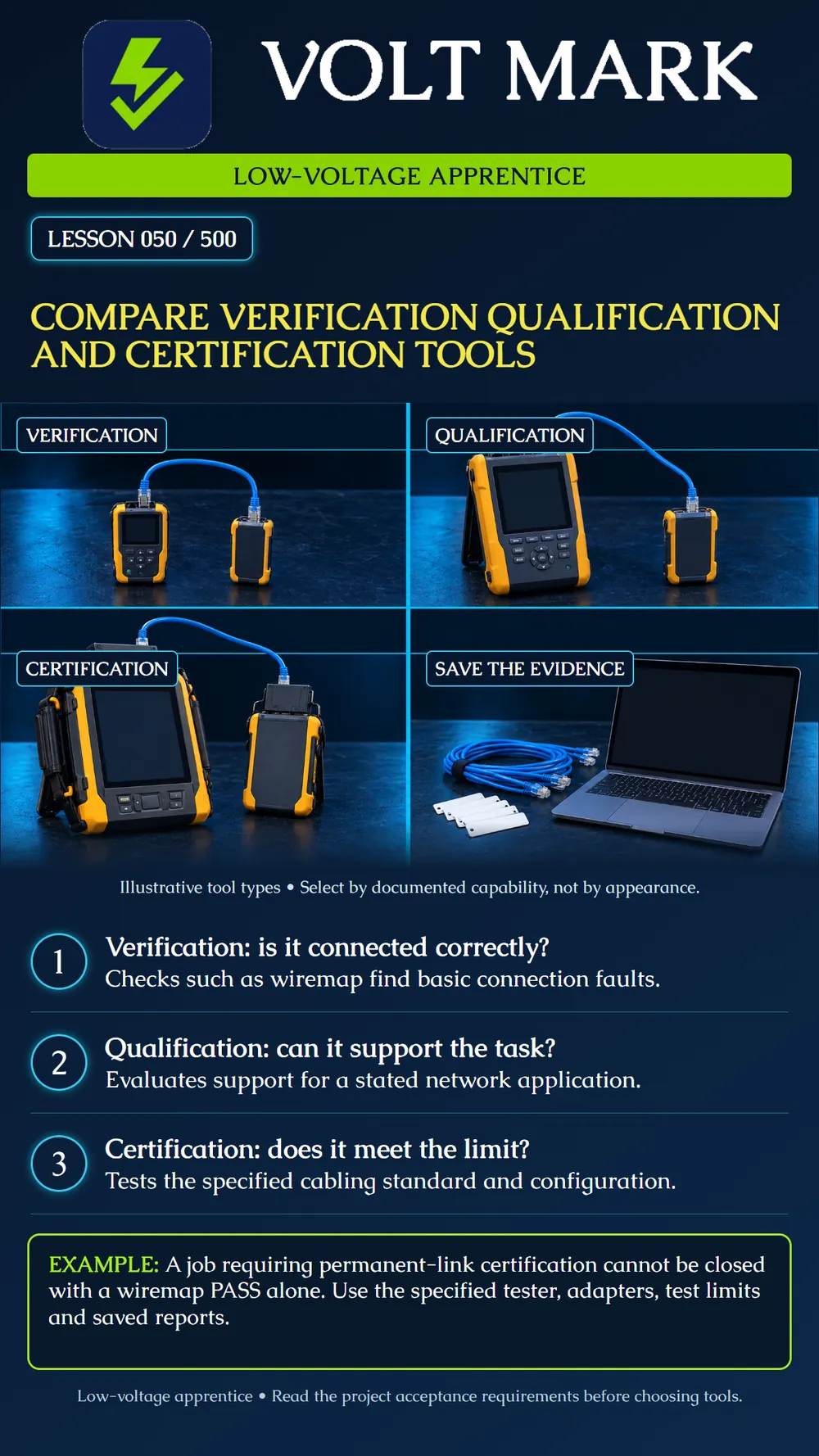
Match a cable-testing requirement to verification, qualification, or certification and explain what evidence is needed to close the work.
Read the scope, cable type, link configuration, application, test limit, and required records before choosing a tester. Similar-looking instruments can have different capabilities. Tool size, price, a colored screen, or a PASS message is not enough to identify the test performed.
Verification addresses basic connection questions, such as whether conductors reach the intended pins. Depending on the tool, it can identify opens, shorts, miswires, split pairs, length information, or other basic conditions. Check the exact capability list. A continuity-only device does not automatically perform every wiremap diagnostic.
Qualification addresses whether cabling can support a specified application or performance level within the tool's method. It can be useful when evaluating existing cabling for a particular network need. Its result must be read with the named application and instrument limits. Qualification is not the same as completing all tests required for cabling certification.
Certification evaluates cabling against a specified standards-based test limit using a suitable instrument, adapters, configuration, and procedure. A permanent-link test and a channel test describe different test boundaries. Select the configuration required by the project. Save the required detailed results with correct cable identifiers rather than keeping only a photograph of a PASS screen.
A certification instrument may also provide wiremap or troubleshooting functions. That does not mean that using one basic function completes a certification test. Describe the actual test run, settings, and result. Conversely, do not reject a tool merely because its exterior resembles a simpler tester; inspect its documented capability and the required configuration.
Job A: An instructor asks whether a disconnected training cable's eight conductors reach the expected pins. A suitable verifier can answer that question. The report should not claim category certification.
Job B: An owner asks whether existing copper cabling can support a named network application under an agreed evaluation method. A suitable qualification tool may address that requirement. Confirm the exact application, test method, and deliverable before starting.
Job C: A new installation contract requires permanent-link certification to its specified category limit and delivery of electronic reports. The crew must use a compatible certification instrument and the required permanent-link adapters and settings. A successful link light, a speed test, or a basic wiremap cannot replace the contracted evidence.
These are learning scenarios, not universal statements about every customer's warranty or contract. Read the actual requirements.
For each cable, record a unique identifier and the tested endpoints. Include the instrument and adapter identification required by the procedure, the selected test configuration and limit, the date, and the saved result. Apply required calibration or verification checks. Keep failed and retested results distinguishable, and document the correction rather than silently renaming a failed file.
The poster illustrates copper testing. Fiber acceptance uses appropriate optical methods, references, instruments, and limits. A copper wiremap tester does not test optical loss, and an OTDR trace does not automatically replace every required optical loss measurement. The later fiber sequence develops those distinctions in detail; start with the project's actual optical deliverables.
For three work orders, write the question being asked, the necessary tool capability, the required adapters, the test boundary, and the record to deliver. Explain one conclusion that the chosen test cannot support. Have the instructor check the selection before any field testing.
Fluke Networks, Verification, Qualification and Certification: https://www.flukenetworks.com/blog/cabling-chronicles/verification-qualification-certification-which-do-i-need Fluke Networks, Certification vs. Qualification: A Closer Look: https://www.flukenetworks.com/blog/cabling-chronicles/certification-vs-qualification-closer-look Source review: September 30, 2026. Apply actual project, tester, and cabling-system requirements.
Free study material for low-voltage apprentices. This is a national foundation course: requirements differ by state and by local jurisdiction, and a practice that is common in one place is not a rule everywhere. Nothing here is a licence, a certification, or authority to work unsupervised, and completing it does not count as apprenticeship hours or continuing-education credit. Check the codes adopted where you are working, the licensing authority for that work, and your employer's safety programme. VoltMark is not affiliated with, endorsed by, or sponsored by NFPA, OSHA, NICET, BICSI, FOA, or any state or local licensing authority.

Electrician licensing exam prep: practice questions, timed exam simulations, and step-by-step help finding every answer in the NEC.