Confirm that the manufacturer's instructions apply to the device in hand, compare essential markings with the documentation, and identify when a mismatch must be resolved before use.
Read the product label without opening or disturbing equipment beyond your authorized scope. Record the manufacturer, full model, suffix, and any relevant hardware revision or variant. Distinguish a serial number identifying an individual unit from a model identifying a product type. Packaging and purchase records can help, but do not assume a box always contains the intended variant.
If the label is missing or unreadable, do not reconstruct a rating from appearance. Ask the supervisor or manufacturer for a documented identification process. Preserve the available identification evidence.
Use the manufacturer's official documentation for the exact product. A manual can cover several models, so read the applicability statements and model-specific tables. The newest document found online is useful only if it applies to the installed hardware and configuration. Check relevant revision notes and official supplements.
A quick-start sheet may direct you to a fuller installation manual. Follow those references. A distributor listing or a photograph of a similar product does not replace applicable manufacturer instructions.
Check the power input type, specified voltage or range, polarity where relevant, and permitted powering methods. AC and DC are different input requirements. Also check environmental restrictions, accessory requirements, and relevant installation conditions.
Read what each number describes. A device input rating, an output limit, a relay contact rating, and a supply capacity are different quantities. Do not treat all values printed on one product as interchangeable. A connector that physically fits is not proof that its voltage, polarity, signaling, or purpose matches.
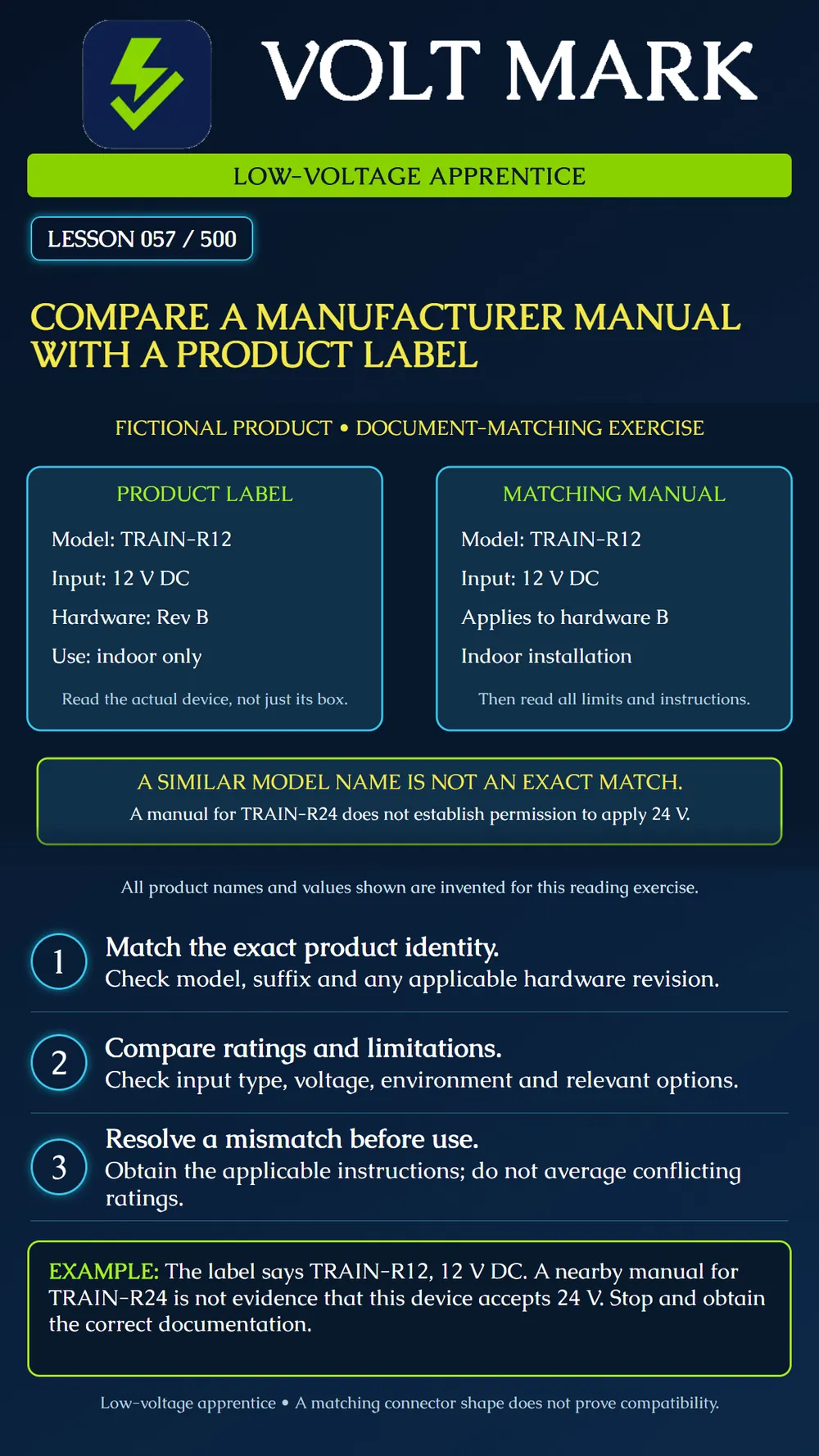
The fictional device label reads TRAIN-R12, input 12 V DC, hardware revision B, indoor only. The matching fictional manual identifies TRAIN-R12 and applicability to hardware B, and agrees with the input and indoor-use information.
That comparison is only the start of reading the instructions. It does not establish unspecified cable lengths, fuse sizes, terminal assignments, or installation methods. Those need the full applicable documentation.
A manual for TRAIN-R24 is nearby. Its different model name means that it does not establish the R12 device's permitted input. Do not apply 24 V based on that other manual, and do not average two voltage numbers into a guessed operating value.
Stop the affected connection or installation and record the discrepancy. Capture the exact label text and manual title, revision, and relevant page. Route the question through the supervisor and appropriate manufacturer support process. Do not energize the device to find out which interpretation works.
A label may abbreviate information that the matching manual expands. An apparent difference therefore needs careful reading, not an automatic declaration that either source is wrong. Conversely, do not dismiss a real mismatch simply because the product looks familiar.
An instructor provides three fictional labels and two manual excerpts. Match by full model and applicability before comparing ratings. Mark each comparison as matched, mismatched, or unresolved, and explain the evidence. Identify one detail that still requires the full instructions.
For a second paper exercise, the correct model manual has separate indoor and outdoor variants. The device suffix matches the indoor variant. Explain why another variant's environmental rating cannot be borrowed for this unit.
Axis Technical Documentation, official model-specific manual directory: https://help.axis.com/en-us Axis P3235-LVE manual, multi-product applicability and device identification: https://help.axis.com/en-us/axis-p3235-lve Sources reviewed September 30, 2026. The fictional example is not an Axis product or a usable product rating.
Free study material for low-voltage apprentices. This is a national foundation course: requirements differ by state and by local jurisdiction, and a practice that is common in one place is not a rule everywhere. Nothing here is a licence, a certification, or authority to work unsupervised, and completing it does not count as apprenticeship hours or continuing-education credit. Check the codes adopted where you are working, the licensing authority for that work, and your employer's safety programme. VoltMark is not affiliated with, endorsed by, or sponsored by NFPA, OSHA, NICET, BICSI, FOA, or any state or local licensing authority.

Electrician licensing exam prep: practice questions, timed exam simulations, and step-by-step help finding every answer in the NEC.