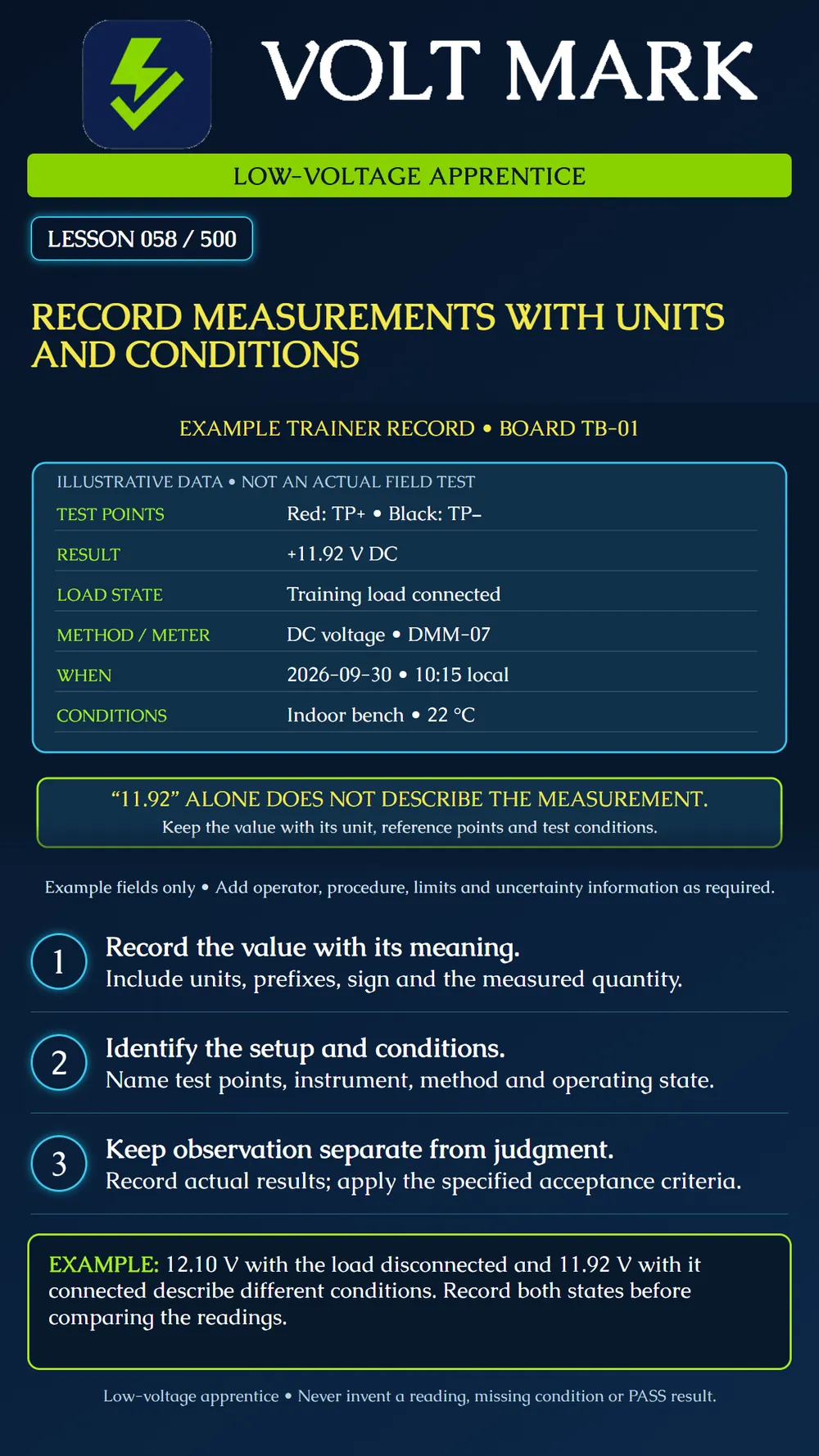
Make a measurement record that another technician can interpret, compare, and trace to the test setup without guessing what the number means.
Writing “11.92” does not identify voltage, current, resistance, optical power, or another quantity. Record the value with the correct unit and prefix. Include DC or AC where relevant and preserve the sign when it conveys the reference polarity. Do not replace an observed value with the nominal value printed on the equipment.
Units and prefixes change meaning. For example, 0.250 A equals 250 mA, while 0.250 mA equals 0.000250 A. If converting for a report, retain the original observation and make the conversion clear. Do not silently change the unit without changing the numerical value.
Record the device, cable, circuit, or training-board identifier and the relevant test points. For a voltage measurement, name both points and the probe reference. A statement such as “panel voltage” may be ambiguous when several terminals and supplies exist.
Record the method and instrument identity required by the procedure. Include mode, range, adapter, or other setup information when it affects interpretation. Retain required calibration or verification information without claiming that a sticker alone proves every measurement is suitable.
Include operating state, connected load, power source, test direction, or other task-specific conditions. Record environmental information where the method or acceptance process requires it. Date, time, operator, and procedure reference help distinguish separate tests and follow-up work.
Do not guess a missing temperature, load state, or instrument setting after the fact. Mark it as unknown and decide through the supervisor whether the measurement must be repeated. “Not recorded” is more honest than invented precision.
Keep the measured result distinct from a pass/fail decision. A positive voltage reading does not prove that a device meets all requirements. A limit comparison needs the correct operating condition, approved criterion, and decision method.
Instrument resolution is not the same as measurement accuracy. A display with many digits does not justify an unsupported claim of precision. Follow the reporting and uncertainty rules required by the procedure; do not attach a guessed uncertainty value or round a failure into an apparent pass.
A trainer reads 12.10 V with its load disconnected and 11.92 V with the specified load connected. The difference is 0.18 V. Record both readings with their load states. Those observations alone do not identify which component caused the change or establish whether it is acceptable.
A second learner writes “250” for a current measurement. Without the unit, it is unclear whether the observation was 250 mA, 250 microamperes, or something else. The correct action is to recover the documented observation or repeat the authorized test, not guess the most plausible unit.
Keep original results and corrected entries distinguishable under the employer's procedure. Link a retest to the same device identifier and explain the intervening change. A photo of a display may support the record but often omits the test points, mode, load state, or acceptance rule.
On an approved training board, use the instructor's method to complete a measurement record. Exchange records with another learner. Ask whether the other person can identify the quantity, setup, conditions, and unresolved information without additional explanation.
NIST Technical Note 1297, 1994 edition: https://www.nist.gov/pml/nist-technical-note-1297 NIST, Calibration Policies, reports and uncertainty: https://www.nist.gov/calibrations/policies Sources reviewed September 30, 2026. NIST reporting policies are not imposed here as universal field paperwork requirements; use the applicable project procedure.
Free study material for low-voltage apprentices. This is a national foundation course: requirements differ by state and by local jurisdiction, and a practice that is common in one place is not a rule everywhere. Nothing here is a licence, a certification, or authority to work unsupervised, and completing it does not count as apprenticeship hours or continuing-education credit. Check the codes adopted where you are working, the licensing authority for that work, and your employer's safety programme. VoltMark is not affiliated with, endorsed by, or sponsored by NFPA, OSHA, NICET, BICSI, FOA, or any state or local licensing authority.

Electrician licensing exam prep: practice questions, timed exam simulations, and step-by-step help finding every answer in the NEC.