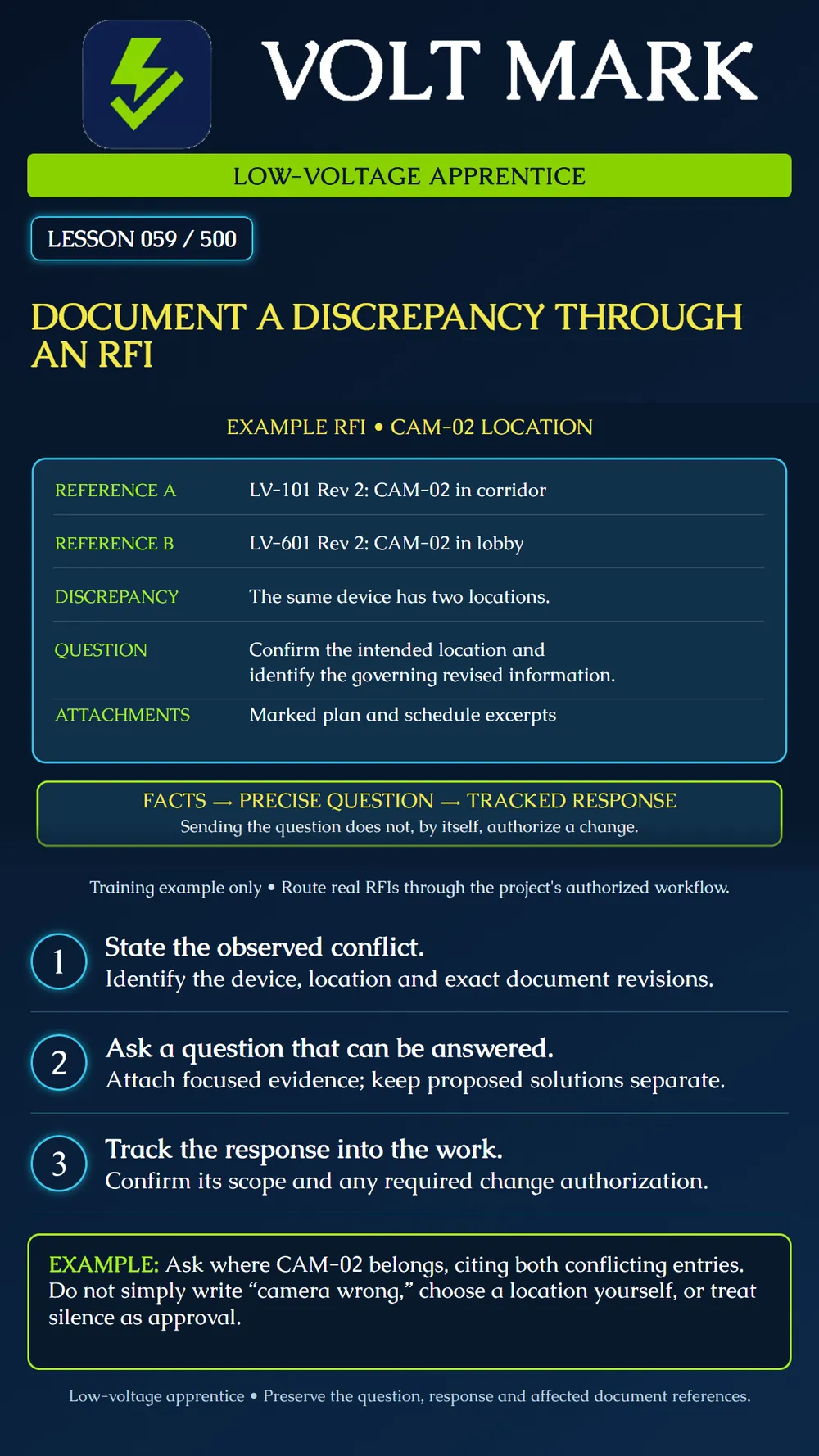
Prepare a clear request for information about a low-voltage drawing discrepancy and understand how its response connects to the authorized work record.
A construction request for information seeks clarification or missing information. It gives the responsible project participants enough context to answer a defined question. The apprentice's role is to identify and document the issue and route it through the employer's authorized process, not to assume design or change authority.
Read the current documents and check existing clarifications before preparing a new request. A question already answered elsewhere should be linked to that answer rather than creating avoidable duplicate records.
Identify the device or affected work, location, sheet or specification references, and revisions. Describe what each source actually says. Keep the description neutral. “The plan shows corridor and the schedule lists lobby” reports evidence; “the designer put the camera in the wrong place” assigns blame and assumes the solution.
For field conditions, identify the observed location and the evidence available. Use authorized photographs or marked excerpts where appropriate. Do not claim that an inaccessible condition was verified when it was not.
Ask for the decision needed to proceed with the affected work. If several unrelated issues exist, follow the project's rules for separating them. Avoid vague requests such as “please advise” without stating what needs clarification.
If a proposed solution is included, label it as a proposal and state its assumptions. A proposed route, mounting method, or equipment substitution does not become approved merely because it appears in the question.
Plan LV-101 Rev 2 locates CAM-02 in the corridor. Device schedule LV-601 Rev 2 lists CAM-02 in the lobby. The request identifies both entries and attaches focused marked excerpts.
The question is: “Confirm the intended location of CAM-02 and identify the governing revised information.” This is specific enough to answer without assuming either entry is correct. The example builds directly on the comparison exercise in Lesson 055.
The RFI is a training artifact only. No actual request is being sent to a designer, customer, or other party by this lesson.
Identify which activity depends on the answer, such as camera mounting layout or cable routing. Include a needed-by date or potential impact if the project procedure calls for it and the information is supported. Do not invent cost or schedule effects to make the question appear urgent.
Coordinate the status of affected work with the supervisor. Keep unrelated authorized work moving where appropriate. An RFI is not a substitute for an immediate safety report or emergency action.
Track the request identifier, status, response, attachments, and related revisions. Check whether the answer actually resolves the stated issue and whether it applies to the intended device and location. If an answer is incomplete or inconsistent, route the remaining question through the project process.
The act of sending an RFI does not by itself authorize a change, and lack of response is not approval. Any required design revision, substitution, cost approval, or work release follows the project's separate controls. Do not assume a universal legal effect for an RFI response.
Update working records only through the permitted process, and keep the answer linked to the original question. Ensure the crew uses the resolved location or detail rather than an old unmarked print.
Using an instructor-provided mismatch, write a short title, two source references, a factual description, one precise question, and an attachment list. Have another learner identify the required decision using only your draft. Revise ambiguous wording before the instructor reviews it.
Autodesk, RFI templates for construction: https://construction.autodesk.com/resources/checklists/rfi-template/ Autodesk, Process RFI: https://help.autodesk.com/cloudhelp/ENU/Build-Rfis/files/work-rfis/Process_RFI.html Sources reviewed September 30, 2026. Follow the actual project's roles and procedures; the example is original teaching material.
Free study material for low-voltage apprentices. This is a national foundation course: requirements differ by state and by local jurisdiction, and a practice that is common in one place is not a rule everywhere. Nothing here is a licence, a certification, or authority to work unsupervised, and completing it does not count as apprenticeship hours or continuing-education credit. Check the codes adopted where you are working, the licensing authority for that work, and your employer's safety programme. VoltMark is not affiliated with, endorsed by, or sponsored by NFPA, OSHA, NICET, BICSI, FOA, or any state or local licensing authority.
Electrician licensing exam prep: practice questions, timed exam simulations, and step-by-step help finding every answer in the NEC.