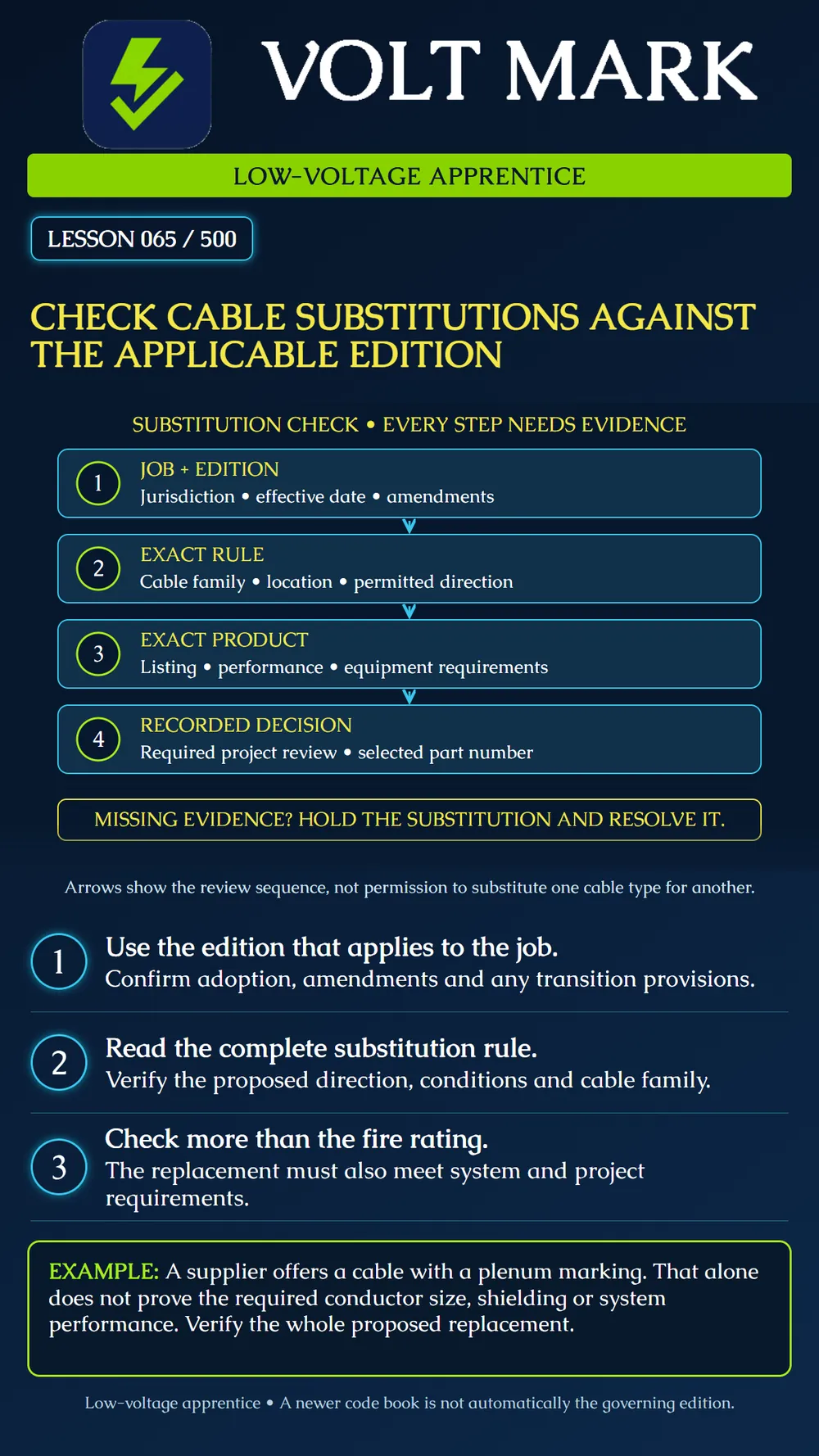
Build an evidence-based cable substitution check using the requirements that apply to the actual job.
A substitution is a proposal to use something different from what was specified or selected. A familiar cable marking is useful evidence, but it does not finish the evaluation. Record the original requirement and the proposed replacement as separate entries, including manufacturer and complete part number.
Confirm the jurisdiction, adopted electrical code edition, amendments and effective dates. Determine whether permit or transition provisions affect the specific project. A published new edition and its adoption are different events. A general national map or a supplier's chart is a starting point, not a substitute for the governing documents.
For a concrete illustration of why dates matter, Washington's published electrical rules identify a transition to the 2026 NEC effective December 31, 2026. This is a dated example checked September 30, 2026, not a rule for another state or a determination for a particular permit. Check the relevant authority's current records for each actual project.
Use the applicable edition to identify the circuit, cable family, installation location and permitted wiring methods. Find the relevant substitution provision, table or figure, if one applies. Read its scope, notes, direction and conditions together. Record the reference rather than relying on a remembered arrow.
Do not assume a permitted substitution is reversible. Do not combine fragments of different editions. NFPA describes ongoing NEC restructuring, including relocation of limited-energy material; a section number from an older training chart may not locate the controlling text in another edition. A proposal or committee report is not automatically the final adopted requirement.
Confirm the actual product's certification and markings using its label and supporting documentation. Separately compare conductor material and size, pair count, shielding, electrical characteristics, temperature limits, termination compatibility and environmental suitability as relevant to the system. A fire-performance designation does not answer all of those questions.
UL provides certification and application resources to help interpret product markings. A generic description from a supplier does not establish that the reel delivered to the site matches the evaluated product. Resolve conflicting or incomplete identification before installation.
Follow the required project review process for substitutions. Include the original requirement, proposed part, applicable rule reference, comparison of critical properties, reviewer disposition and resulting drawing or schedule changes. A code-permitted cable type is not, by itself, acceptance of a contract substitution. Conversely, a project approval cannot waive applicable installation requirements.
A design calls for a particular shielded two-pair cable. The supplier offers an unshielded cable carrying a plenum designation and says it is "better." The proposal has not established equivalent system suitability. A location rating does not replace the missing shield requirement. Hold the proposed change and obtain a documented technical resolution.
Job and circuit: Jurisdiction and governing edition: Amendments and applicable date: Original product and required properties: Proposed manufacturer and full part number: Controlling substitution reference and conditions: Product evidence and unresolved differences: Required reviewer disposition: Final selected product and record revision:
No to all four. Establish the governing requirements, read the actual permitted substitution, verify the product and complete the required project process.
Washington Administrative Code, Chapter 296-46B, including adoption provisions: date-specific example only. https://apps.leg.wa.gov/wac/default.aspx?cite=296-46B&full=true Washington L&I — Electrical Laws, Rules & Policies: official adoption and amendment resources. https://www.lni.wa.gov/licensing-permits/electrical/laws-rules-policies
https://www.nfpa.org/codes-and-standards/nfpa-70-standard-development/70 UL Solutions — Wire and Cable: certification and performance verification resources. https://www.ul.com/industries/wire-and-cable UL Solutions — Wire and Cable Application Guide: interpreting suitability and markings. https://www.ul.com/thecodeauthority/knowledge/wire-cable-guide
This is a verification workflow, not a cable substitution table. No particular cross-family substitution is approved by this lesson.
Free study material for low-voltage apprentices. This is a national foundation course: requirements differ by state and by local jurisdiction, and a practice that is common in one place is not a rule everywhere. Nothing here is a licence, a certification, or authority to work unsupervised, and completing it does not count as apprenticeship hours or continuing-education credit. Check the codes adopted where you are working, the licensing authority for that work, and your employer's safety programme. VoltMark is not affiliated with, endorsed by, or sponsored by NFPA, OSHA, NICET, BICSI, FOA, or any state or local licensing authority.
Electrician licensing exam prep: practice questions, timed exam simulations, and step-by-step help finding every answer in the NEC.