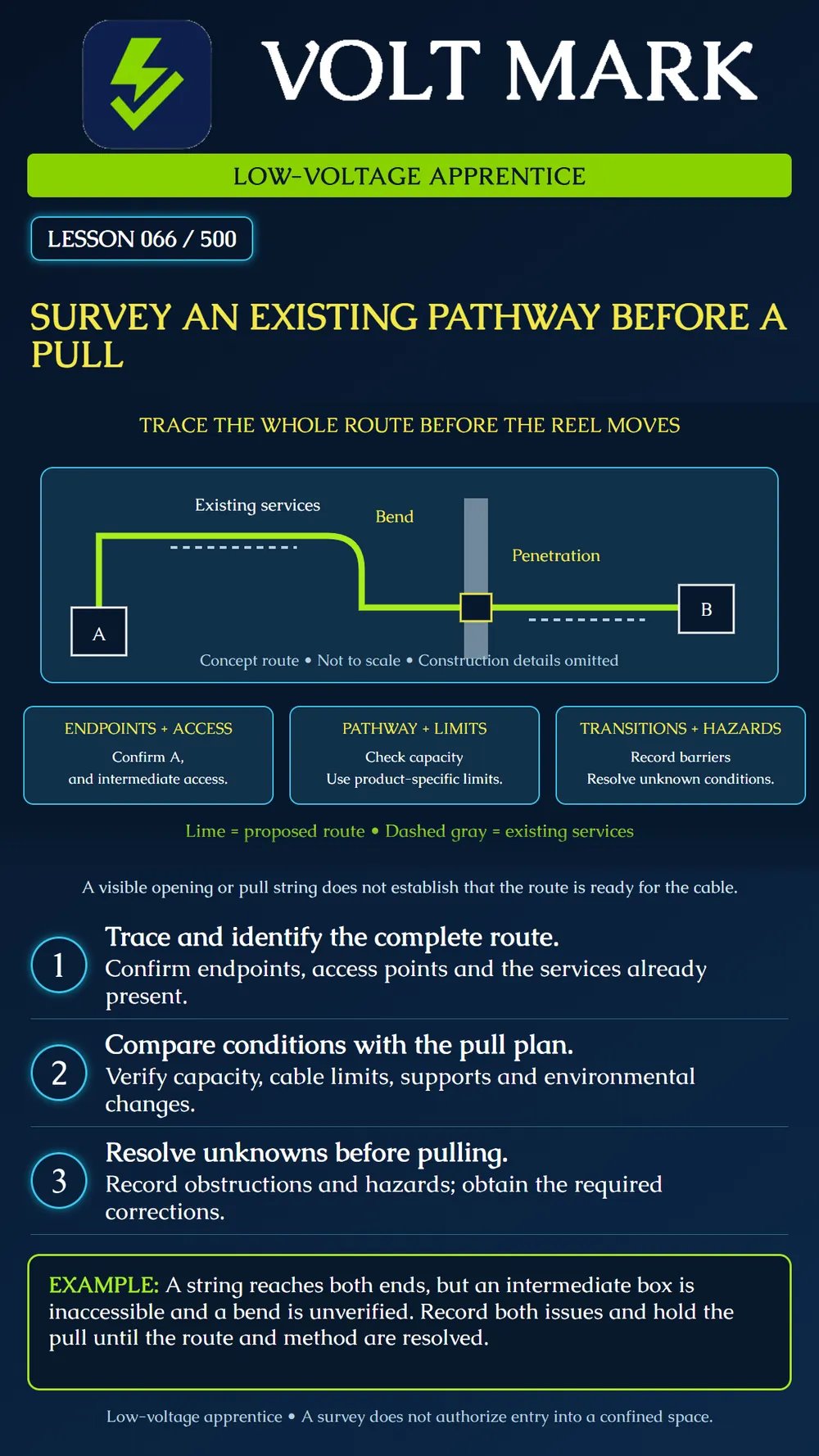
Produce a useful route survey that identifies whether a proposed cable pull can proceed under the approved plan.
Find and identify both ends of the intended route. Compare room names, pathway identifiers and device locations with current drawings. Trace intermediate boxes, changes of direction and transitions between spaces. Mark portions that cannot yet be verified as unknown. Do not turn an assumption into a measured fact on the survey record.
Check its condition, usable dimensions, occupied space and access. Identify existing services before disturbing anything. A cable that looks unused may still serve an active system; appearance is not authorization to disconnect or remove it. Plan protection of existing cables during the new work.
FOA's premises preparation guidance addresses pathway sizing, bends, support and the care needed around existing installations. Apply those concepts to the actual approved pathway design. Do not assume an old installation establishes compliance or available capacity for a new cable.
Obtain the exact cable's installation limits. Pulling tension and minimum bend radius may differ among products and between installation and final service conditions. Consider corners, access-box geometry and pulling equipment as part of the route. A clear opening is not proof that a cable can pass without exceeding its limits.
Do not copy one generic bend multiplier into every survey. FOA explicitly notes variation in cable specifications and the difference between radius and diameter. Record the manufacturer's value, its unit and whether it applies while pulling or after installation. Arrange the detailed pull plan with the responsible installer.
Identify where the route crosses floors or walls, enters environmental-air spaces, goes outside or encounters moisture. Confirm the applicable cable and wiring-method requirements for each portion. Document the need to maintain or restore required penetration protection. Do not remove firestop material or alter an opening merely to see whether a cable fits.
Confirm that workers and equipment can reach the planned work locations safely. Restricted rooms, occupied areas and intermediate access points can affect scheduling and the pull method. Report damaged pathway edges, water, unidentified services and inaccessible sections before the crew starts.
A route survey is not a confined-space entry procedure. For construction work covered by OSHA's confined-space rule, the employer must ensure that a competent person identifies applicable confined and permit spaces before work. Follow the employer's required evaluation and entry controls. Do not enter a vault or other suspected space just to complete the sketch.
Route R-06 runs from telecommunications room A to room B. A pull string is visible at both ends. Box BX-2 is above equipment that blocks access. The cable route then turns at a bend whose dimensions have not been checked.
Write: "Endpoints identified; intermediate access and bend suitability unresolved." Attach the marked route and identify who must resolve each issue. Do not write "pathway clear" or "ready to pull." A string can indicate continuity without establishing access, capacity, condition or compliance with the cable's limits.
FOA — Premises Site Preparation for Fiber Optics. https://thefoa.org/tech/ref/install/premsite.html FOA — Installing Fiber Optic Cable: Bend Radius. https://www.thefoa.org/tech/ref/install/bend_radius.html FOA — Designing Premises Cabling Systems. https://www.thefoa.org/tech/ref/premises/PremInstall.html
https://www.osha.gov/laws-regs/regulations/standardnumber/1926/1926.1203
Diagram is an illustrative survey map, not an installation drawing.
Free study material for low-voltage apprentices. This is a national foundation course: requirements differ by state and by local jurisdiction, and a practice that is common in one place is not a rule everywhere. Nothing here is a licence, a certification, or authority to work unsupervised, and completing it does not count as apprenticeship hours or continuing-education credit. Check the codes adopted where you are working, the licensing authority for that work, and your employer's safety programme. VoltMark is not affiliated with, endorsed by, or sponsored by NFPA, OSHA, NICET, BICSI, FOA, or any state or local licensing authority.
Electrician licensing exam prep: practice questions, timed exam simulations, and step-by-step help finding every answer in the NEC.