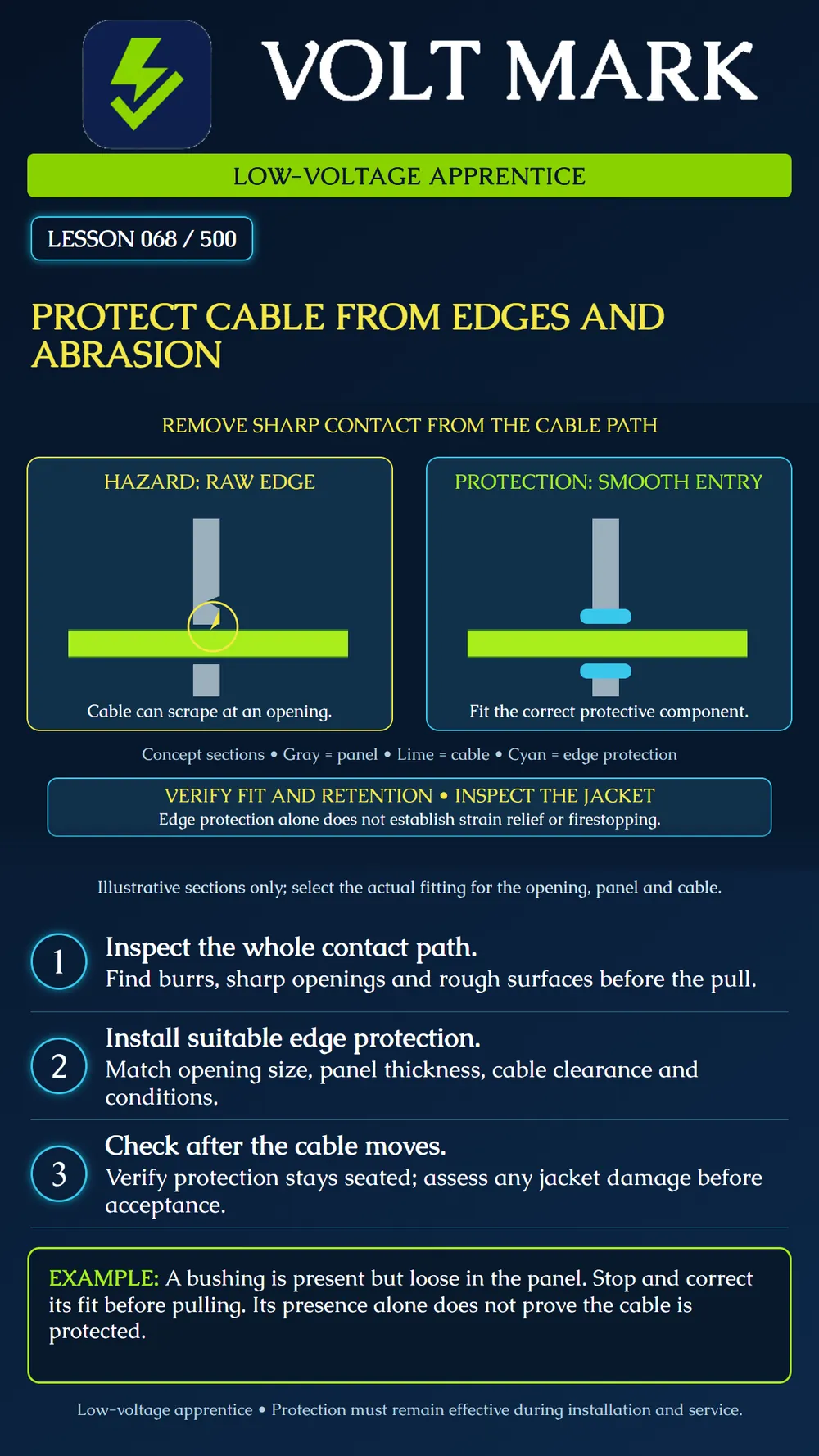
Identify cable abrasion hazards and verify that protective components fit and remain effective.
Survey the actual cable path before installation. Check panel openings, raceway ends, support surfaces and changes in direction for rough or sharp contact. A cable can be damaged as it slides during a pull or later when it moves against an edge. Do not assume an opening is safe because another cable already passes through it.
FOA's UTP installation guidance calls for inspection of surfaces that may abrade cable and supports that do not distort it. Apply this to the route rather than looking only at the final termination. Correct identified hazards through the approved work method before proceeding.
A suitable bushing or grommet can convert an exposed edge into a smoother cable entry. Manufacturer selection data can include mounting-hole size, panel thickness, inside opening and environmental limits. Verify those properties for the exact part. A component that falls out, rocks loose or pinches the cable does not provide the intended protection.
Heyco's snap-bushing information illustrates that products are selected against dimensional and material properties. Its product-specific push-back figures or temperature limits must not be applied to unrelated fittings. No universal dimensions or force values are supplied in this lesson.
Follow the component and enclosure instructions. Where edge preparation is required, use the authorized method and protect nearby equipment and cables from debris or accidental contact. Do not modify listed equipment or remove required protective parts without the appropriate direction.
Check the protective component before the pull, after cable movement and during final inspection. Confirm that it remains seated and covers the relevant contact surface. If the route bends immediately after the entry, verify that cable movement does not pull the cable back onto an unprotected edge.
Edge protection reduces harmful contact with the opening. Strain relief controls transmitted pulling or movement forces at an entry or termination. Firestopping addresses a penetration through a rated assembly using the appropriate system. A component may perform several functions only when its documented application establishes those functions. Do not assume an ordinary bushing is a cable clamp, water seal or firestop.
A trainee finds a loose bushing at a control-panel opening. The cable has a visible scrape where it meets the panel. Stop further movement and record the location and cable identity. Have the fitting corrected and the cable assessed under the manufacturer's requirements and the project's acceptance process. Do not declare the cable acceptable merely because a continuity check passes. Do not cover the scrape with tape and treat that as an automatically approved repair.
Cable and location: Hazard observed: Protective component and installation reference: Fit and clearance verification: Condition after the pull: Damage or unresolved issue: Required corrective action and final disposition:
FOA — Installing UTP Cabling: abrasive route surfaces and support contact. https://thefoa.org/tech/ref/premises/install.html Heyco — Snap Bushings, 3.000 to 6.000 inch diameter parts: smooth entries, dimensional selection and product limits. This is an illustrative product reference, not a required size. https://www.heyco.com/products/bushings-grommets-heycaps-plugs/tubing-caps-and-plugs/heyco-snap-bushings-3-000-762-mm-to-6-0-1524-mm-diameter-parts/ Heyco — Product categories distinguish bushings, strain-relief products and other cable accessories. https://heyco.com/products/ FOA — Fiber Optic Installation: workmanship inspection and review of test evidence. https://www.thefoa.org/tech/ref/basic/install.html
Diagram is not an approved firestop, enclosure modification or repair detail.
Free study material for low-voltage apprentices. This is a national foundation course: requirements differ by state and by local jurisdiction, and a practice that is common in one place is not a rule everywhere. Nothing here is a licence, a certification, or authority to work unsupervised, and completing it does not count as apprenticeship hours or continuing-education credit. Check the codes adopted where you are working, the licensing authority for that work, and your employer's safety programme. VoltMark is not affiliated with, endorsed by, or sponsored by NFPA, OSHA, NICET, BICSI, FOA, or any state or local licensing authority.
Electrician licensing exam prep: practice questions, timed exam simulations, and step-by-step help finding every answer in the NEC.