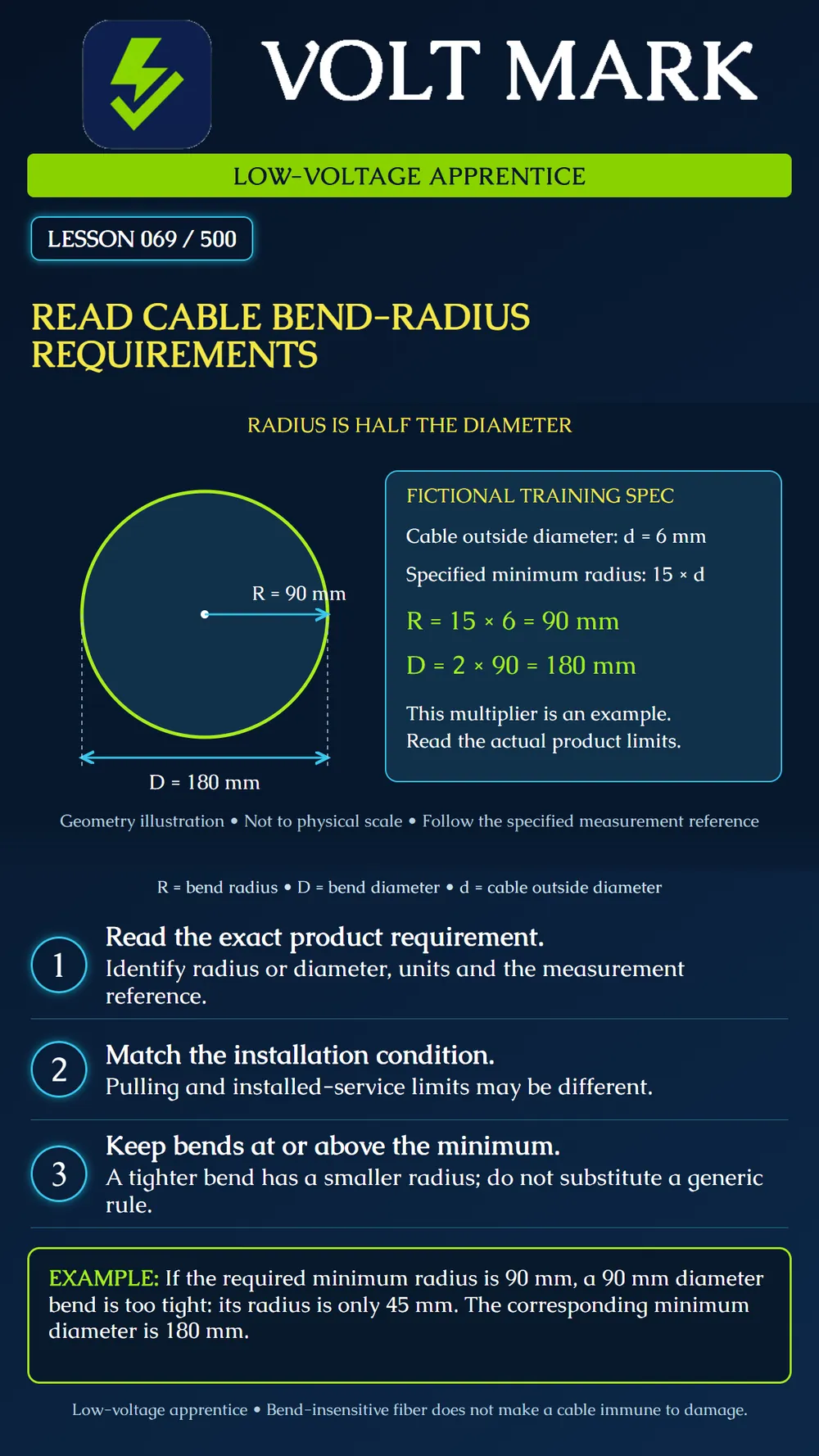
Read a bend requirement accurately, distinguish radius from diameter and apply the stated installation condition.
Find the exact cable part number and current installation documentation. Identify whether the limit is stated as a radius, a diameter or a multiple of the cable outside diameter. Record the units and the condition to which the value applies. Do not substitute the diameter of an individual conductor or glass fiber for the outside diameter of the cable assembly.
Check where the manufacturer measures the bend. A drawing may specify a measurement reference at an inner surface or another defined location. The poster illustrates circle geometry; it does not choose the reference for every cable or piece of pulling equipment. If the reference is unclear, resolve it before selecting hardware.
Radius is the distance from a circle's center to its circumference. Diameter crosses the whole circle through the center. Diameter equals twice the radius. A minimum radius is a lower limit: making the bend tighter reduces its radius.
In this lesson, R means bend radius, D means bend diameter and d means cable outside diameter. These labels are defined for our example. Other documents may use different symbols; always read their definitions.
Assume a training specification states a minimum bend radius of 15 times cable outside diameter for the condition being evaluated. Assume cable outside diameter is 6 mm. R minimum = 15 × 6 mm = 90 mm. D corresponding minimum = 2 × 90 mm = 180 mm.
The circle in the poster has a radius line half as long as its diameter line. Its dimensions are explanatory, not a full-size bend template. The 15 multiplier is a fictional exercise input, not a general rule for low-voltage cable.
A 90 mm diameter bend has only a 45 mm radius, so it does not meet the example's 90 mm minimum radius. Conversely, a 200 mm diameter circle has a 100 mm radius and exceeds the example minimum, provided the measurement reference and all other conditions match.
Manufacturers can specify different limits during installation and in final operation. For example, Corning's product page for 024TD9-T1390-M2 lists installation bend radius of 115.5 mm and operation bend radius of 77 mm. Those figures belong to that specific product. They are evidence that conditions matter, not values to copy onto another cable.
A final storage arrangement that meets an operation limit is not automatically suitable while the cable is being pulled under tension. Plan the route, guides, turns and storage separately as required by the actual instructions. Do not select a pulley solely by a familiar outside dimension; verify the relevant cable-path geometry.
FOA explicitly discusses variation among cable specifications and the risk of confusing radius and diameter. Bend limits can differ with construction. Apply the product documentation for copper, coaxial, fiber and other low-voltage cable rather than assigning the same multiplier to all of them. Bend-insensitive fiber still resides within a cable assembly with mechanical limits.
Product and document revision: Stated limit, units and symbols: Installation or operation condition: Measurement reference: Calculation if required: Planned route or hardware verification: Unresolved questions:
FOA — Installing Fiber Optic Cable: Bend Radius, including radius/diameter distinctions and product-specific variation. https://www.thefoa.org/tech/ref/install/bend_radius.html Corning — MIC 250 2.0 Indoor Cable, 024TD9-T1390-M2: product-specific installation and operation bend radii. https://ecatalog.corning.com/optical-communications/US/en/Fiber-Optic-Cables/Indoor/Indoor-Plenum-Cables/MIC%E2%84%A2-250-2-0-Indoor-Cable/p/024TD9-T1390-M2 FOA — Fiber Optic Cables: cable construction and bending limits. https://www.thefoa.org/tech/ref/basic/cable.html
No general bend multiplier, equipment size or installation approval is asserted.
Free study material for low-voltage apprentices. This is a national foundation course: requirements differ by state and by local jurisdiction, and a practice that is common in one place is not a rule everywhere. Nothing here is a licence, a certification, or authority to work unsupervised, and completing it does not count as apprenticeship hours or continuing-education credit. Check the codes adopted where you are working, the licensing authority for that work, and your employer's safety programme. VoltMark is not affiliated with, endorsed by, or sponsored by NFPA, OSHA, NICET, BICSI, FOA, or any state or local licensing authority.

Electrician licensing exam prep: practice questions, timed exam simulations, and step-by-step help finding every answer in the NEC.